
Author name: Ishika Amardeep Sinha

Uncategorized

How Businesses Can Prepare Their GST Records for Future Tax Assessments

GST Records for Tax Assessment It almost always turns up on a normal Tuesday, addressed to a financial year you haven’t thought about. The accountant who filed those returns left 18 months ago. The ERP was migrated. The supplier whose invoice you are querying has shut down. Somewhere in a shared drive, in a folder no one has looked at since the migration, is the one document that will end the matter in a paragraph. That lack – the time between what happened and the time you can still prove what happened – is the risk. It isn’t the tax. The tax is almost certainly justifiable. What your business loses in hearings is rarely the argument; it is the evidence. The timeline is longer than most expect, Books of account and related records, under section 36 of the CGST Act, 2017, must be retained for 72 months after the due date of the corresponding annual return – and longer if an appeal, review or investigation is still pending, at which point they must be kept for a year after completion. GST Records for Tax Assessment GST Records for Tax Assessment: Build files, not folders. Most businesses file documents by type: all invoices in one place, all bank statements in another, all e-way bills in yet another. That works well for filing, not well for defending. Departmental queries are almost never about a category. They are about a transaction. A notice seeking clarification under section 61 – issued in Form ASMT-10, with thirty days to respond in ASMT-11 – will specify the inaccuracies: input tax credits taken against a supplier who didn’t file GSTR-3B, values in GSTR-1 that don’t match e-invoices. These e-way bill movements are greater than the reported outward supply. That means bringing together, for just one invoice, a full trail: the purchase order or agreement, the tax invoice, evidence the supply happened (e-way bill, transporter documentation, gate or goods inward entry), proof of the payment by banking channels, and the credit’s path through GSTR-2B and your books. Add the 180-day payment time frame under the second proviso to section 16(2), and the section 16(4) deadline to take advantage of the credit, and a single line item may require six or seven files from four systems. Reconcile monthly – the system now does, The Invoice Management System has changed the shape of this work. Since a mandated part of the monthly process from April 2026, GSTR-2B isn’t a statement provided to you – it is a result of your decisions on the portal. Accepting, rejecting, or holding an invoice is a recorded act, and you can replay it later. That works both ways. Rejecting a bad invoice in IMS forces the supplier to put it right while the parties are still engaged, and the facts are fresh in everyone’s mind. So the monthly reconciliation – purchase register to IMS to GSTR-2B, outward supply to e-invoices to e-way bills, GSTR-1 to GSTR-3B – isn’t proper bookkeeping; it’s the lowest-cost version of the work you’ll otherwise end up doing under pressure and three years late from recall. GST Records for Tax Assessment Write down why, not just what, This is the part that almost no one does, and this is the part that matters most. Every business makes judgement calls: a classification decision, a related-party cost valuation method, a place-of-supply decision, an ITC apportionment under Rule 42/43, a decision that one cost qualifies as an expense. At the time, the assumption is clear. Four years later, it isn’t. A brief note to go with it – one page, dated, clearly spelling out the decision made, the facts relied upon, the cited rule or circular, and who approved it – is worth disproportionately more. It turns an apparently arbitrary error into a documented position taken in good faith. Since section 74A retains the fraud exception for penalty calculation even if it has been removed from notice periods, the distinction between one position and another oversight is worth a lot of money. Good documentation means less tax review risk – and no one can demonstrate it better than a file that explains itself. GST Records for Tax Assessment GST Records for Tax Assessment: Make the records searchable. Electronic records are allowable, subject to proper authentication, backups, and the ability to access file passwords on demand. But reality falls apart in three ways. Some data gets stuck in older systems after migration and becomes today-preserved, but practically unavailable. Approvals are locked away in people’s email inboxes, which are deleted when the person leaves. And the audit trail – who changed what and when – is disabled or replaced. GST Records for Tax Assessment A good test: pick a random invoice from two financial years ago and have someone else produce it in its entirety. Give them an hour. Anything they can’t produce is the business you won’t have when you need it. Rehearse it before anyone else needs to GST Records for Tax AssessmentDo an internal sampling audit each year, checking some transactions against the same comparison tools the portal uses. Think of it as real-time free intelligence rather than a private fault-finding mission. GST Records for Tax Assessment: The quiet advantage A form of tax compliance that is solely defensive is, frankly, exhausting. But businesses that keep their records this way tend to notice a different thing: they close their books faster; they identify supplier issues before they become unresolvable; and they can meet a banker or potential acquirer’s due diligence requirements without a panic. GST Records for Tax Assessment The file you prepare for a future GST audit is also the file that will tell you whether you are actually doing well. That makes an unglamorous habit something that pays back. GST Records for Tax Assessment References AI Detection Proof reading Plagiarized
Uncategorized

Why Accurate Invoicing Is One of the Most Important GST Compliance Practices

GST Invoicing Compliance Ask any accountant what keeps him awake at night while filing GST returns: chances are that he’ll point towards invoices and invoicing. It’s easy to dismiss the invoice as something simple, a document that captures what was sold to whom and at what price, but under India’s indirect tax regime it serves multiple downstream functions. Correct invoices form the basis for multiple GST compliances and processes, and errors at this junction tend to reverberate downstream, affecting everything from individual filings to a firm’s reputation with the tax department. GST Invoicing Compliance: The Invoice Is the Origin Point for Most Things GST Every GST return a business files, and every GST reconciliation it does, boils down to its invoices. Sales figures, tax liability, input tax credit: all come back to invoices. An incorrectly issued invoice will cause issues not just for the recipient, but also the issuer, as discrepancies propagate through the reconciliation process. GST Invoicing Compliance This is why GST invoices are much more than one of many aspects of a business’s broader accounts and compliance processes: they are the source code that much of the rest depends on. Get this right, and much of the rest tends to fall into place; get this wrong, and you’re left cleaning up the mess weeks or even months later.Input Tax Credit Doesn’t Always Go the Way of the Intention One of the most common lessons for any business operating under the GST regime centres on input tax credit. A firm may be fully justified in claiming a particular amount of ITC, but an error on the supplier’s invoice can cause the ITC application to be rejected or delayed, regardless of intention. It’s one of those perennial GST nightmares where a business’s own processes are correct, but a vendor’s invoicing errors hold things up. GST Invoicing Compliance: Small Errors Have Multiple Consequences Any business operating under the GST regime for a while will know that invoicing errors tend to have a range of downstream consequences. GST Invoicing ComplianceMismatched invoices: The most immediate consequence of incorrect invoicing is the impact on GSTR-1, GSTR-3B, and related reconciliations and audits. Holdups in ITC: As discussed in the previous point, incorrect or incomplete invoicing can trigger downstream delays and even rejections in ITC claims.Penalties and interest: At the extreme end, incorrect invoicing can lead to penalties and interest being levied by tax authorities.Audits: Invoicing errors are one of the surest ways to draw the attention of tax authorities, whether through audits or notices.None of these are things that any business would actively want for themselves, which is why the ability to get invoicing right consistently is a highly coveted goal.The Invoice Needs to Be Right to Save Time and Money Much of invoicing errors stem from businesses viewing this as an end in itself. In many ways, the invoice represents the closure of a sale, and many businesses only pay attention to it at that point. Under GST however, the invoice has to be treated as a critical part of the broader GST compliance process. Thinking about the invoice differently makes it possible to address invoicing errors much more effectively. The invoice needs to contain the correct GSTIN of the recipient, the correct tax rate and value, and should be issued on time. It’s not enough for these to be correct in theory; they must also be correctly captured on the invoice. It’s a delicate process that requires attention and in many ways is the most error-prone part of GST compliance for most businesses.Practical Examples of Addressing Invoice Errors Many businesses adopt some or all of the following practices to reduce invoicing errors in their GST Invoicing Compliance own operations as well as when dealing with vendors.Automated validation tools for fields such as GSTIN, tax rate, and others help to reduce errors at the point of raising the invoice. GST Invoicing Compliance Regular monthly or quarterly audits of sales and purchase registers against GST filings help to identify and address errors before they become bigger problems.Employees responsible for raising invoices are trained and kept up to date on compliance-centric aspects of invoicing. GST Invoicing ComplianceVendors with frequent invoicing errors are put on notice and sometimes penalised.Such steps are tedious and time-consuming in the short term, but are vital for reducing invoice-related errors in the long term. GST Invoicing ComplianceGST Invoicing Compliance: A Final Word on Invoice ErrorsCompliance under GST often makes people think about returns, filings, notices, and so on. Much of it comes back to correct invoicing for both businesses and their vendors. Correct invoicing is a major boon for cash flow, tax savings, and smoother audits. References AI detection Proofreading Plagiarized

Uncategorized

How Indian Exporters Can Better Understand GST Refunds on International Sales

Section 263 Tax Assessment Ask any exporter what their worst nightmare is, and somewhere down the line, they will mention the dreaded refund process, where all of their money gets hoarded by the tax department. The refund process is still one of the most painful processes, despite being a decade since GST rolled out – not because it is complicated but because it is different, and most small and medium-sized businesses have never dealt with anything like this before.We hope you find this article useful. Section 263 Tax Assessment: Exports Are “Zero-Rated”, Not “Exempt” The first thing any exporter should know is that exports are zero-rated, not exempt, as many believe. The difference is that for exempt supplies, the supplier is unable to claim a credit for the tax paid. In the case of zero-rated supplies, as an exporter, you are eligible to claim a refund of the tax paid.This is precisely the reason why a GST refund is available on exports and what zero-rating of the supply actually means. Section 263 Tax Assessment Section 263 Tax Assessment: Indian Exporters Have Two Ways To Claim Export Refunds As an exporter, you can opt for two ways to claim a refund on tax paid – either you pay the IGST on the invoice and claim a refund on it, or you pay nothing on the invoice but claim a refund of your accumulated credit. Each of these options has its own advantages and disadvantages and the choice between them depends on your cash-flow requirements for the year. Section 263 Tax Assessment Section 263 Tax Assessment: Option 1: Pay IGST and Claim it Back This will require you to pay IGST on the export invoice and claim a refund, which means you temporarily pay your money to the government until the refund is approved. The advantage of this route is that your shipping bill for the export becomes your application for a GST refund, and you don’t need any more documentation or forms as long as your shipping manifest is the same as the export returns you’ve submitted in GSTR-3B.The disadvantage with this option however, is that your cash-flow for the year is affected as you pay the IGST on the shipment value.Option 2: LUT and Claim your Input Tax Credit (ITC)This will require you to provide a Letter of Undertaking (LUT) to the tax department to let them know that you are exporting a specific consignment. In this route, you don’t pay the IGST, but you claim back a refund of your input tax credit on the purchase of goods and services you’ve used in making the export. The advantage of this route is that it does not tie up your cash to fund the government. The LUT must be submitted on the GST portal in Form GST RFD-11 and it will be valid for one financial year (1 year), so you’ll have to renew it before making your first export in the next financial year. If you don’t renew it, you’ll have to pay the IGST due on the consignment, and potentially interest as well. For one export, you can choose either of these options, but you can’t combine both. Section 263 Tax Assessment Section 263 Tax Assessment: Common Export Refund Headaches When you speak to exporters about refunds, you’ll find that the problems are usually not glaring issues, but something as simple as a typo in the shipping bill or an expired LUT. Some of the most common problems we see when claiming GST export refunds are: Mismatch of documents – shipping bill, invoice and GST returns – even if just one of the three has a different consignment value, it can delay the refund.Expired LUT – the LUT is only valid for 1 year and many exporters forget to renew it on time before a new financial year begins.Claimed ITC on blocked goods by mistake – certain goods like motor vehicles for personal use can’t claim ITC, regardless of the supply. Claiming ITC on such goods would result in a rejection of the refund.Incorrect wording on export invoices – Invoices for exports should have specific words in order for the supply to qualify as an export under this heading. Not having such words may result in rejection of your export refund.These are just some of the issues you could face as an exporter, but as you can see, any of them can cause serious delays. Section 263 Tax Assessment: Automation Is Working For You If You’re Compliant As mentioned above, the authorities are promoting increased automation in processing GST export refunds. So, as long as you’ve been keeping clean books all year, the process will be easier and quicker, as most of the data and forms will match automatically. But if you haven’t been keeping your books in order, you’ll have to spend time manually filling out the forms. Section 263 Tax Assessment Helpful Tips for Exporters Who Need Speedier Refunds Some helpful tips for exporters who need speedier refunds are: Reconcile your returns every month, rather than at the end of the year.Be aware when your LUT expires and renew it on time.Keep a list of all the necessary documents for a specific export, such as invoice, shipping bill, bank realisation certificate, and LUT reference, and ensure they’re all in order.Consult your GST consultant before you assume any new product or service you start supplying is an export. Section 263 Tax Assessment: The Final Words Indian exporters are competing in a brutal global market, and every rupee of working capital is critical. One of the best ways to keep your cash flow healthy is to understand the GST refund process and keep your records straight. The convoluted refund process might seem tough and complex, but it can be made easier by following a few tips. Section 263 Tax Assessment References AI detection Proofreading Plagiarized

Uncategorized

5 Critical Insights on Section 263 and PCIT Powers in Tax Assessments

Section 263 Tax Assessment Background: Among the most consistent subjects of debate in Indian tax litigation is the boundary between supervisory jurisdiction and regular assessment work. As judicial scrutiny over administrative orders deepens, the Income Tax Appellate Tribunal (ITAT) recently ruled that the Principal Commissioner of Income Tax (PCIT) cannot substitute its own opinion for the Assessing Officer’s (AO’s) plausible view under section 263. This legal clarity cannot be grasped overnight through casual reading; it requires structured, analytical understanding. There is a particular frustration that tax professionals and assessees encounter when an assessment order, completed after detailed inquiry, is reopened under revisionary powers simply because a higher authority holds a different viewpoint. Understanding the scope of section 263 powers and what specifically constitutes an “erroneous and prejudicial” order is the exact difference between secure tax finality and endless litigation cycles. 1. Section 263 Tax Assessment: Review Assessment Records Every Day Without Exception The foundation of handling revisionary proceedings effectively is continuous awareness—not occasional reviews, not weekend scrambles, or looking at case files only when a notice arrives. Tax professionals build procedural fluency through repeated, cumulative engagement with assessment orders in the same way they handle regular filings. For tax practitioners, the daily review target should involve structured examination of scrutiny notices, noting whether orders passed by the AO reflect adequate application of mind. 2. Section 263 Tax Assessment: Focus on Inquiry Logic, Not Just Information Extraction One of the most important shifts a tax practitioner must make is moving from simple information checking—what documents were submitted?—to inquiry structure analysis—did the AO conduct proper verification during the assessment? Revisionary provisions under section 263 are designed to test whether an assessment order is both erroneous and prejudicial to the interests of the revenue, rather than merely re-evaluating an issue where the AO took a legally sustainable view. Section 263 Tax Assessment 3.Section 263 Tax Assessment: Time Your Case Analysis and Track Precedents Legal compliance and defense strategy require measurement and timing. Without tracking statutory limitation periods and recent tribunal rulings, a consultant has no reliable way to know whether a response to a revision notice is robust. Timed case law reviews—analyzing judicial precedents against specific factual matrices—provide the data that makes legal preparation genuinely developmental rather than reactive. Section 263 Tax Assessment 4.Section 263 Tax Assessment: Build Jurisprudential Clarity Through Contextual Study Case law application is both a defense enabler and a direct requirement in tax litigation. Practitioners frequently respond to section 263 notices by citing generic case lists—a strategy that produces short-term comfort but limited long-term protection. The more effective strategy is contextual legal analysis, examining how appellate authorities interpret the limits of PCIT powers within specific factual scenarios before drafting submissions. 5.Section 263 Tax Assessment: Practice Specific Assessment Scenarios Across Jurisdictions While general tax knowledge builds the baseline foundation, targeted analysis of specific assessment disputes—such as corporate disallowances, capital gains evaluations, and transfer pricing margins—is essential for protecting assessment orders. Tax professionals handling complex audits should ensure their review processes cover diverse scrutiny profiles rather than focusing only on familiar sectors. Conclusion Understanding section 263 powers is not a talent that some tax experts possess and others do not. It is a skill built through systematic case study, measured through regular tracking of judicial trends, and deepened through analytical engagement with tax jurisprudence. The practitioner who commits to structured legal analysis, evaluates AO discretion honestly, and respects recent tribunal rulings is building the single most reliable litigation defense skill available. References [1] Income Tax Appellate Tribunal, “Recent Rulings on Section 263 and PCIT Jurisdiction,” ITAT Reports, New Delhi, 2026. [Online]. Available: https://itat.gov.in/ [2] Central Board of Direct Taxes, “Income Tax Act, 1961: Section 263 Revision of Orders Prejudicial to Revenue,” Government of India, New Delhi, 2026. [Online]. Available: https://incometaxindia.gov.in/ [3] Supreme Court of India, “Judicial Precedents on Commissioner’s Revisionary Powers,” SCC Online, New Delhi, 2025. [Online]. Available: https://main.sci.gov.in/ [4] S. L. Pressley and P. Afflerbach, “Verbal Protocols of Reading: The Nature of Constructively Responsive Reading,” Lawrence Erlbaum Associates, New Jersey, 1995. [Online]. Available: https://www.routledge.com/ [5] Institute of Chartered Accountants of India, “Guidance Note on Tax Scrutiny and Revision Proceedings,” ICAI, New Delhi, 2025. [Online]. Available: https://www.icai.org/ [6] Internal link: Add Post ‹ Eve Consultancy — WordPress

Uncategorized

Essential Insights Into How GST Registration Rules Are Tightening for New Businesses

 GST Registration Rules Among the most significant regulatory shifts impacting India’s commercial sector is the tightening of compliance frameworks for new enterprises. As tax authorities move toward tighter security and real-time fraud mitigation, understanding how compliance protocols evolve has become critical for business owners. This level of operational preparedness cannot be achieved overnight through rushed filings; it requires systematic familiarity with changing norms. There is a specific frustration that almost every new business founder encounters at some point—realizing that onboarding delays or unexpected application flags stall operations before trading even begins. Understanding how these verification protocols work and what specific steps to track is the exact difference between seamless market entry and frustrating regulatory roadblocks. 1. GST Registration Rules: Monitor Compliance Changes Every Day Without Exception The foundation of smooth business operations is continuous regulatory tracking—not occasional checks, not discovering rule updates at filing deadlines, or looking at compliance portals only when problems arise. Companies build administrative fluency through repeated, cumulative awareness of tax updates in the exact same way they build any other operational capability.GST Registration Rules For modern enterprises, staying informed requires regular engagement with official announcements, registration updates, and procedural circulars. Reviewing operational requirements helps establish clear onboarding timelines and highlights potential documentation bottlenecks before they turn into major business disruptions. 2. GST Registration Rules: Focus on Identity Verification Architecture, Not Just Basic Form Filling One of the most important shifts a founding team must make is moving from simple data entry—such as filling out basic portal fields—to understanding the broader verification architecture that governs approval. Modern compliance checks evaluate the logical connection between identity documents, ownership structures, and physical business locations rather than just processing surface-level details. Practising this analytical approach during routine business planning—identifying primary documentation requirements, tracking how digital signatures relate to company credentials, and ensuring all credentials match—builds the exact administrative readiness that successful incorporation demands. Businesses that adopt this habit find that it prevents common verification errors and speeds up overall approval times. GST Registration Rules 3.GST Registration Rules: Time Your Onboarding Steps and Track Your Approvals Registration velocity requires active measurement. Without tracking how fast applications move through validation stages and at what accuracy level, a company has no reliable way to know whether its onboarding process is progressing smoothly or sitting on a compliance plateau. Timed evaluation exercises—submitting applications according to strict schedules and monitoring status changes—provide the data that makes performance tracking genuinely developmental rather than reactive.GST Registration Rules. Tracking progress toward clear operational timelines and adjusting preparation intensity accordingly converts regulatory compliance from a vague administrative chore into a measurable process with specific, achievable milestones. 4. GST Registration Rules: Build Security Standards Through Contextual Data and Biometrics Fraud prevention is both a regulatory requirement and a direct indicator of corporate governance health. Companies frequently respond to shifting tax frameworks by attempting shortcuts—a strategy that produces short-term movement but severe long-term penalties. GST Registration Rules The more effective security strategy is contextual verification—examining how biometric authentication, Aadhaar validation, and risk-based screening integrate into the overall registration workflow before submitting documents. Identity validation understood this way—embedded in mandatory security frameworks—ensures that businesses establish authentic, transparent commercial profiles right from inception. 5. GST Registration Rules: Practice Segment-Specific Compliance Across Business Categories While broad regulatory tracking builds the baseline foundation, targeted awareness of sector-specific rules is essential for ensuring smooth incorporation. Service-oriented startups, retail ventures, and multi-state manufacturing units each encounter unique verification triggers and documentation standards under current commercial laws. Companies managing diverse operational setups should ensure their review processes include compliance checks representative of each sector’s specific profile—not just the rules they find most familiar. Working through an unfamiliar regulatory requirement during early planning is significantly preferable to facing unexpected application rejection during peak launch cycles. Conclusion Compliance proficiency is not an administrative burden that some entrepreneurs manage effortlessly and others struggle with. It is a structured process built through careful preparation, measured through realistic timelines, and deepened through the kind of analytical attention to tax regulations that transforms bookkeeping from passive paperwork into active corporate governance. The founder who commits to thorough document review, who understands identity verification architecture rather than just basic form filling, who tracks onboarding milestones honestly, and who builds operational security through proper authentication is building the single most reliable foundation for long-term business success. References [1] Ministry of Finance, “GST Data Analytics and Economic Trends Report,” Government of India, New Delhi, 2026. [Online]. Available: https://www.finmin.nic.in/ [2] Confederation of Indian Industry, “Digital Taxation and Business Intelligence Frameworks,” CII Publications, Mumbai, 2025. [Online]. Available: https://www.cii.in/ [3] Reserve Bank of India, “Quarterly Review of Commercial Trends and Tax Collection Dynamics,” RBI, Mumbai, 2026. [Online]. Available: https://www.rbi.org.in/ [4] S. L. Pressley and P. Afflerbach, “Verbal Protocols of Reading: The Nature of Constructively Responsive Reading,” Lawrence Erlbaum Associates, New Jersey, 1995. [Online]. Available: https://www.routledge.com/ [5] National Institute of Public Finance and Policy, “GST Compliance and Revenue Analytics for MSMEs,” NIPFP, New Delhi, 2023. [Online]. Available: https://www.nipfp.org.in/ [6] Internal Link: Add Post ‹ Eve Consultancy — WordPress

Uncategorized

5 Vital Reasons Why Taxpayers Should Understand the New Income Tax Act 2025 Before Tax Filing

New Income Tax Act 2025 Among the most critical milestones for individual and corporate taxpayers navigating India’s fiscal ecosystem is adapting to regulatory updates. As administration frameworks evolve, TY 2026-27 is governed under new provisions, forms, and payment mechanisms. This level of administrative shift cannot be mastered overnight through rushed paperwork; it must be built through structured, everyday awareness. There is a particular frustration that almost every serious taxpayer encounters at some point during the filing season, which is realizing that familiar deduction categories, filing portals, or calculation schemas have completely changed, leading to unexpected tax liabilities or rejected submissions. Understanding how to approach the Income Tax Act 2025 systematically and what specific procedural areas to focus on is the exact difference between a seamless tax filing experience and a stressful compliance penalty.  1. New Income Tax Act 2025: Review Tax Provisions Every Day Without Exception The foundation of accurate tax filing under updated regulations is daily or consistent engagement—not occasional reviews, not weekend panic, or looking at rules right when the due date arrives. Taxpayers build regulatory fluency through repeated exposure to official circulars and portal notifications, gradually raising the baseline of what feels normal and manageable. New Income Tax Act 2025 For modern taxpayers, the daily or weekly routine should involve a structured window of focused learning—not scrolling through social media speculation, but deliberate engagement with official guidelines concerning the Income Tax Act 2025. Reviewing evolving tax provisions well ahead of time helps establish clarity and prevents last-minute filing bottlenecks. New Income Tax Act 2025 is an important topic for taxpayers who want to understand India’s updated income tax framework before filing their returns. Learning about the new provisions can help individuals understand tax rules, identify applicable deductions and exemptions, maintain accurate financial records, and meet filing requirements. Being aware of the changes can also help taxpayers avoid common filing mistakes and make informed financial decisions. Reviewing official Income Tax Department guidance before submitting a tax return helps ensure that taxpayers follow the applicable rules and deadlines. New Income Tax Act 2025 is important for taxpayers who want to stay informed about changes in India’s tax system and understand their responsibilities before filing returns. Knowing the key provisions can help individuals understand applicable tax rates, deductions, exemptions, and documentation requirements. It also helps taxpayers organize their financial information, reduce filing errors, and plan their finances more effectively. By reviewing official tax guidelines and keeping track of important deadlines, individuals can prepare their income tax returns with greater confidence and comply with the rules applicable to the relevant financial year. 2.New Income Tax Act 2025: Focus on Legal Architecture, Not Just Form Filling One of the most important shifts a taxpayer must make is moving from simple information extraction—what numbers go into this specific box?—to structural analysis—how do these new legislative provisions alter my overall tax liability? Filing questions under the Income Tax Act 2025 are designed to test whether a filer understands the logical architecture of the law rather than just copying figures from old formats. Practising this analytical review during preparation—identifying core statutory shifts in the first instance, tracking how subsequent schedules relate to those changes, and summarizing structural adjustments—builds the exact comprehension orientation that modern tax portals require. Individuals who develop this habit find that it prevents calculation errors and secures accurate tax filing outcomes. New Income Tax Act 2025 New Income Tax Act 2025 is important for taxpayers who want to stay informed about changes in India’s tax system and understand their responsibilities before filing returns. Knowing the key provisions can help individuals understand applicable tax rates, deductions, exemptions, and documentation requirements. It also helps taxpayers organize their financial information, reduce filing errors, and plan their finances more effectively. By reviewing official tax guidelines and keeping track of important deadlines, individuals can prepare their income tax returns with greater confidence and comply with the rules applicable to the relevant financial year. 3. New Income Tax Act 2025: Time Your Preparation and Track Your Progress Tax filing efficiency requires measurement. Without tracking how much documentation has been reviewed and at what accuracy level, a filer has no reliable way to know whether their preparation is producing improvement or maintaining a dangerous plateau. Timed review sessions—working through specific tax schedules against a structured timeline—provide the data that makes preparation genuinely developmental rather than reactive. New Income Tax Act 2025 Tracking progress toward completion targets and adjusting preparation intensity accordingly converts tax season from a vague source of anxiety into a measurable skill development process with specific, achievable milestones. 4.New Income Tax Act 2025: Build Financial Vocabulary Through Context, Not Memorisation Tax terminology is both a compliance enabler and a direct requirement for accurate filing. Taxpayers frequently respond to unfamiliar terminology by attempting to memorise disconnected word lists or sections—a strategy that produces short-term recall but limited long-term retention and minimal practical understanding. The more effective strategy is contextual learning—encountering unfamiliar tax terms within real financial documentation, inferring their operational meaning before verifying through official guides, and noting them in a personal reference journal. Terms learned this way—embedded in meaningful context—are retained and applied to tax filing far more reliably. 5. New Income Tax Act 2025: Practice Specific Formats and Document Types While general financial awareness builds the baseline, targeted practice on the specific forms and payment mechanisms introduced for TY 2026-27 is essential for successful execution. Different income streams require different reporting schedules, and new digital portals demand familiarity with updated layouts. Taxpayers should ensure their preparation includes material representative of all applicable filing profiles rather than relying only on what feels familiar from previous years. Working through an unfamiliar return format during practice is significantly preferable to encountering it for the first time on the final submission portal. New Income Tax Act 2025  Conclusion Tax filing proficiency under the Income Tax Act 2025 is not a talent that some individuals have and others do not. It is a skill built through systematic practice, measured through

Uncategorized

A Guide to TDS Credit Rules When Your Employer Fails to Deposit Tax

TDS Credit Rules During my internship this year, I kept running into the same query from tax queries desk: “My Form 26AS doesn’t show TDS, but my payslip clearly says it was deducted, what now?” It’s a genuinely stressful situation for a salaried employee, so I decided to dig into how the law actually treats this, and the answer turned out to be more employee-friendly than most people assume.TDS Credit Rules The Core Problem: TDS Credit Rules Under the Income Tax Act, 1961, an employer deducting salary TDS is acting as a deductor on the government’s behalf. Ideally, that amount shows up in the employee’s Form 26AS within a few weeks. But when an employer deducts the tax and simply doesn’t deposit it — due to cash flow trouble, negligence, or fraud — the mismatch between what the employee claims in their ITR and what appears in 26AS triggers an automated demand notice from the CPC [1]. The employee, who has already lost that money from their salary, suddenly finds themselves facing a tax bill for money they never actually received. What the Law Actually Says : TDS Credit Rules This is where Section 205 becomes important. It places a clear bar on the department raising a direct demand against a deductee for tax that has already been withheld at source once tax has been deducted, the revenue cannot directly demand tax from the assessee to that extent. Read alongside Section 199, which treats deducted tax as paid on behalf of the employee, the logic is straightforward: the liability for actually depositing the money is the employer’s, not the employee’s. TDS Credit Rules The above given picture is generated by ChatGPT TDS Credit Rules Judicial Trend The judiciary trend has increasingly reinforced this reading. In one Kingfisher Airlines employee matter, the tribunal quashed demands raised under Sections 143(1) and 154 for multiple assessment years, holding that the employee cannot be blamed for the deductor’s failure to deposit tax or deprived of their legitimate right to credit. A related bench, dealing with a similar Kingfisher case, went further and clarified that once tax is deducted at source, the employee is entitled to claim credit under Section 199 regardless of whether the employer actually deposits it. Even in cases where 26AS shows nothing at all, ITAT Mumbai has allowed credit purely on the strength of salary slips and deduction proof, reasoning that denying credit amounts to double taxation and form 26AS is not the sole determinant of credit eligibility.  TDS Credit Rules: What an Employee Should Actually Do If you’re stuck in this situation, don’t panic and don’t pay the demand outright: 1. Keep your salary slips, Form 16, and bank statements as deduction proof. 2. Cross-check Form 26AS/AIS periodically instead of waiting for a notice. 3. Respond to any CPC intimation citing Sections 199 and 205, attaching payroll evidence. 4. If the demand isn’t withdrawn, escalate to CIT(Appeals) — recent tribunal orders are largely in the taxpayer’s favor. Conclusion : TDS Credit Rules What struck me most while researching this is how the burden quietly gets shifted onto the person with the least control over the situation. The judiciary’s consistent stance — protect the deductee, chase the defaulting deductor feels like the correct reading of the statute, and it’s reassuring that courts keep saying so. TDS Credit Rules TDS Credit Rules: References [1] TaxBuddy, “TDS Deducted but Not Deposited Notice: How to Respond,” TaxBuddy Blog, 2025. [Online]. Available: https://www.taxbuddy.com/blog/tax-deducted-not-deposited-employer-notice [2] Enterslice, “Grant of TDS Credit to Employee When It Is Not Deposited by Employer,” 2021. [Online]. Available: https://enterslice.com/learning/grant-of-tds-credit-to-employee-when-the-same-is-not-deposited-by-employer/ [3] TaxHeal, “Employee Entitled to TDS Credit and Refund Even If Employer Fails to Deposit Tax,” 2026. [Online]. Available: https://www.taxheal.com/employee-entitled-to-tds-credit-and-refund-even-if-employer-fails-to-deposit-tax.html [4] TaxHeal, “Employee Cannot Be Held Liable or Denied Credit for TDS Deducted by Employer but Not Deposited,” 2026. [Online]. Available: https://www.taxheal.com/dinesh-mehta-and-rajneesh-kumar-gupta-jj-19.html [5] TaxHeal, “Credit for TDS Deducted by an Employer Cannot Be Denied,” 2026. [Online]. Available: https://www.taxheal.com/dinesh-mehta-and-rajneesh-kumar-gupta-jj-17.html [6] RJA, “TDS Not Deposited? Can You Still Claim TDS Credit?,” carajput.com, 2026. [Online]. Available: https://carajput.com/blog/tds-not-deposited-can-you-still-claim-tds-credit/ [7] CA India, “Who Is Liable If TDS Is Deducted But Not Paid by Employer?,” 2026. [Online]. Available: https://www.caindelhiindia.com/blog/who-is-liable-if-tds-is-deducted-but-not-paid-by-employer/ [8] Internal link: Add Post ‹ Eve Consultancy — WordPress

Uncategorized

How GST Refunds Affect Business Cash Flow and Working Capital

GST Refunds and Cash Flow This article examines how delays and timing of Goods and Services Tax (GST) refunds influence the cash flow and working capital position of businesses, with particular focus on exporters, who are among the most exposed to this issue. Evidence from India’s GST rollout is used to illustrate the practical consequences of refund timing on firm-level liquidity. The above given picture is generated by ChatGPT I. Introduction: GST Refunds and Cash Flow When people talk about GST, the conversation usually stops at tax rates or filing deadlines. What gets discussed far less is what happens after a business pays that tax and is owed money back. A GST refund sounds like a formality, but in practice, the gap between paying tax upfront and actually receiving the refund can quietly strain a company’s cash position, sometimes badly enough to affect day-to-day operations. GST Refunds and Cash Flow II. The Cash Flow Problem: GST Refunds and Cash Flow Under GST, exporters are typically required to pay tax on inputs first and then apply for a refund later, rather than being exempted upfront as under earlier tax regimes [1]. Although exporters are meant to receive 90% of their input tax refund within seven days of filing, the actual process has often taken far longer, with some firms waiting months for money that was rightfully theirs. This is not a minor accounting inconvenience — it directly determines how much cash a company has on hand to pay suppliers, wages, and short-term obligations. GST Refunds and Cash Flow The scale of the problem becomes clearer when looking at real numbers. One estimate placed roughly ₹95,000 crore of exporters’ working capital as locked up nationally at a given point, tied up for four to six months between purchasing raw materials and finally receiving the refund [2]. For firms operating on thin margins, that is money that could otherwise fund the next production cycle.  III. Who Feels It Most: GST Refunds and Cash Flow Larger firms with strong balance sheets can usually absorb a delayed refund by dipping into reserves or short-term borrowing. Smaller and medium enterprises rarely have that cushion. Refund delays disproportionately affected labor-intensive and MSME sectors, since these businesses depend heavily on turning inventory into cash quickly and have limited access to affordable credit [3]. In several documented cases, companies described being pushed to consider scaling back operations simply because a large share of their funds was sitting with the government rather than in their own accounts [4]. GST Refunds and Cash Flow There is also research suggesting a broader economic ripple effect. Sectors with higher working capital requirements experienced sharper dips in export performance during periods of refund backlogs, and export growth only recovered once government measures eased the refund bottleneck [1].  IV. Timing as a Strategic Variable: GST Refunds and Cash Flow What this really points to is that a GST refund isn’t just “money owed” — it’s a timing problem. A business that expects ₹10 lakh back in refunds in a given quarter may plan working capital around that assumption. If the refund arrives late, that plan breaks, and the company may need to borrow at commercial rates just to bridge the gap, adding an indirect cost to what should have been a simple reimbursement. V. Conclusion:GST Refunds and Cash Flow GST refunds are often treated as a background compliance detail, but the timing of these refunds has a real and measurable effect on business liquidity, particularly for exporters and smaller firms. Faster, more predictable refund processing would reduce the need for costly stopgap financing and let businesses plan cash flow with more confidence. GST Refunds and Cash Flow References [1] S. Tomar, S. Mathur, and S. Ghosh, “Working Capital Constraints and Exports: Evidence from the GST Rollout,” RBI Mint Street Memo, no. 10, Feb. 2018. Press Releases | Official Website of Reserve Bank of India [2] “Chemexcil News,” Chemical Export Promotion Council, Aug.–Sep. 2017.Basic Chemical Export Promotion Council, Dyes, Intermediates Exporters India-chemexcil.in [3] “Refund Delay Worsens Firms’ Woes,” The Tribune, India.Refund delay worsens firms’ woes – The Tribune [4] “Working Capital Costs Set to Rise Due to GST Issues,” Business Standard, Oct. 2017. Working capital costs set to rise due to GST issues [5] Internal Link: Add Post ‹ Eve Consultancy — WordPress

Uncategorized

Understanding GSTR-3B, GSTR-1, and Other Key GST Return Deadlines This Month

Trend: September 2026 GST filing deadlines range from the 10th through the 28th  GST Return Deadlines If you have ever sat with a GST portal tab open at 11:58 PM on the 20th, refreshing the page and praying it doesn’t time out, you already understand why GST deadlines matter more in practice than they do on paper. As someone tracking compliance data this semester, I found September particularly instructive, it packs almost every kind of GST return into one calendar month, which makes it a useful case study for understanding how the filing system is structured. GST Return Deadlines are essential for businesses to manage their tax responsibilities and maintain GST compliance in India. Filing returns such as GSTR-1 and GSTR-3B on time helps businesses report sales, calculate tax liabilities, and claim eligible input tax credits. Understanding the important GST filing dates can help taxpayers avoid late fees, maintain accurate financial records, and ensure smooth business operations. Businesses should regularly check the official GST portal for updated due dates and filing requirements. Why September Is a Crowded Month : GST Return Deadlines Unlike months with a single dominant deadline, September 2026 spreads obligations across the 10th through the 28th for forms including GSTR-1, GSTR-3B, GSTR-5, GSTR-6, GSTR-7, GSTR-8, and GSTR-11. This spread is not incidental; it reflects how GST separates taxpayers by role deductor, collector, non-resident, regular filer rather than applying one blanket date to everyone.GST Return Deadlines GST Return Deadlines GSTR-1: Reporting Sales First : GST Return Deadlines GSTR-1 reports details of all outward supplies, or sales, and is due on the 11th of the following month for monthly filers. This return exists to give the tax department (and downstream buyers) visibility into what was sold before any tax liability is settled. For quarterly filers under the QRMP scheme, the equivalent submission, the Invoice Furnishing Facility (IFF) falls due around the 13th. GST Return Deadlines GSTR-3B: Where the Tax Is Actually Paid : GST Return Deadlines GSTR-3B is the summary return covering sales, purchases, tax liability, and Input Tax Credit claims, due on the 20th of the following month. This is the return most businesses treat as the real deadline, since it is where actual cash liability gets settled. In 2026, this date carries an added wrinkle worth noting for research purposes: both the 13th and 20th of September fall on a Sunday, and GST due dates do not automatically shift to the next working day, though the portal does accept filings over the weekend. The catch is banking infrastructure, not the portal high-value payment windows may not function on a Sunday, so any cash liability under GSTR-3B is best arranged a day or two early. GST Return Deadlines The Supporting Cast: GSTR-5, 6, 7, 8, and 11: GST Return Deadlines The other forms serve narrower audiences. GSTR-6, for Input Service Distributors, is due by the 13th, while GSTR-7 (TDS deductors) is due by the 10th. GSTR-7 and GSTR-8 share the 10th, though they apply to different TDS and TCS reporting obligations for e-commerce operators. GSTR-11, filed by embassies, UN bodies, and similarly notified entities claiming input tax refunds, falls due on the 28th. GST Return Deadlines QRMP Filers Follow a Different Rhythm : GST Return Deadlines Not everyone files monthly. Taxpayers with turnover up to ₹5 crore can opt into the Quarterly Return Monthly Payment scheme, filing GSTR-1 and GSTR-3B quarterly while still paying tax monthly via the PMT-06 challan. For August 2026, the second month of the July–September quarter, this PMT-06 payment is due on the 25th of September, even though the actual quarterly GSTR-3B doesn’t get filed until October. Why This Matters Beyond Compliance : GST Return Deadlines From a research standpoint, what stands out is how the deadline structure encodes the government’s priorities: sales data first (GSTR-1), tax settlement second (GSTR-3B), and niche categories filed around the edges. Missing any of these isn’t just an administrative slip late filing attracts a fee of ₹50 per day for returns with tax liability, and ₹20 per day for nil returns, alongside interest on unpaid tax. Tracking a single busy month like this made the logic of GST’s return architecture click for me in a way that reading the statute never quite did. GST Return Deadlines play an important role in helping businesses stay organized and meet their tax obligations without delays. Returns like GSTR-1 and GSTR-3B allow taxpayers to report outward supplies, declare tax liabilities, and manage eligible input tax credits. By tracking monthly and quarterly filing schedules, businesses can reduce the risk of penalties, improve financial planning, and maintain compliance with GST regulations. Regularly checking official GST updates ensures that businesses stay informed about changes in filing dates and requirement References [1] DMI Finance, “GST Return Due Dates 2026: Monthly, Quarterly & Annual Calendar,” 2026. Online Accounting Software for India | Zoho Books [2] TaxReply, “GST Due Dates for September 2026,” 2026. GST Due Dates for September 2026: Complete Filing Calendar | GST Consultancy [3] Ebizfiling, “GST Compliance Calendar September 2026: Due Dates,” 2026.GST compliance calendar September 2026: Due Dates | Ebizfiling [4] TaxSlabs, “Tax Due Dates September 2026: Complete Expert Guide,” 2026. https://taxslabs.com/tax-due-dates-september-2026/ [5] Mark IT Solutions, “GST Return Due Date Finder 2026,” 2026.GST Return Due Date Finder 2026 | Mark IT [6] Internal Link: Add Post ‹ Eve Consultancy — WordPress

Uncategorized

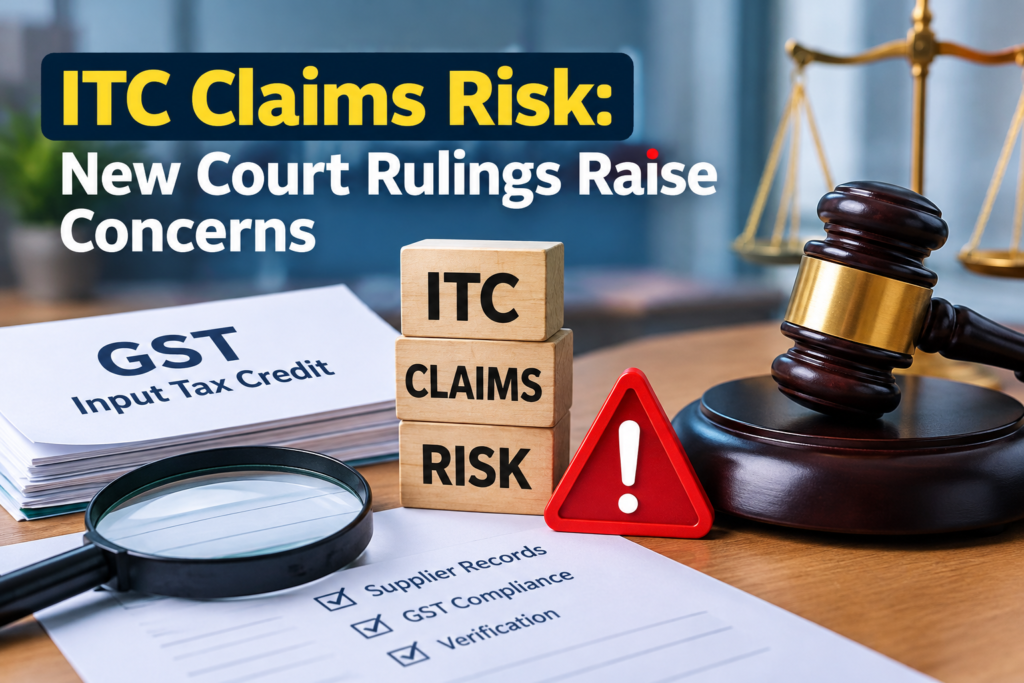
Why ITC Claims Now Carry Greater Risk for Buyers Under Recent Court Rulings

Abstract: ITC Claims Risk ITC Claims Risk Input tax credit (ITC) is a central feature of India’s Goods and Services Tax (GST) framework because it reduces cascading of taxes by allowing eligible businesses to offset tax paid on inputs against output tax liability. However, recent judicial developments have increased the compliance risk faced by buyers when their suppliers fail to discharge the corresponding GST liability. Section 16(2)(c) of the Central Goods and Services Tax (CGST) Act, 2017 makes ITC conditional on the tax charged on a supply being actually paid to the Government. In July 2026, the Supreme Court in Bhandari Scrap Traders v. Union of India upheld the constitutional validity of this condition and declined to read it down. A Rajasthan High Court decision in August 2026 subsequently treated supplier tax payment as a mandatory condition for ITC. This article explains the legal position, the resulting input tax credit risk for buyers, and practical compliance considerations. I. How to Reduce ITC Claims Risk Under GST GST operates through a value-added tax mechanism in which eligible businesses generally receive credit for input tax, subject to statutory conditions. For purchasers, an invoice alone does not establish an unconditional right to ITC. Section 16(2) of the CGST Act specifies conditions that must be satisfied before credit can be claimed. Among them, Section 16(2)(c) requires the tax charged on the relevant supply to have been actually paid to the Government, either in cash or through admissible input tax credit, subject to the statutory framework. ITC Claims Risk Input Tax Credit (ITC) claims have become a greater concern for buyers under recent court rulings in India. Businesses must ensure that their suppliers issue valid GST invoices, report transactions correctly, and comply with GST regulations. If suppliers fail to meet these requirements, buyers may face difficulties claiming ITC, along with potential tax demands, interest, or penalties depending on the circumstances. Therefore, buyers should regularly verify supplier details, maintain accurate purchase records, reconcile invoices with GST returns, and monitor supplier compliance. Taking these precautions can help businesses reduce ITC claims risk, avoid unnecessary disputes, and maintain proper GST compliance. Common ITC Claims Risk Factors for Buyers ITC Claims Risk The importance of this requirement has increased following recent court rulings. The Supreme Court’s July 2026 decision in Bhandari Scrap Traders reinforced the validity of Section 16(2)(c), while subsequent High Court decisions have applied the provision in disputes involving supplier defaults. These developments mean that buyers need stronger vendor and transaction controls when claiming ITC. II. LEGAL BASIS OF ITC ELIGIBILITY:ITC Claims Risk Section 16(2) of the CGST Act establishes multiple conditions for ITC. In addition to possession of prescribed tax documents and receipt of goods or services, the statutory framework includes the requirement that the tax charged on the supply be actually paid to the Government. The courts have therefore treated ITC as a statutory benefit subject to compliance with the conditions prescribed by Parliament. ITC Claims Risk Section 155 of the CGST Act is also relevant because it places the burden of proving eligibility for ITC on the person claiming the credit. Consequently, disputes may require the recipient to substantiate the underlying transaction and its compliance with the applicable ITC conditions. III. RECENT COURT RULINGS:ITC Claims Risk In Bhandari Scrap Traders v. Union of India, decided on July 24, 2026, the Supreme Court dismissed the challenge to Section 16(2)(c) and upheld the Gujarat High Court’s approach. The Court did not accept the request to declare the provision unconstitutional or to read it down. This development is significant because some earlier High Court decisions had adopted a more protective approach toward bona fide purchasers where the supplier had failed to remit tax. The divergence in earlier cases is important for understanding the present position. The Tripura High Court in Sahil Enterprises had held that Section 16(2)(c) should not operate to deny ITC in a bona fide transaction merely because the supplier defaulted, while other courts had taken a stricter view. The Supreme Court’s 2026 ruling strengthened the latter statutory interpretation. In M/s Shree Karni Electrovision v. Union of India, decided by the Rajasthan High Court on August 17, 2026, the Court held that Section 16(2)(c) is a mandatory condition, subject to the statutory provisions, and observed that ITC cannot be claimed as a matter of right unless the relevant conditions are satisfied. The decision further emphasized that the clauses of Section 16(2) are to be read together. IV. WHY BUYERS FACE GREATER INPUT TAX CREDIT RISK: ITC Claims Risk The recent rulings shift greater practical attention toward supplier compliance. A buyer may have a genuine invoice, receive the goods or services, make payment to the supplier, and record the transaction correctly, yet still face an ITC dispute if the supplier does not discharge the corresponding tax liability. The purchaser therefore faces a risk that is partly dependent on conduct outside its direct control. ITC Claims Risk This does not mean that every supplier default automatically establishes fraud by the purchaser. The legal issue is whether the statutory conditions for ITC have been fulfilled. Buyers should therefore distinguish between transaction-level evidence, supplier-level compliance, and allegations of fraud or collusion. V. BUSINESS IMPACT:ITC Claims Risk The principal business impact is potential reversal or denial of ITC, together with associated interest or other consequences where applicable under the GST framework. For businesses with high input-tax volumes, even a small proportion of disputed credits can affect working capital and tax costs. The rulings also increase the importance of vendor selection and monitoring. Procurement teams may need to consider GST compliance as part of supplier due diligence rather than treating tax documentation as a purely accounting function. ITC Claims Risk VI. COMPLIANCE MEASURES FOR BUYERS ITC Claims Risk Businesses can reduce input tax credit risk by strengthening controls around supplier onboarding and ongoing monitoring. Important measures include: (1) verifying supplier GST registration and core business details; (2) matching purchase invoices with GST records and available credit statements; (3) confirming receipt

Scroll to Top