Abstract: ITC Claims Risk
ITC Claims Risk Input tax credit (ITC) is a central feature of India’s Goods and Services Tax (GST) framework because it reduces cascading of taxes by allowing eligible businesses to offset tax paid on inputs against output tax liability. However, recent judicial developments have increased the compliance risk faced by buyers when their suppliers fail to discharge the corresponding GST liability. Section 16(2)(c) of the Central Goods and Services Tax (CGST) Act, 2017 makes ITC conditional on the tax charged on a supply being actually paid to the Government. In July 2026, the Supreme Court in Bhandari Scrap Traders v. Union of India upheld the constitutional validity of this condition and declined to read it down. A Rajasthan High Court decision in August 2026 subsequently treated supplier tax payment as a mandatory condition for ITC. This article explains the legal position, the resulting input tax credit risk for buyers, and practical compliance considerations.
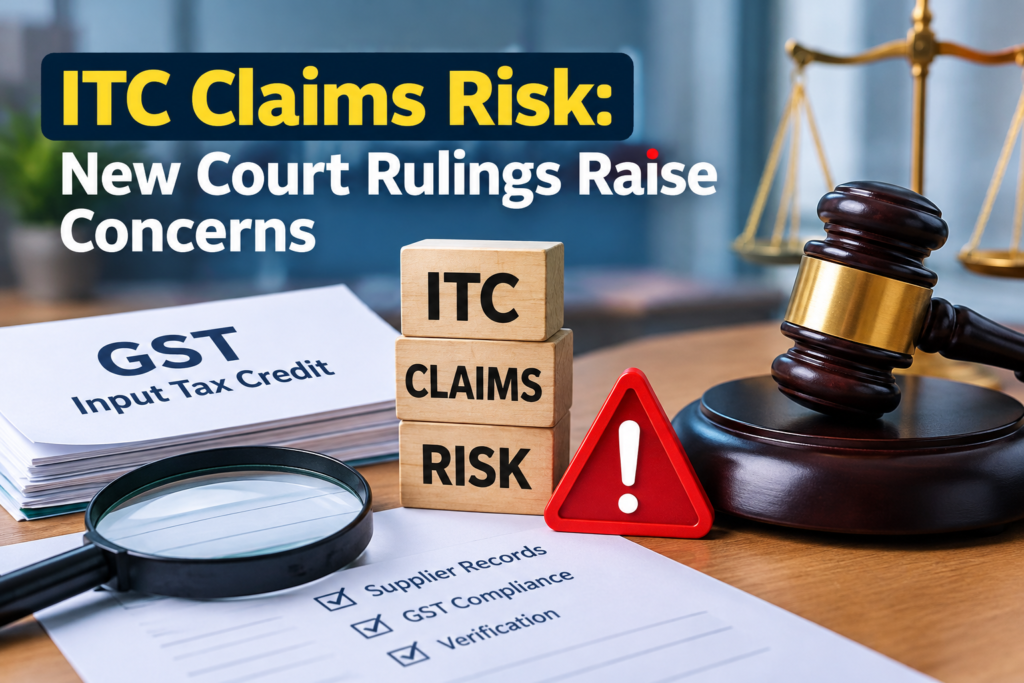
I. How to Reduce ITC Claims Risk Under GST
GST operates through a value-added tax mechanism in which eligible businesses generally receive credit for input tax, subject to statutory conditions. For purchasers, an invoice alone does not establish an unconditional right to ITC. Section 16(2) of the CGST Act specifies conditions that must be satisfied before credit can be claimed. Among them, Section 16(2)(c) requires the tax charged on the relevant supply to have been actually paid to the Government, either in cash or through admissible input tax credit, subject to the statutory framework. ITC Claims Risk
Input Tax Credit (ITC) claims have become a greater concern for buyers under recent court rulings in India. Businesses must ensure that their suppliers issue valid GST invoices, report transactions correctly, and comply with GST regulations. If suppliers fail to meet these requirements, buyers may face difficulties claiming ITC, along with potential tax demands, interest, or penalties depending on the circumstances. Therefore, buyers should regularly verify supplier details, maintain accurate purchase records, reconcile invoices with GST returns, and monitor supplier compliance. Taking these precautions can help businesses reduce ITC claims risk, avoid unnecessary disputes, and maintain proper GST compliance.
Common ITC Claims Risk Factors for Buyers
ITC Claims Risk The importance of this requirement has increased following recent court rulings. The Supreme Court’s July 2026 decision in Bhandari Scrap Traders reinforced the validity of Section 16(2)(c), while subsequent High Court decisions have applied the provision in disputes involving supplier defaults. These developments mean that buyers need stronger vendor and transaction controls when claiming ITC.
II. LEGAL BASIS OF ITC ELIGIBILITY:ITC Claims Risk
Section 16(2) of the CGST Act establishes multiple conditions for ITC. In addition to possession of prescribed tax documents and receipt of goods or services, the statutory framework includes the requirement that the tax charged on the supply be actually paid to the Government. The courts have therefore treated ITC as a statutory benefit subject to compliance with the conditions prescribed by Parliament. ITC Claims Risk
Section 155 of the CGST Act is also relevant because it places the burden of proving eligibility for ITC on the person claiming the credit. Consequently, disputes may require the recipient to substantiate the underlying transaction and its compliance with the applicable ITC conditions.
III. RECENT COURT RULINGS:ITC Claims Risk
In Bhandari Scrap Traders v. Union of India, decided on July 24, 2026, the Supreme Court dismissed the challenge to Section 16(2)(c) and upheld the Gujarat High Court’s approach. The Court did not accept the request to declare the provision unconstitutional or to read it down. This development is significant because some earlier High Court decisions had adopted a more protective approach toward bona fide purchasers where the supplier had failed to remit tax.
The divergence in earlier cases is important for understanding the present position. The Tripura High Court in Sahil Enterprises had held that Section 16(2)(c) should not operate to deny ITC in a bona fide transaction merely because the supplier defaulted, while other courts had taken a stricter view. The Supreme Court’s 2026 ruling strengthened the latter statutory interpretation.
In M/s Shree Karni Electrovision v. Union of India, decided by the Rajasthan High Court on August 17, 2026, the Court held that Section 16(2)(c) is a mandatory condition, subject to the statutory provisions, and observed that ITC cannot be claimed as a matter of right unless the relevant conditions are satisfied. The decision further emphasized that the clauses of Section 16(2) are to be read together.
IV. WHY BUYERS FACE GREATER INPUT TAX CREDIT RISK: ITC Claims Risk
The recent rulings shift greater practical attention toward supplier compliance. A buyer may have a genuine invoice, receive the goods or services, make payment to the supplier, and record the transaction correctly, yet still face an ITC dispute if the supplier does not discharge the corresponding tax liability. The purchaser therefore faces a risk that is partly dependent on conduct outside its direct control. ITC Claims Risk
This does not mean that every supplier default automatically establishes fraud by the purchaser. The legal issue is whether the statutory conditions for ITC have been fulfilled. Buyers should therefore distinguish between transaction-level evidence, supplier-level compliance, and allegations of fraud or collusion.
V. BUSINESS IMPACT:ITC Claims Risk
The principal business impact is potential reversal or denial of ITC, together with associated interest or other consequences where applicable under the GST framework. For businesses with high input-tax volumes, even a small proportion of disputed credits can affect working capital and tax costs.
The rulings also increase the importance of vendor selection and monitoring. Procurement teams may need to consider GST compliance as part of supplier due diligence rather than treating tax documentation as a purely accounting function. ITC Claims Risk
VI. COMPLIANCE MEASURES FOR BUYERS ITC Claims Risk
Businesses can reduce input tax credit risk by strengthening controls around supplier onboarding and ongoing monitoring. Important measures include: (1) verifying supplier GST registration and core business details; (2) matching purchase invoices with GST records and available credit statements; (3) confirming receipt of goods or services through purchase orders, delivery records, service confirmations, and payment documentation; (4) periodically reviewing supplier filing and tax-compliance status where legally and operationally feasible; (5) maintaining a documented exception process for mismatched or unusual invoices; and (6) using contractual provisions that address tax compliance, documentation, and cooperation in case of a GST dispute. ITC Claims Risk
These controls cannot guarantee that a supplier will always pay tax, but they can improve the buyer’s evidentiary position and help identify higher-risk transactions before substantial credit is accumulated.
VII. BALANCING STATUTORY COMPLIANCE AND COMMERCIAL REALITY ITC Claims Risk
A key difficulty is that a purchaser generally cannot directly control the supplier’s tax payment after the transaction. Earlier court decisions recognized this practical concern and, in certain circumstances, sought to protect bona fide purchasers. The current Supreme Court position, however, confirms that the statutory condition in Section 16(2)(c) cannot simply be disregarded because compliance may be difficult for the recipient to verify.
Accordingly, businesses should approach ITC as a conditional statutory entitlement rather than as an automatic consequence of receiving a GST invoice. Commercial contracts, vendor monitoring, reconciliation systems, and internal tax reviews can become important parts of managing this exposure.
VIII. CONCLUSION: ITC Claims Risk
Recent court rulings have made the supplier-tax-payment condition under Section 16(2)(c) a more significant consideration for GST-registered buyers. The Supreme Court’s July 2026 decision in Bhandari Scrap Traders upheld the provision’s validity, and the August 2026 Rajasthan High Court ruling reinforced the mandatory nature of the condition. The resulting input tax credit risk means that buyers should place greater emphasis on supplier due diligence, transaction documentation, GST reconciliation, and timely resolution of mismatches. While businesses cannot fully control supplier conduct, stronger compliance systems can help identify exposure and support the evidentiary requirements associated with ITC claims.
REFERENCES
[1] Central Goods and Services Tax Act, 2017, §16 and §155, Government of India.The CGST Act 2017.pdf
[2] Bhandari Scrap Traders v. Union of India, SLP (C) No. 23931 of 2026 and connected matters, Supreme Court of India, July 24, 2026. Bhandari Scrap Traders vs Union Of India on 24 July, 2026
[3] M/s Shree Karni Electrovision v. Union of India, CW-4266/2023, Rajasthan High Court, Aug. 17, 2026. M/S Shree Karni Electrovision vs Union Of India on 17 August, 2026
[4] Sahil Enterprises v. Union of India, Tripura High Court, Jan. 6, 2026. M/S. Sahil Enterprises vs Union Of India on 6 January, 2026
[5] Trendships Online Services Pvt. Ltd. v. Commissioner, Commercial Taxes, Uttar Pradesh, Allahabad High Court, May 26, 2025. Trendships Online Services Private … vs Commissioner Commercial Taxes U.P. At … on 26 May, 2025
[6] Internal work: Add Post ‹ Eve Consultancy — WordPress