Section 263 Tax Assessment Ask any exporter what their worst nightmare is, and somewhere down the line, they will mention the dreaded refund process, where all of their money gets hoarded by the tax department. The refund process is still one of the most painful processes, despite being a decade since GST rolled out – not because it is complicated but because it is different, and most small and medium-sized businesses have never dealt with anything like this before.
We hope you find this article useful.
Section 263 Tax Assessment: Exports Are “Zero-Rated”, Not “Exempt”
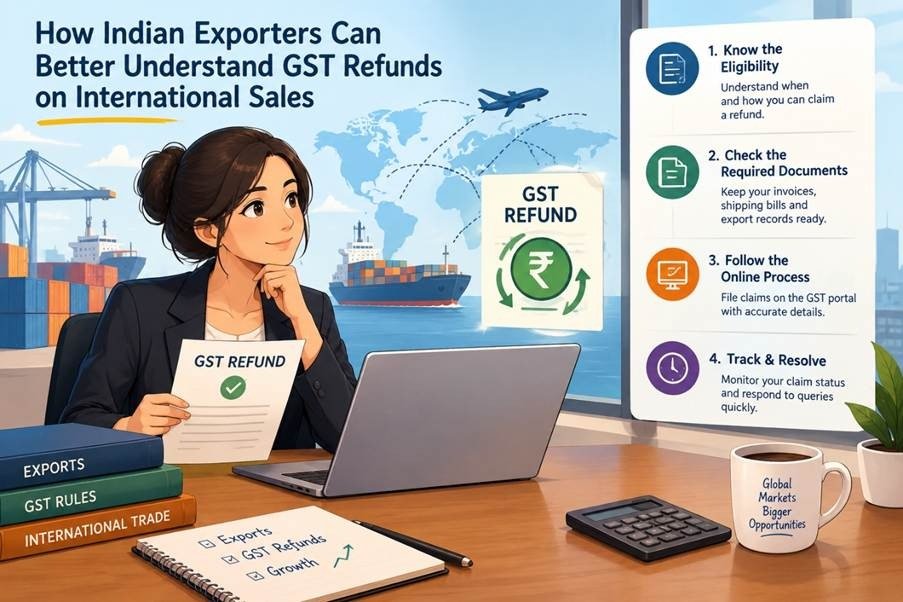
The first thing any exporter should know is that exports are zero-rated, not exempt, as many believe. The difference is that for exempt supplies, the supplier is unable to claim a credit for the tax paid. In the case of zero-rated supplies, as an exporter, you are eligible to claim a refund of the tax paid.
This is precisely the reason why a GST refund is available on exports and what zero-rating of the supply actually means. Section 263 Tax Assessment
Section 263 Tax Assessment: Indian Exporters Have Two Ways To Claim Export Refunds
As an exporter, you can opt for two ways to claim a refund on tax paid – either you pay the IGST on the invoice and claim a refund on it, or you pay nothing on the invoice but claim a refund of your accumulated credit. Each of these options has its own advantages and disadvantages and the choice between them depends on your cash-flow requirements for the year. Section 263 Tax Assessment
Section 263 Tax Assessment: Option 1: Pay IGST and Claim it Back
This will require you to pay IGST on the export invoice and claim a refund, which means you temporarily pay your money to the government until the refund is approved. The advantage of this route is that your shipping bill for the export becomes your application for a GST refund, and you don’t need any more documentation or forms as long as your shipping manifest is the same as the export returns you’ve submitted in GSTR-3B.
The disadvantage with this option however, is that your cash-flow for the year is affected as you pay the IGST on the shipment value.
Option 2: LUT and Claim your Input Tax Credit (ITC)
This will require you to provide a Letter of Undertaking (LUT) to the tax department to let them know that you are exporting a specific consignment. In this route, you don’t pay the IGST, but you claim back a refund of your input tax credit on the purchase of goods and services you’ve used in making the export. The advantage of this route is that it does not tie up your cash to fund the government. The LUT must be submitted on the GST portal in Form GST RFD-11 and it will be valid for one financial year (1 year), so you’ll have to renew it before making your first export in the next financial year. If you don’t renew it, you’ll have to pay the IGST due on the consignment, and potentially interest as well. For one export, you can choose either of these options, but you can’t combine both. Section 263 Tax Assessment
Section 263 Tax Assessment: Common Export Refund Headaches
When you speak to exporters about refunds, you’ll find that the problems are usually not glaring issues, but something as simple as a typo in the shipping bill or an expired LUT. Some of the most common problems we see when claiming GST export refunds are:
Mismatch of documents – shipping bill, invoice and GST returns – even if just one of the three has a different consignment value, it can delay the refund.
Expired LUT – the LUT is only valid for 1 year and many exporters forget to renew it on time before a new financial year begins.
Claimed ITC on blocked goods by mistake – certain goods like motor vehicles for personal use can’t claim ITC, regardless of the supply. Claiming ITC on such goods would result in a rejection of the refund.
Incorrect wording on export invoices – Invoices for exports should have specific words in order for the supply to qualify as an export under this heading. Not having such words may result in rejection of your export refund.
These are just some of the issues you could face as an exporter, but as you can see, any of them can cause serious delays.
Section 263 Tax Assessment: Automation Is Working For You If You’re Compliant
As mentioned above, the authorities are promoting increased automation in processing GST export refunds. So, as long as you’ve been keeping clean books all year, the process will be easier and quicker, as most of the data and forms will match automatically. But if you haven’t been keeping your books in order, you’ll have to spend time manually filling out the forms. Section 263 Tax Assessment
Helpful Tips for Exporters Who Need Speedier Refunds
Some helpful tips for exporters who need speedier refunds are:
Reconcile your returns every month, rather than at the end of the year.
Be aware when your LUT expires and renew it on time.
Keep a list of all the necessary documents for a specific export, such as invoice, shipping bill, bank realisation certificate, and LUT reference, and ensure they’re all in order.
Consult your GST consultant before you assume any new product or service you start supplying is an export.
Section 263 Tax Assessment: The Final Words
Indian exporters are competing in a brutal global market, and every rupee of working capital is critical. One of the best ways to keep your cash flow healthy is to understand the GST refund process and keep your records straight. The convoluted refund process might seem tough and complex, but it can be made easier by following a few tips. Section 263 Tax Assessment
References
- ClearTax — GST Export Refunds: Key Differences Between Rule 96 and Rule 89, https://cleartax.in/s/gst-export-refunds-rule-96-vs-rule-89
- TaxGuru — GST Refund on Exports in India (Updated as on 01-04-2026), https://taxguru.in/goods-and-service-tax/gst-refund-exports-india-updated-01-04-2026.html
- PayGlocal — GST on Export of Services in India: Rules, LUT, and Refunds, https://payglocal.in/blog/gst-on-export-of-services-impact
- RegisterKaro — GST Registration for Export of Services 2026: Conditions, https://www.registerkaro.in/post/gst-registration-for-export-of-services
- DMI Finance — GST on Exports: Zero-Rated Supply & Refund Process, https://www.dmifinance.in/gst/gst-on-exports-zero-rated-supply-refund-process/
- Internal Link: Add Post ‹ Eve Consultancy — WordPress
AI detection
Proofreading
Plagiarized