
Goods and Services Tax is one of the primary indirect tax reforms that have been introduced in India to unify the system. For businesses, consumers, and students, it is essential to understand what GST is in India since it plays an essential role in regulating purchase and sale activities at the national level. This reform was implemented on July 1, 2017, and it replaced a set of indirect taxes by one tax system, which unifies the central excise duty, service tax, and several state taxes like VAT and others.
SOURCE-CHATGPT
What Is GST?
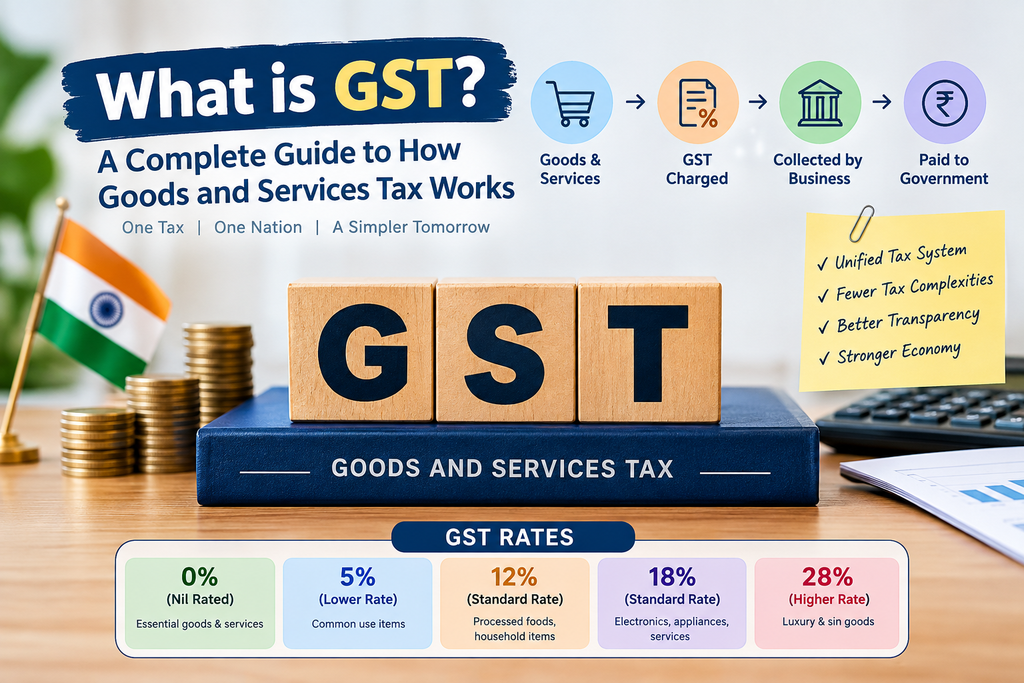
GST is a destination-based indirect tax on the supply of goods and services. Collected by businesses from consumers and other businesses, goods and services tax is subsequently paid to the government by businesses. Unlike direct taxes, which are levied directly on individuals and businesses, GST is an indirect form of taxation.
Simply stated, “goods and services tax explained” refers to a levy imposed at each stage of the supply chain, with businesses and manufacturers able to claim back the GST paid on goods and services purchased. As such, this tax aims to prevent the cascading effects of taxation or “tax on tax” during the supply chain.
How Does GST Work in India?
GST is a credit-based tax system. When a manufacturer buys materials, GST is charged to them. When the same manufacturer sells the finished product, they collect GST from the buyer. The manufacturer can claim back the eligible GST they have paid on the materials and only pay the difference to the government.
Suppose a company collects 18000 rupees as GST on its sales and 10000 rupees as eligible GST on its purchases. The company’s total GST liability would be 8000 rupees.
GST is split into several components based on the type and location of any transaction.
- CGST: The amount of GST collected by the Central Government on local sales.
- SGST: The amount of GST collected by the state government on local sales.
- IGST: The amount of GST collected on inter-state sales and other transactions
Understanding GST Rates
One of the significant features of GST is that various goods and services may be subject to different tax rates. By way of example, the applicable GST rates depend upon the categorisation of goods or services. The GST rate structure may involve nil-rated supplies and various other standard rate categories.
Due to the possibility of changes in the tax rate structure through government notifications and the decisions of the GST Council, it is necessary for businesses and consumers to check the applicable GST rate for a given product or service and not rely on generalizations.
Why Was GST Introduced?
GST Introduction and Its Impact on Businesses Essay (Article)
GST was introduced to ease the indirect tax system and to form a common unified market in India. It subsumes various indirect taxes and provides a digital platform for tax registration, return filing, tax payment, and compliance.
Businesses have to register and comply with GST norms based on turnover, nature of supply, and other criteria. Also, consumers bear this tax in the prices of most of the goods and services they buy.
Conclusion
Understanding what GST India is would be of immense importance to the taxpayer, the businesspeople, and those making purchases on a regular basis. GST, or goods and service tax, is imposed on the supply of goods and services, and a credit is given to eligible people on the taxes they have paid. An in-depth description of goods and service tax examples and rates would shed light on the workings of the indirect tax system in India. Note that the government may make changes to the tax rates and rules from time to time, and therefore it is necessary to consult the latest information on the official GST website.
REFERENCE
[1] Goods and Services Tax Council, “Goods and Services Tax (GST),” Government of India. GST Council
[2] Government of India, “Goods and Services Tax,” Department of Revenue, Ministry of Finance. Department of Revenue, Ministry of Finance
[3] Central Board of Indirect Taxes and Customs, “Goods and Services Tax,” Ministry of Finance, Government of India. CBIC GST
[4] Government of India, The Central Goods and Services Tax Act, 2017, Ministry of Law and Justice, 2017. India Code