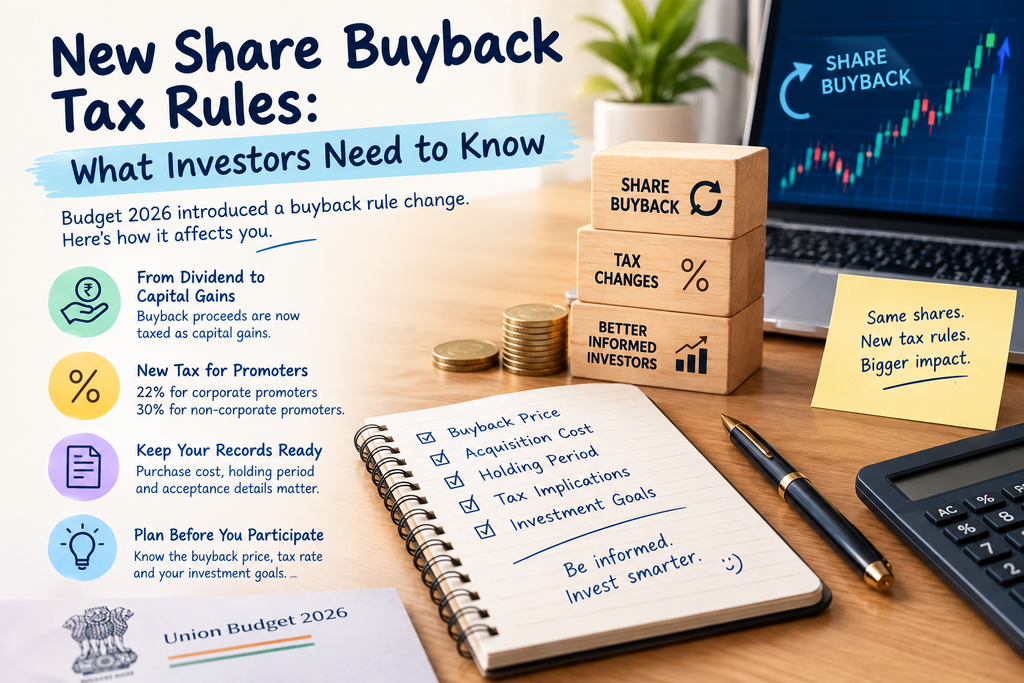
Share buyback tax rules in India have changed from April 1, 2026, affecting how investors calculate taxes on shares repurchased by companies.
Share buybacks are one of the major corporate transactions that involve the repurchase of shares by the company that pays money back to the shareholder. A buyback can be seen by investors as a chance to get money back from the company, and possibly at a higher price than the market. The tax treatment of these transactions can however make a huge difference to the final investor’s return.
There is a significant modification in India’s share buyback taxation that was recently introduced in the Union Budget 2026. For tax purposes, income from a share buyback is considered to be capital gains income, instead of dividend income, beginning April 1, 2026. The updated structure also adds another tax burden for promoters to deter their use of buybacks for tax reasons.
Table of Contents
What is a Share Buyback?
Share buyback is a share repurchase program by the company from the shareholders. Buyback programs can be implemented by companies facing excess cash, wishing to decrease the number of shares issued, or wanting to return the invested fund to the investor.
Let’s say a person has 100 shares of a business. The price of the buyback is announced at ₹500, and the market price is ₹450. In case the investor’s shares are accepted in the buyback, the investor gets ₹500 per share.
A buyback can be a good way for shareholders to sell for a good price. But the gain really depends on the buyback price, number of shares redeemed, the cost of the original purchase and the taxes that would apply.
What are the changes in Budget 2026?
The Union Budget 2026-27 recommended a significant change in the tax regime for share buyback. The changes will be made from 1 April 2026 and will be effective for tax year 2026-27 onwards.
The previous regime, which kicked in from October 1, 2024, to March 31, 2026, would have classified buyback proceeds of domestic companies as deemed dividend income to the shareholders. The price paid for the shares was recognised as a capital loss in accordance with the relevant provisions.
As per the new framework, buyback is considered under the head of Capital Gains. This allows an investor to generally reduce the consideration received for the buyback from the cost of the shares acquired when determining the capital gain or loss.
There was also a new tax for promoter shareholders in the Budget. The goal is to reduce the use of share buybacks as a means for promoters to “harvest” tax benefits rather than deliver a more consistent capital gains treatment to other shareholders.
What is the Share Buyback Tax Calculation Now?
The new rules are simple: the base calculation is the difference between the total consideration given and the acquisition cost of the shares repurchased.
Let’s say an investor bought shares worth Rs 30,000 and then got a buyback of those shares from the company for Rs 45,000.
Buyback consideration: ₹45,000
Original purchase cost: ₹30,000
Capital gain: ₹15,000
- The investor would have the taxable gain of ₹15,000 (subject to the provisions and relevant adjustments).
The buyback tax will be based on the type of investor, the type of shares, the holding period requirements, and the tax rates in effect. There may be a difference between the short-term capital gains and long-term capital gains treatments. As such, investors are not to assume that the entire amount of the buyback is taxable, or that investors all pay the same rate.
A capital loss could result from a buy back consideration that is less than the acquisition cost. The allowable set-off or carry-over for that loss will depend upon the tax rules and the tax filing procedures.
Each promoter will have to pay extra tax.
The one of the most significant changes in new rules is the extra tax levied on the promoters. For all shareholders the buyback is considered as capital gains, while the promoters have a tax component in addition.
The effective tax rate due on the gains from a buyback is supposed to be: announced in Budget 2026.
22% for corporate promoters (domestic qualifying companies).
30% for non-corporate promoters: which includes qualifying persons and other non-corporate entities.
The announced effective rates of promoter buyback gains are not applicable to all investor groups, but rather only to specific investors who opt-in to the buyback. The exact amount will depend on the legislative provisions and the nature of the shareholder.
The distinction is important because it means the promoters can influence the company’s decision to conduct a buyback, how it’s structured, and when it will take place. The extra tax is meant to reduce tax arbitrage, but not to end up depriving the shareholders of their capital gains treatment in general.
Retail investors should look at the ordinary capital gains provisions instead of the promoter rates for their tax liability if they don’t fit into the promoter category.
Here is how the New Rules impact Retail Investors.The Impact of the New Rules on Retail Investors.
The new tax regime on share buybacks might be more advantageous for ordinary investors in some cases, as the tax levied is based on the capital gain instead of the buyback consideration.
The old scheme involved the buyback being taxed as dividend income and the acquisition at the same time being capitalized as a capital loss. The new method can be used to reduce the purchase cost when computing the capital gain, which may simplify the tax treatment.
The real benefit, however, will rely on the investor’s situation. Before an investor decides to buy back, they should look at the buyback price, number of years held, capital gain rates that would apply, and their tax situation as a whole.
New rules aren’t designed to help all investors save more in taxes. However, if there is a large gain, depending on the rates and provisions that apply, there could still be a big tax bill.
What investors should do before investing?
Investors should understand stock market basics for beginners before making decisions about share buybacks and other investment opportunities.
Investors need to consider a few key factors before taking a share buyback offer.
Comparison of the company’s offer price to the market price is called Buyback price. A premium does not necessarily mean a better return, but can make the deal appealing.
Conclusion
The new share buyback tax rules introduced through Union Budget 2026 represent a significant change in how investors are taxed when companies purchase their own shares. Effective April 1, 2026, buyback consideration is treated as capital gains rather than dividend income, and the acquisition cost can generally be deducted when calculating the gain.
The revised buyback tax framework also introduces effective tax rates of 22% for corporate promoters and 30% for non-corporate promoters, subject to the applicable statutory provisions.
For retail investors, the change may make buyback taxation more favourable in some circumstances, but the final outcome depends on individual tax rates, holding periods, and the details of each transaction.
Investors should therefore evaluate both the financial attractiveness of a buyback and its tax implications before participating. Understanding the revised rules can help them make better-informed investment decisions and plan their tax obligations more effectively.
References
[1] Press Information Bureau, Government of India, “Union Budget 2026–27: Other Tax Proposals,” Feb. 1, 2026. [Online]. Available: https://www.pib.gov.in/PressReleasePage.aspx?PRID=2221458
[2] Income Tax Department, Government of India, “Rationalisation of Other Direct Tax Provisions: Taxation of Buyback of Shares,” Finance Bill, 2026. [Online]. Available: https://www.incometaxindia.gov.in/documents/81799/11848482/memo-2026.pdf/fe530cfa-9c49-fc5c-4bfa-fc96fd5e7b7a
[3] EY India, “Union Budget 2026: Consolidated Tax and Policy Alert,” Feb. 1, 2026. [Online]. Available: https://www.ey.com/content/dam/ey-unified-site/ey-com/en-in/services/tax/union-budget-2026/ey-consolidated-tax-and-policy-alert.pdf