
Cash transaction limits in India help taxpayers understand the rules for large cash receipts, loans, repayments, and business payments under income-tax law.
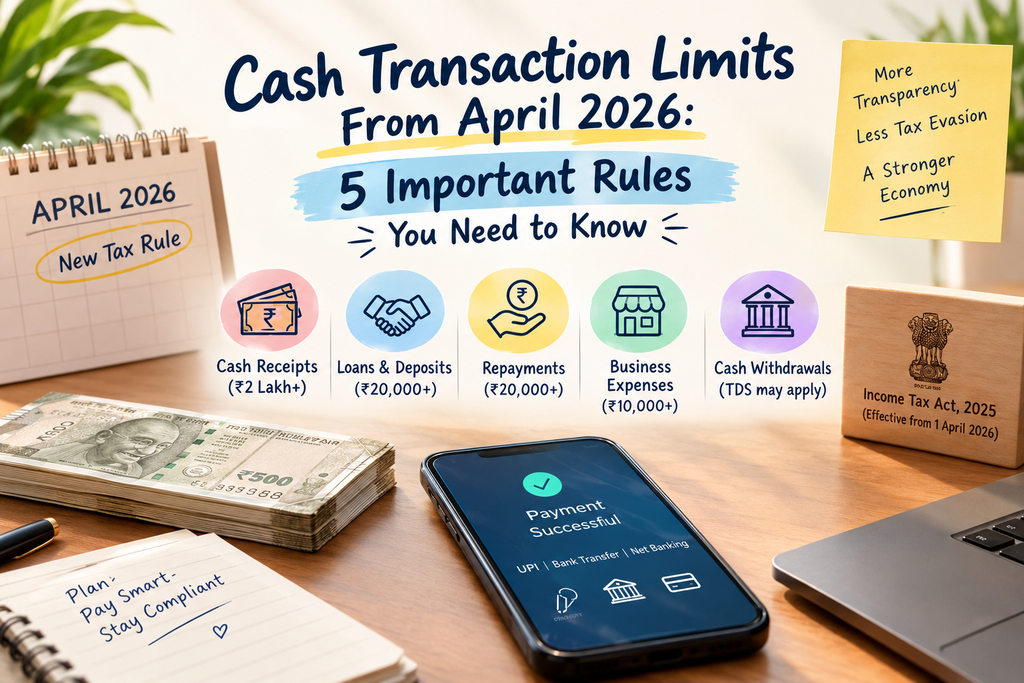
Source : AI generated image
In India cash is still an integral part of the daily lives when it comes to financial transactions. Many people feel the need to carry cash for convenience, whether they are shopping for food or paying for their service providers, to their business-related expenses. There are, however, certain limits on the cash payments, receipts, loans and repayments that are provided by the income tax laws to enhance transparency and minimise tax evasion.
The Income-tax Act, 2025, came into force from 1st April, 2026 with a number of changes to various existing provisions on cash transactions. This has led to a renewed focus on cash limits and on the new tax rule that will apply to individuals, businesses and other taxpayers. As a discussion about new cash transaction limits continues, it is important to keep in mind that certain limits that already exist will continue to apply under the new law.
What are the Cash Transaction Limits?
Limits on cash transactions are legal limits on the amount of money that can be paid or received in cash in some circumstances. The aim of these rules is to deter non-registered transactions, combat tax evasion and promote the use of traceable payment instruments.
The limitations are not a prohibition on cash, or a ban on cash’s use as a means for everyday transactions. Rather, certain transactions of a certain size have to be completed by means of authorized banking channels or electronic payment methods.
A person, for instance, might still use cash for common transactions under the rules. Payment for a big sum in one hit, or a large cash loan or a business payment may result in penalties or tax implications, however.
What Changed April 2026?
The Income-tax Act, 2025, came into force from 1st April 2026 for the new-law framework.The new-income tax law, namely Income-tax Act, 2025, is applicable from 1st April 2026 as the new-law framework. A number of known limitations on cash payments has been re-numbered.
The significant issue for taxpayers is that the new law doesn’t immediately signal that all cash limits have been lowered, or that cash transactions are banned. The old law has provisions to many of the existing limitations.
Hence, users should be aware that any new cash deal will now have a new limit, and that is very different from the old one. The relevant provisions depend on the nature, volume of transactions and the exceptions thereof.
Understanding Important Cash Transaction Limits You Should Know
There are a number of limitations that people, businesses and those who perform large payments need to be aware of.
1. Cash Receipts of ₹2 Lakhs and Above
The most crucial limitation is that of receipt of ₹2 lakhs or more. In the following circumstances, no person can receive an amount of ₹2 lakh or more in cash or any other impermissible mode:In the following circumstances, no person can receive an amount of ₹2 lakh or more in cash or by any mode other than cash:
Total amount collected from one individual on an individual day.
The earnings obtained from a single trading.
Amounts relating to one event or occasion from the same person.
For instance, if a particular person gets ₹2.2 lakh as a customer for one deal. The payment should be made via an authorised banking or electronic transfer, not in cash.
It is not always possible to avoid the restriction by splitting up a payment into smaller amounts. The law is based on the type and relationship of transactions, rather than just the amount received in one transaction.
There are various exemptions, such as certain receipts received by government officials and banks.
2. Cash Loans & Deposits
Another key limitation is relating to loans and deposits. If a bank accepts a covered loan, deposit or specified sum of ₹20,000 or more, then the bank is required to use a permitted banking or electronic payment system.
The limitation could be imposed even if the quantity is not obtained through any single transaction. Under the provisions, the amount of money and the outstanding balances may also be relevant.
For instance, if a person wants to borrow ₹50,000 from a friend, taking the entire sum in cash could be a contravention of the relevant rule. In general, a bank transfer or other accepted form of payment is more secure.
The rule is designed to ensure that the financial record is clear and it will facilitate the trace of money origins and flows.
3. Cash Reimbursement of Loans
There are also limitations on the repayment of certain loans, deposits and specified advances. Repayments of covered repayments of ₹20,000 or more will normally have to be made by authorized banking or electronic means under Section 188.
It is important to be aware that just because a loan can be accepted via a bank transfer, there’s no guarantee that it will be repaid in cash without any repercussions. The receipt and repayment processes need to be audited against the relevant rules.
Keeping bank statements, confirmations of transfers and other records of transactions can support that such transfers were made by approved means.
4.To receive cash payments for business expenses.
Cash expense limits are particularly important for cash expense management of business owners, freelancers, traders and professionals.
Business expenses will not be allowed as a deduction if the payment to a person is made through an unacceptable method, where the amount paid is more than ₹10,000 within a single day, under the provisions of business expense. The threshold for specified payments for hiring, plying or leasing of goods carriages is ₹35,000.
For example, in case a business incurs an expenditure and pays the supplier for it in cash, the payment might not be deductible except for the exceptions. This does not necessarily imply the payments are illegal, it may impact the taxable earnings of the business.
Therefore it is important for businesses to keep their invoices, receipts, and good payment records.
5. Large Cash Withdrawals at Banks?
The term cash withdrawal limits is sometimes confused with cash transaction limits. They are not the same thing.
Cash can be withdrawn from a bank account but under the provisions, tax deduction at source (TDS) may apply to cash withdrawals exceeding a certain limit. The threshold varies depending on issues like how much is being extracted and the history of taxpayer income-tax return filing.
So, it is not the case that if you’re withdrawing a lot of money it’s automatically illegal or that a large amount of money you withdraw is subject to tax. But, keep records of large cash receipts and expenditures for taxpayers.
Consequences for breaking the rules.
Failure to abide by the cash transaction guidelines may cause severe economic repercussions. The penalties for the provision may be equivalent to the amount of the prohibited loan, receipt or repayment. Violations of the business expenses may also lead to the disallowance of business expenses, which can lead to an increase in taxable income.
If a person takes a loan of ₹50,000 from a loan company that has no regulations for cash loans, then the maximum penalty that a person can receive could be ₹50,000. The effect of this provision will depend on the relevant provision, exceptions that may apply, and the facts.
Taxpayers never assume that, just because they both agree, a transaction is allowed. There is a separate requirement for compliance with income-tax rules.
How to Comply With the New Tax Rule?
Understanding personal finance basics can help individuals manage payments, maintain financial records, and make informed financial decisions.
There are a few tips that can help individuals or businesses prevent unwelcome tax issues.
- Use digital payments: Make payments using cashless payment options like UPI, bank transfers, NEFT, RTGS and others as allowed in restricted cash payments.
- Maintain transaction records: Be sure to store invoices, receipts, bank statements, and payment confirmations.
- Know the threshold: There are different thresholds for cash receipts, loans and repayments and business expenses.
- Don’t break payments up: Making several smaller payments might not be themed to avoid the limitations.
- Confirm official statements: Do not trust to the claims of new cash limits before confirming it from the Income Tax Department.
- Get advice: When you are dealing with property transactions, business payments or large financial transactions, do not hesitate to seek professional advice when needed.
Conclusion
The implementation of cash transaction limits continues to be a significant aspect of efforts aimed at enhancing financial transparency and deterring tax evasion in India. The Income-tax Act, 2025, lays the ground rules for these restrictions from April 2026, and these restrictions include limits on large cash receipts, loans and repayments, and some business expenses.
The key lesson to be learned is that there is no universal cash limit for any financial transaction. The ₹2 lakh receipt cap, ₹20,000 limit on covered loans and repayments, and the ₹10,000 business expense cap have different objectives.
Taxpayers can benefit from understanding these differences so they can properly follow the new tax rule, can keep financial records in order and can stay off the penalties. If you are considering making or accepting a large cash payment, always check the provision, NOT on what is rumoured to be new cash limits.
Disclaimer: The information provided in this article should NOT be relied upon for tax purposes and should not be considered a replacement for tax professional advice. Please refer to the most up-to-date official provisions and exceptions before making substantial financial transactions.
References
1 Income Tax Department, Government of India, “Income-tax Act, 2025,” Ministry of Finance. Online. Available: https://incometaxindia.gov.in/Documents/Act/Income-tax-Act-2025.pdf
2 Income Tax Department, Government of India, “Section 186: Mode of undertaking transactions,” Income-tax Act, 2025. Online. Available: https://www.incometaxindia.gov.in/w/section-186-41
3 Income Tax Department, Government of India, “Section 185: Mode of taking or accepting certain loans, deposits and specified sum,” Income-tax Act, 2025. Online. Available: https://wmstatic-prd.incometaxindia.gov.in/web/guest/w/section-185-77
4 Income Tax Department, Government of India, “Threshold limits under Income-tax Act,” Ministry of Finance. Online. Available: https://wmstatic-prd.incometaxindia.gov.in/web/guest/w/threshold-limits-under-income-tax-act
5 Income Tax Department, Government of India, “Business or Profession: Payment made in cash and disallowance of cash payments.” Online. Available: https://www.incometaxindia.gov.in/w/business-or-profession
6 Income Tax Department, Government of India, “Section 269ST: Mode of undertaking transactions,” Income-tax Act, 1961. Online. Available: https://www.incometaxindia.gov.in/w/section-269st-7