Income tax return filing for business owners involves reporting business income, checking eligible expenses, and choosing the correct ITR form based on the taxpayer’s income and eligibility.
Running a business is a lot more than just handling sales, customers, and daily costs. One key task that business owners have to deal with every year is filing their income tax return. No matter if you own a store or work on your own, as a freelancer offering professional services or running a big company it’s essential to report your income properly.
For business owners, the hard part is figuring out which ITR form to use and what details need to be included. ITR-3 and ITR-4 are two forms that business owners might see. They don’t work for everyone. The correct form depends on the kind of income you have. Whether you qualify to use it.
Table of Contents
What is Income Tax?
Income tax is the money that individuals and businesses give to the government from the income they earn during a year. Income tax means that if you get money from a salary, a business, a profession, investments, or other sources, part of that money may be counted as taxable under the rules for income tax.
For example, if you run a small business, the money you receive from customers is not necessarily the same as your taxable income. You may have legitimate business expenses such as rent, salaries, electricity, or other costs. These details are considered while determining the taxable business income, subject to the applicable rules.

Source: ChatGPT
Why Is It Important to File the Correct ITR?
Filing the income tax return is a crucial and critical responsibility for business owners. ITR-3 and ITR-4 apply to different situations so selecting the right one helps ensure that business income and other required details are reported properly. Filing information can also help avoid errors, delays, notices, or problems with tax compliance. Therefore, business owners should understand their eligibility. Check their financial details carefully before submitting their income tax return.
Another important reason to file correctly is to avoid corrections later. If wrong information is submitted, the taxpayer may have to revise the return or take steps to fix the error. Therefore business owners should know whether ITR-3 or ITR-4 filing applies to their situation and make sure all relevant documents are ready before filing.
Overall, filing the ITR accurately makes the business income return process smoother and helps business owners stay organised with their tax responsibilities.
Income Tax Return Filing for Business Owners: Why It Matters
Maintaining accurate financial records helps business owners manage their finances and prepare for tax filing.
ITR-3 vs ITR-4: Which one is applicable?
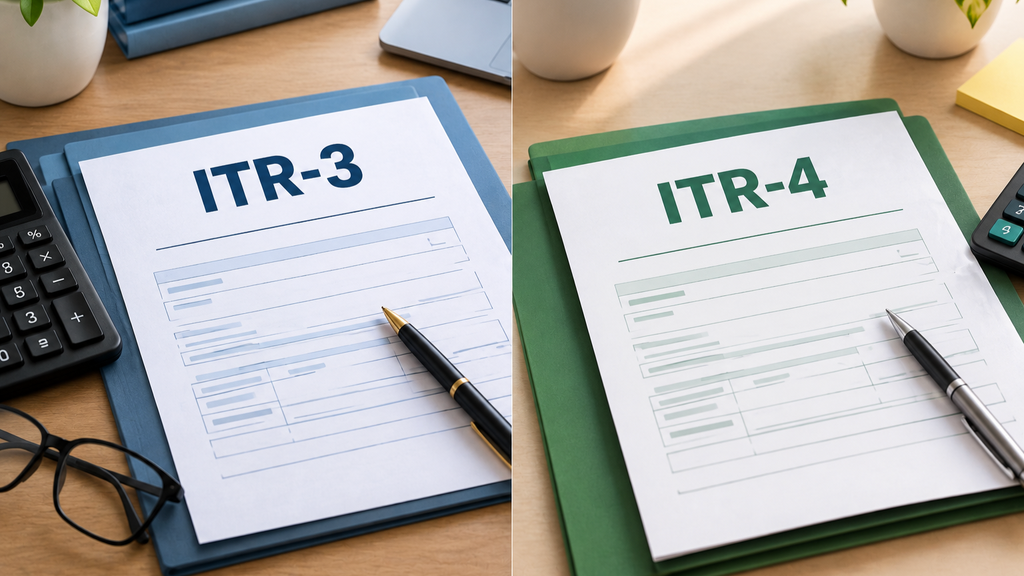
Two forms that business owners often come across are ITR-3 and ITR-4.
ITR-3
ITR-3 is usually used by individuals and Hindu Undivided Families (HUFs) who have income from a business or profession and are not allowed to file ITR-4.
Because ITR-3 can include information, business owners need to make sure they have proper records of their income, expenses, investments, taxes and other important details.
ITR-4
ITR-4, called Sugam, is for eligible resident individuals, HUFs and firms (not including LLPs) who meet the requirements for using the presumptive taxation scheme.
With this taxation method eligible taxpayers can figure out their taxable business or professional income based on the rules provided instead of keeping track of every single business expense like they would under regular taxationDocuments required to file ITR
Source: ChatGPT
Documents required to file ITR
Before starting business income return filing, it is useful to organise your financial documents. Depending on your circumstances, these may include:
- PAN and Aadhaar details
- Bank account information
- Sales and business income records
- Details of business expenses
- Form 16, if applicable
- Form 26AS
- Annual Information Statement (AIS)
- Tax information and TDS details
- Details of investments and eligible deductions
- Previous year’s ITR acknowledgement
- Details of other sources of income
Common mistakes business owners should avoid
A mistake for business owners is picking the wrong ITR form. Another mistake for business owners is putting business income on the form without checking the data in AIS and Form 26AS.
Business owners must not ignore income from other sources. For example, interest income or other taxable income may also need to be reported depending on the business owner’s circumstances.
Another mistake for business owners is waiting until the moment. Filing close to the deadline makes it harder for business owners to spot missing documents or fix errors.
Why timely filing matters
Timely ITR filing for business owners helps keep financial records organised and reduces the chances of last-minute problems. It can also be useful when applying for loans, visas, or other financial requirements where income-tax documents may be requested.
More importantly, filing an accurate return helps a taxpayer meet their income-tax compliance responsibilities.
Conclusion
Filing an income tax return is a part of managing a business responsibly. Business owners must select the ITR form such as ITR-3 or ITR-4, based on the type of business they have. It is important to report business income to prevent errors and delays. Keeping all documents in order is also essential at all times. Checking income and tax details carefully before filing can prevent errors. Filing returns on time means no penalties will be applied. When you stay on top of these tasks, the whole process becomes much smoother. A prepared business income return helps maintain proper tax compliance and also keeps financial records in order.
A well-prepared business income return not only helps maintain proper tax compliance but also keeps financial records in order. By understanding the filing requirements and avoiding common mistakes, business owners can complete their ITR filing with greater confidence and avoid unnecessary complications later.
REFERENCE:
[1] Tax Garden, “ITR 3 Filing Guide for AY 2026-2027: Process, Eligibility and Key Changes,” 2026 [Online]. Available. ITR-3 Filing Guide for Business Owners 2026 | Tax Garden
[2] TaxBuddy, “ITR-3 vs ITR-4: Filing Guide for Business Owners,” 2025 [Online]. Available. ITR-3 vs ITR-4: Filing Guide for Business Owners
[3] Tide Business, “ITR-3 vs ITR-4: Which Form Should Business Owners Use?”, 2026 [Online]. Available. ITR-3 vs ITR-4: Which ITR Form Should Business Owners Use? (2026) | Tide Business India
Plagiarism Report:

AI Report:

Grammar Report: