
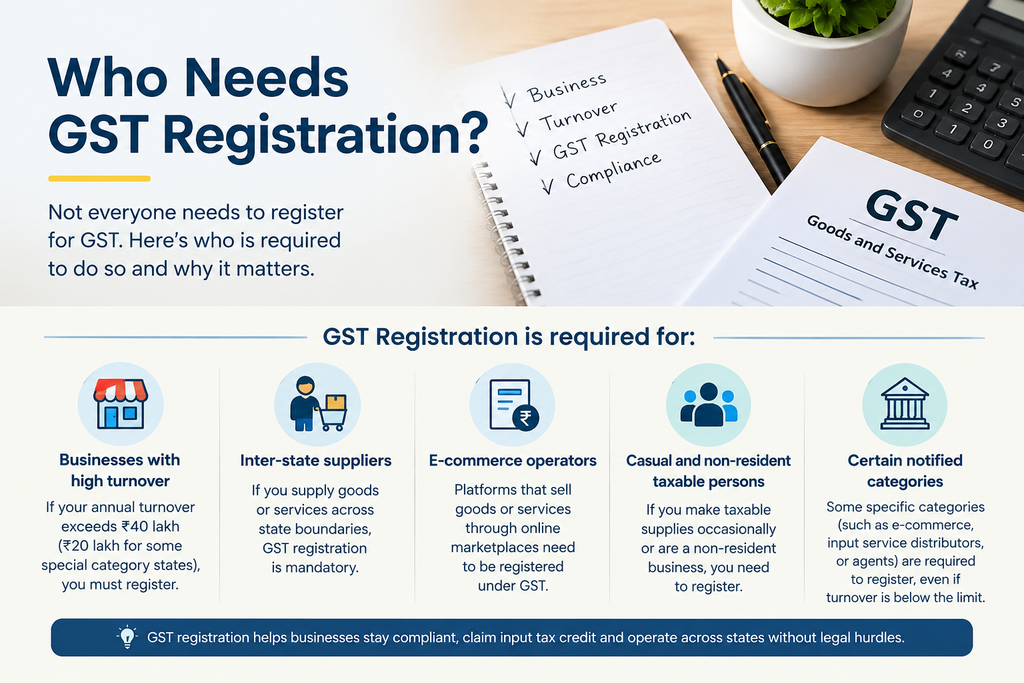
We need GST registration when our yearly turnover goes above a set limit .But some time there are also some cases where you must register even with very low turnover GST registration is required for many businesses in India. But it does not mean that every small business has to register from the beginning. In most cases, it depends on the business’s yearly turnover and the type of work it does.
Turnover-Based Thresholds
GST registration depends primarily on aggregate turnover, which includes all taxable supplies, exempt supplies, exports, and inter-state supplies under the same PAN, computed on an all-India basis.These limits are not the same for every business. They can change depending on the state and the type of goods or services being supplied. It excludes GST itself and inward supplies under reverse charge .However, there are also some situations where registration can become compulsory even if the turnover is below the threshold.
# Goods suppliers: Mandatory registration if annual turnover exceeds ₹40 lakh (₹20 lakh in special category states like Arunachal Pradesh, Manipur, Mizoram, Nagaland, Puducherry, Sikkim, Telangana, Tripura, and Uttarakhand) .
# Service providers: Mandatory registration if annual turnover exceeds ₹20 lakh (₹10 lakh in special category states).
# Composition scheme thresholds: Small businesses under the composition scheme have higher limits, e.g., ₹1.5 crore for goods and ₹50 lakh for services
Turnover here means all your sales added together, including exempt sales and exports. This stops people from avoiding registration by splitting their income.
Some businesses have to register for GST even if their turnover is below the usual limit.
- People who sell goods to another state (inter-state supply of goods)
- Sellers who sell through e-commerce platforms like Amazon or Flipkart, and the platform operators themselves
- People who must pay tax under reverse charge
- Casual taxable persons (for example, someone who sets up a temporary stall at a fair)
- Non-resident taxable persons
- People who must deduct tax at source (TDS/TCS)
- Input service distributors
Voluntary Registration
Even if you are below the limit, you can register if you want to. The main benefit is that you can claim input tax credit , Interstate sales, Credibility, Marketplace onboarding and buyers (especially other businesses) will trust you more.
Voluntary registration can be cancelled after one year, subject to conditions. It is most beneficial when a business needs ITC, plans interstate expansion, or works with GST‑registered clients. It is optional but can provide business advantages.
What happens if you don’t register ?
If you cross the limit and don’t register, you can face penalties and interest. incorpx.
The rules can differ for special cases, so it’s worth checking on the official GST portal (gst.gov.in) or with a tax professional before you decide.
GST registration mainly depends on the turnover of a business, but there are some exceptions. The ₹20 lakh threshold is generally relevant to many service providers, while the ₹40 lakh threshold applies to eligible suppliers of goods in many states. Businesses should also check whether their activities fall under any category where registration is mandatory.
Understanding these basic rules can help a business know when it needs to register for GST and avoid problems later.
References
[1] Central Board of Indirect Taxes and Customs (CBIC), “The Central Goods and Services Tax Act, 2017—Chapter VI: Registration,” Government of India. [Online]. Available: CBIC – CGST Act. [Accessed: Sep. 28, 2026].
[2] Central Board of Indirect Taxes and Customs (CBIC), “Frequently Asked Questions: Registration,” Government of India. [Online]. Available: CBIC GST FAQs. [Accessed: Sep. 28, 2026].
[3] Central Board of Indirect Taxes and Customs (CBIC), “New FAQs on GST,” Government of India. [Online]. Available: CBIC GST FAQs – Aggregate Turnover and Registration. [Accessed: Sep. 28, 2026].
[4] Central Board of Indirect Taxes and Customs (CBIC), “Sectoral FAQs: Registration,” Government of India. [Online]. Available: CBIC Sectoral FAQs. [Accessed: Sep. 28, 2026].