
Things That Actually Decide Your GST Registration Turnaround Time
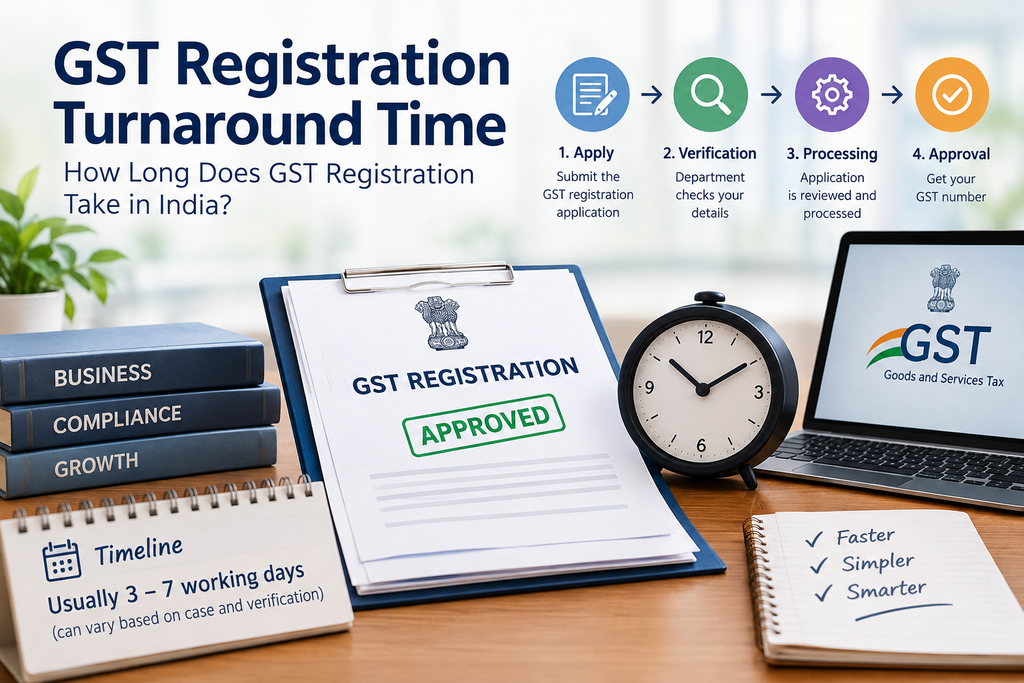
Source – ChatGPT
If you have just applied for GST and are refreshing the portal every hour wondering how long does GST registration actually take, you’re not alone; it’s generally the single most asked question by business owners in India right now. The honest answer is: it depends, but not in an unclear way. There are specific, identifiable factors that determine whether your GSTIN lands in your inbox in three days or drags on for three weeks. Understanding GST registration turnaround time and how to track it properly through ARN verification can save a lot of unnecessary stress. Here’s what actually moves the needle.
1. A Standard Timeline Isn’t Fixed It’s a Range
Most people expect a single number, but GST registration doesn’t work that way. Under normal conditions, with no red flags in your application, a GST registration application is
generally processed within 3-7 working days of submission. That’s the baseline most applicants should plan around. But that number can stretch considerably depending on what happens after you hit submit which is exactly why the next few points matter more than the headline figure.
2. Your ARN Is the Real Tracker, Not Your GSTIN
The moment you submit your application, the portal doesn’t give you a GST number right away, but it gives you a number called an ARN. The Application Reference Number is a unique 15 digit code generated after you successfully submit your GST registration form on the official GST portal, and it functions as your acknowledgment of submission, your tracking ID, and your reference number for any clarification requests, all rolled into one. This is where ARN verification becomes essential because it’s the only reliable way to know where your application actually stands, rather than guessing based on how many days have passed.
3. Checking ARN Status Is Simpler Than Most People Think
A lot of applicants don’t realise that we don’t even have to login to the GST portal to track your application. You can track status without logging in the GST portal using the ARN, or via SMS by sending “Status ARN” to 14409 from your registered mobile number. Logging in gives you more detailed remarks, downloadable notices but for a quick check, the SMS route or the public tracker works just fine and takes under a minute.
4. Not All ARN Statuses Mean the Same Thing
Once you start tracking, you will notice your ARN moves through distinct stages, and each one tells a different story about your timeline. Common status updates include Pending for Processing,Site Verification Assigned, Pending for Clarification, Approved and Rejected, each requiring a specific action from the applicant. Pending for Processing simply means you’re in the queue and nothing to worry about yet. Site Verification Assigned or Pending for Clarification are the two stages that actually extend your turnaround time.
5. Clarification Requests Are the Single Biggest Delay Factor
If your GST registration is taking longer than a week, there is a chance that a clarification notice is the reason for the delay . Approvals typically take 3 to 7 working days, extending to 15 to 20 days if clarifications or verification are required. This usually happens because of a mismatch in documents, an incomplete address proof or a variance between your PAN details and what you have entered in the application. The good news is that this delay is largely within your control and when you respond quickly and with the right documents it is often the difference between a two week delay and a two month one.
6. High Risk Applications Get Extra Scrutiny And That’s Deliberate
Not every application is treated similarly, and that’s by design, not by accident. GST authorities run every application through a risk rating system, and officers are expected to pay special attention to cases where a “High” risk rating has been assigned to an ARN, including situations where the applicant’s PAN has a history of cancelled or suspended registration elsewhere. Separately, GSTN has clarified that applicants who have completed Aadhaar authentication but are identified for detailed verification based on their risk profile will need to wait up to 30 days from the application date to complete the registration process. If your application falls into this category, a longer wait doesn’t necessarily mean something’s wrong, it usually means the system has simply flagged it for closer review.
7. Physical Verification Can Add Real Time to the Clock
In certain cases, particularly where Aadhaar authentication alone doesn’t fully satisfy the officer, an actual site visit gets triggered. Officers are permitted to arrange physical verification of the business premises in a time bound manner when it’s essential to confirm the applicant’s authenticity. If this happens to you, keep your business premises easily identifiable and with a visible signboard, an accessible address, and someone available to receive the officer, since a failed visit is one of the most common (and entirely avoidable) causes of extended delays.
How to Keep Your Turnaround Time on the Shorter End
None of this is left entirely to chance. A clean, accurate application with matching PAN and Aadhaar details, correctly formatted address proof, and a promptly answered
clarification notice will almost always land you inside that standard 3 to 7 working day window. The applicants who end up waiting three or four weeks are, more often than not, the ones who either submitted mismatched documents or missed a clarification deadline because they weren’t actively tracking their ARN.
So if you’re in mid application right now, the practical move is simple, save your ARN the moment you get it, check its status every couple of days using the SMS shortcut or the portal tracker, and if a clarification notice does land in your inbox, treat it as urgent rather than optional. That single habit of staying on top of ARN verification instead of just waiting passively is usually what separates a smooth week-long registration from a frustrating month-long one.
References
[1] How to Check GST Registration Status & GST Application ARN Status, ClearTax, updated Jun. 5, 2025. Available: https://cleartax.in/s/gst-registration-application-arn-status
[2] Quick Summary: GST Status Check by ARN,” Cashfree Payments. Available: https://www.cashfree.com/blog/gst-status-check-by-arn/
[3] How to Check GST Registration and ARN Status, TaxGuru. Available: https://taxguru.in/?p=1025051
[4] EY Tax Alert: CBIC Issues Guidelines for Processing of Applications for Registration Under GST, EY India. Available: https://ey.com/content/dam/ey-unified-site/ey-com/en-in/technical/alerts-hub/documents/ey-cbic-issues-guidelines-for-processing-of-applications-for-registration-under-gst.pdf