Source: ChatGPT (OpenAI)
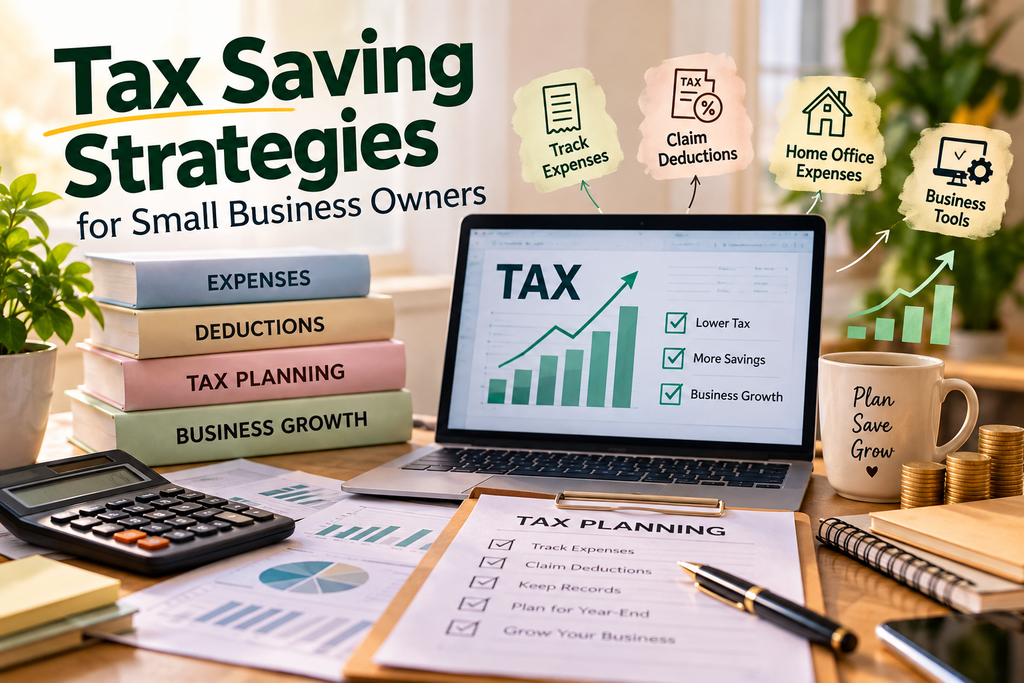
Tax saving strategies for small business owners include tracking business expenses, claiming eligible deductions, separating personal and business finances, and maintaining accurate financial records.
Do you feel that a significant portion of your small business’s profits is going to taxes?
Every year you pay more taxes just because you don’t know about the legal ways to save taxes. If you knew how to save taxes legally, you could save a lot of taxes every year.
Most small businesses concentrate on operations and sales, and skip tax planning. Therefore, they pay a large portion of their profits in taxes. But if you make a plan for legal tax savings you may be able to save a lot of tax.
Table of Contents
Why Do Small Businesses Often Pay More Tax Than Necessary?
There are a few reasons why small businesses often end up paying more taxes. Keep receipts or bills, they are proof of these and without them many expenses cannot be claimed back. Another reason is the mixing of personal and business expenses, when purchases made for personal use are included as business expenses, making it difficult to isolate actual business costs later.
Many businesses only consider taxes at the end of the financial year (in March) and so do any planning at the last minute, missing out on a range of deductions and savings. So tax
planning all along the year is way more beneficial. You may keep receipts or invoices, but if the transaction history is not organized, the records are useless. If you don’t organize your records, you may end up with an inflated amount of taxable income.
If these mistakes are driving up your tax liability, what tax planning strategies should you adopt for the upcoming financial year to reduce your tax burden?
Tax Saving Strategies for Small Business Owners
- Track Every Business Expense
Small business expenses equal big tax savings. It is important to keep a daily or weekly record of all business expenses like office supplies, internet bills, travel expenses, power bills, stationery, etc. Maintaining a record of income and expenses in an organized manner is very helpful in calculating taxable income and saving taxes.
Accurate bookkeeping helps small business owners monitor cash flow, organise expenses, and prepare their financial records for tax filing.
- Claim Eligible Business Expense Deductions
You can deduct some basic expenses from your income when calculating your taxes. These include rent, electricity, internet bills, salaries for your employees, marketing/advertising, software subscriptions (e.g. Canva, accounting software, MS Office) and professional fees (e.g. for a CA or lawyer). This lowers your taxable income and, therefore, your tax bill. But only claim the expenses you actually have for business reasons.
- Separate Personal and Business Finances
Many small businesses tend to ignore this and mix personal expenses such as groceries, shopping or personal recharge of mobiles with business expenses, which affects their taxes. Use a separate bank account and credit/debit card for the business and track every business transaction separately. It makes for easier bookkeeping and it makes it easier to locate deductible business expenses.
- Use Home Office Expenses If Eligible
But this deduction is only available if a specific area of the home is used regularly and exclusively for business purposes. If you also use that same room for personal purposes, the deduction may not apply. Some examples of eligible home office expenses include internet bills, electricity bills, a portion of rent or home maintenance costs related to business use, office furniture, and workspace maintenance. Properly recording and maintaining records of home office expenses can help reduce your tax liability.
- Software, Marketing and Professional Services Deduction
Business owners also use a lot of online tools that are subscription-based like Canva Pro, Microsoft Office, accounting software, website hosting and Facebook/ Google ads. If you use these tools only for your business, the cost of the tools is a business expense, so be sure to keep the bills or subscription invoices for the tools.
- Buy Business Equipment Before Year-End
Purchase the required equipment like a laptop, printer, office furniture, and business equipment before the financial year closes. A tax planning strategy can be done. Eligible purchases can reduce the taxable income for the current year.
- Keep Digital Records for Every Transaction
It is easier to prepare your tax return if you keep track of every payment, purchase and sale. Digital records allow for a more accurate tracking of expenses and income. Keep a track of receipts, invoices (pdf or photo), bank statements, UPI/payment confirmations, GST invoices (if applicable) and bills for software subscriptions. This is the proof for you to claim your business expenses deductions.
Reference
[1] IDFC FIRST Bank, “How Tax Planning Helps Business Owners Boost Profits,” FINFIRST Blogs, Apr. 19, 2025. [Online]. Available: https://www.idfcfirstbank.com/finfirst-blogs/finance/tax-planning-for-entrepreneurs
[2] City National Bank, “Small Business Tax Planning Strategies,” City National Bank Insights. [Online]. Available: https://www.cnb.com/business-banking/insights/small-business-tax-planning-strategies.html
[3] Groww, “Best 10 Tax Saving Tips for an Entrepreneur,” Groww Blog, Jul. 12, 2024. [Online]. Available: https://groww.in/blog/best-tax-saving-tips-for-an-entrepreneur
Plagiarism Report:

Grammar Report: