Why Tax Compliance Matters Early
A tax compliance checklist for startups helps founders in India organise registrations, track tax payment deadlines, file returns on time, and maintain accurate financial records.
A missed date can cost more than the tax itself.
Most founders think about product and funding first, and taxes only come up around month eight, when an email from the accountant lands. That’s usually where the trouble starts. Indian tax rules run on fixed dates, and penalties don’t care whether you’re a five-person team or a big company. This checklist covers registrations, advance tax, TDS and the monthly filings, plus a simple calendar you can keep handy.
Sort Out the Registrations First
Paperwork comes before the first invoice.
Before you earn or pay anyone, make sure these are in place:
- PAN for the company, and a TAN if you’ll deduct TDS on salaries or vendor payments.
- GST registration once turnover crosses the threshold, or earlier if you sell across states.
- PF and ESI registration once your headcount reaches the limits.
- Startup India recognition, if you qualify, since it may open up tax benefits.
- A separate business bank account, so the books stay clean.
Do these early. Fixing a missing TAN after three months of salary payments is a headache nobody needs.
Advance Tax: Pay as You Earn
Don’t wait for March to settle the bill.
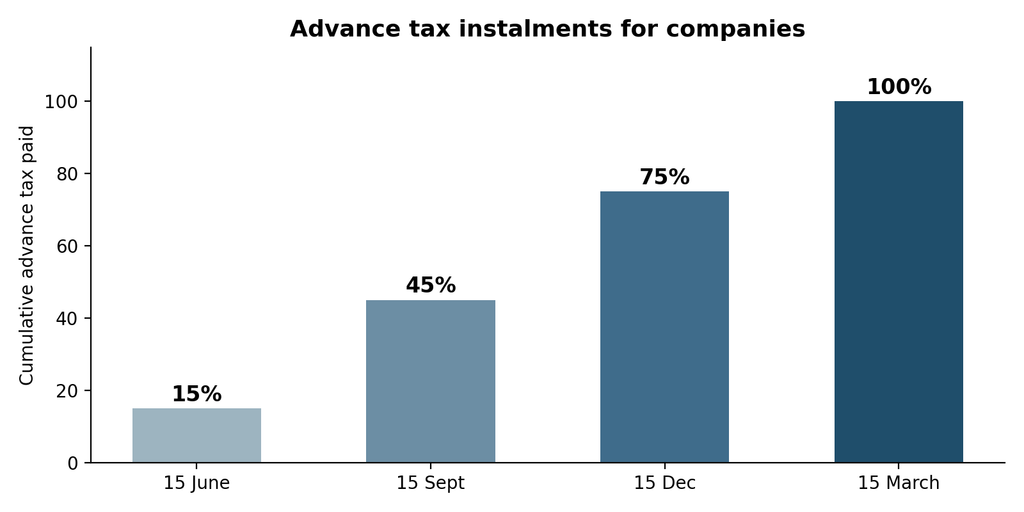
If your estimated tax for the year is ₹10,000 or more, you generally pay it in instalments during the year instead of one lump sum. For most companies that means 15% by 15 June, 45% by 15 September, 75% by 15 December and the full amount by 15 March. The figures are cumulative, so the September payment is just the gap between 45% and what you already paid.
Early-stage startups often run at a loss, so this can feel irrelevant. It stops being irrelevant once you turn profitable or earn decent interest on the funding sitting in your account. A shortfall attracts interest. Also note that the Income-tax Act, 2025 has renumbered the old sections, so check the current one when your CA quotes a number.
TDS: Deduct, Deposit, Report
Three steps, and each has its own deadline.
Once you pay salaries, rent, contractor bills or professional fees above the set limits, you have to cut tax at source. Then comes the part people mix up. The tax must be deposited by the 7th of the following month (30 April for March). Separately, the quarterly return is due on 31 July, 31 October, 31 January and 31 May, using Form 24Q for salaries and Form 26Q for other payments to residents.
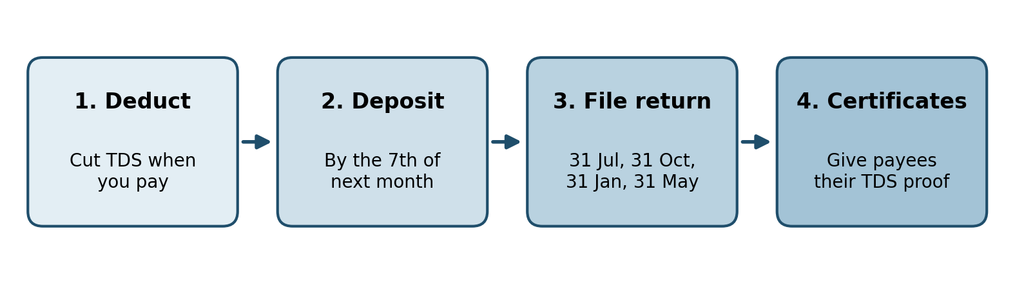
Depositing the money doesn’t mean the return is filed. Late deposit attracts 1.5% interest per month, and a late return costs ₹200 per day, capped at the TDS amount. The expense itself can also be partly disallowed in your own return if TDS wasn’t deducted or paid.
GST and Other Monthly Filings
The routine that never really stops.
Regular GST filers submit GSTR-1 (sales details) by the 11th and GSTR-3B (summary and payment) by the 20th of the next month. Even a month with no sales needs a nil return. PF and ESI contributions are generally due by the 15th. Put all of it in a shared calendar with reminders two days ahead.
Tax Compliance Checklist for Startups: Important Due Dates
One page, the whole year.
| When | What is due |
| 7th of every month | Deposit TDS (30 April for March) |
| 11th / 20th of every month | GSTR-1 / GSTR-3B |
| 15th of every month | PF and ESI contributions |
| 15 Jun, 15 Sep, 15 Dec, 15 Mar | Advance tax instalments |
| 31 Jul, 31 Oct, 31 Jan, 31 May | Quarterly TDS returns |
Quick Monthly Checklist
Tick these off before the month closes.
- Deduct TDS on every eligible payment.
- Deposit it by the 7th.
- File GST returns, even for nil months.
- Match purchase invoices with your GST portal data.
- Keep invoices, challans and bank statements in one folder.
- Recheck your profit estimate each quarter for advance tax.
Maintaining accurate financial records helps startups monitor expenses, prepare tax returns, and manage business finances effectively.
Mistakes Founders Keep Making
Learn from other people’s penalties.
The usual ones: mixing personal and company spending, skipping TDS on small vendor payments, ignoring nil returns, and assuming the accountant will remember everything. Don’t lean on old blog posts for dates either. Rules change, so confirm on the official portals before filing.
Final Thoughts
Boring habits protect the business.
Tax compliance won’t win you customers, but ignoring it drains cash you’d rather spend on growth. Set the calendar, give one person ownership, and review it every quarter. This is general information, not professional advice, so confirm the details with a chartered accountant.
References
Sources used for this checklist.
[1] Startup India, “Startup India,” Government of India. [Online]. Available: https://www.startupindia.gov.in/
[2] Income Tax Department, “Instalments of advance tax and due dates (Section 408),” Income Tax Department, Government of India. [Online]. Available: https://www.incometaxindia.gov.in/w/section
[3] Income Tax Department, “What are the due dates for payment of advance tax?,” Income Tax Department, Government of India. [Online]. Available: https://www.incometaxindia.gov.in/w/what-are-the-due-dates-for-payment-of-advance-tax-
[4] Virtual Accounting, “Founders: Don’t Miss The Last Date To Deposit TDS,” Virtual Accounting. [Online]. Available: https://www.aiaccountant.com/blog/last-date-to-deposit-tds
[5] TDSMAN, “TDS / TCS – Deposit & Filing of Returns,” TDSMAN Blog. [Online]. Available: https://blog.tdsman.com/s-tcs-annual-compliance-calendar/
[6] GSTN, “Goods and Services Tax Portal,” GST Portal. [Online]. Available: https://www.gst.gov.in/
[7] EPFO, “Employees’ Provident Fund Organisation,” EPFO. [Online]. Available: https://www.epfindia.gov.in/
Reports