7 Essential ITR-6 Filing Checks Companies Should Complete Before the Deadline
ITR-6 filing is an important compliance requirement for companies that are required to submit an income tax return and are not claiming exemption under Section 11.
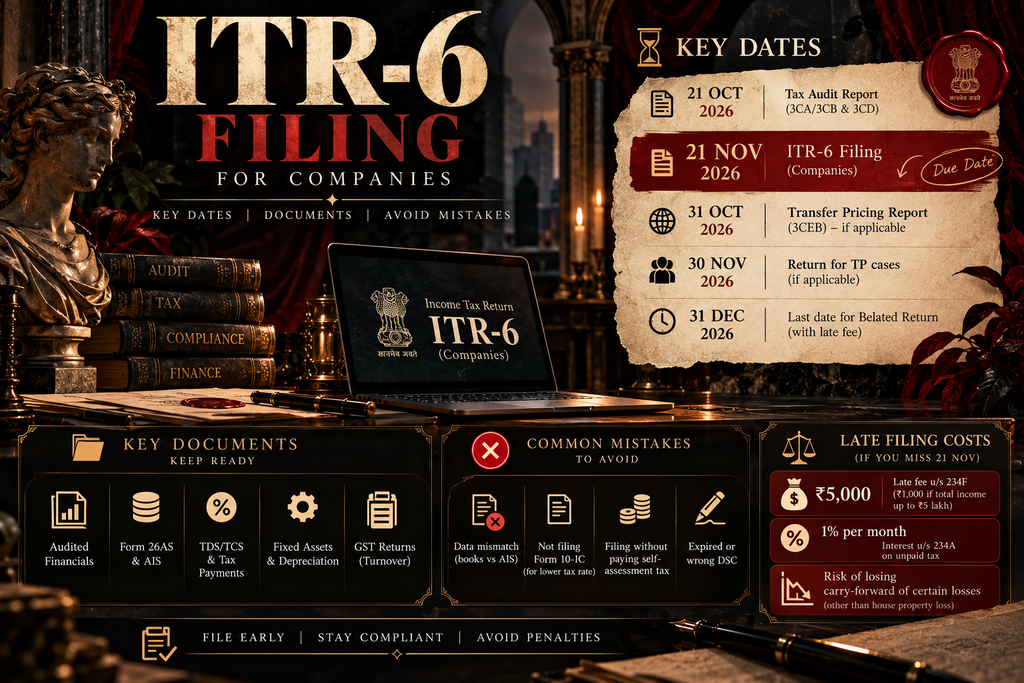
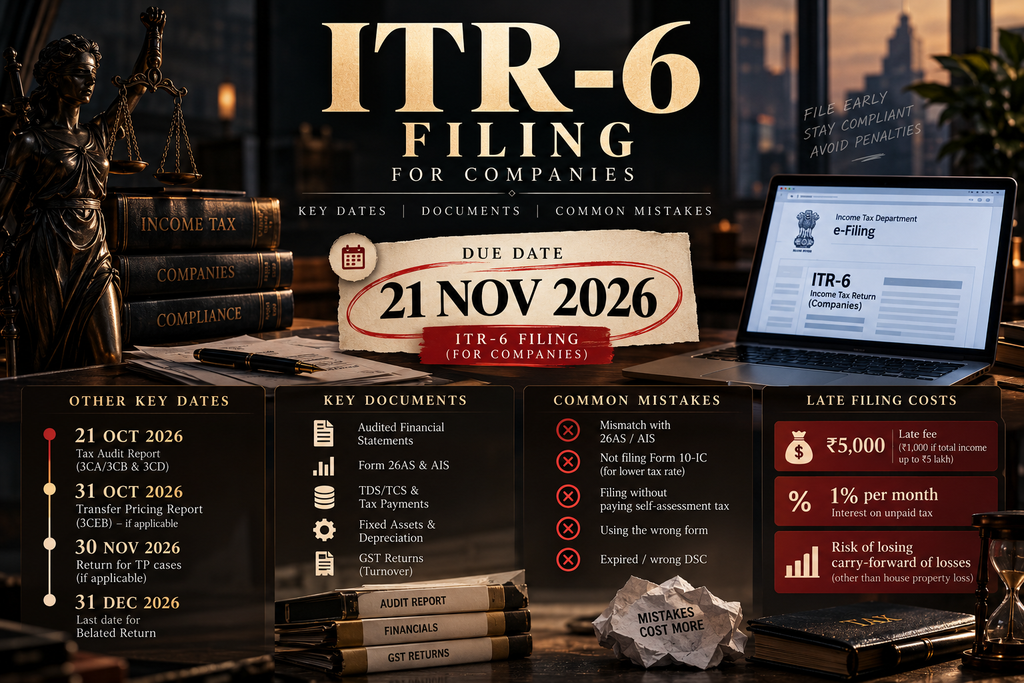
Companies typically utilise ITR-6 to make their income declaration for the year. For Assessment Year 2026-27 (FY 2025-26), the new due date for Company ITR is 21st November 2026. This was moved from 31st October after the tax audit report was moved from 30th September to 21st October by CBDT. In this article I will talk about important dates, docs to keep ready for submission, common mistakes to avoid and a simple 3 Week Plan to submit it within due time which is 21st November.
Important dates:
- 21 October 2026: revised due date for the tax audit report (Forms 3CA/3CB and 3CD), moved from 30 September.
- 21 November 2026: revised due date for ITR-6 filing, moved from 31 October.
- Transfer pricing cases: if the company must furnish a Section 92E report (Form 3CEB), this extension does not apply. The report stays due on 31 October and the return on 30 November 2026.
- 31 December 2026: The last date for a belated return under Section 139(4), at a cost.
Documents to keep ready:
Before filing, make sure you have the following documents and details handy:
- The company’s audited balance sheet, profit and loss statement, and related notes.
- Form 26AS, AIS and TIS to check the tax-related information.
- TDS and TCS certificates, along with advance tax and self-assessment tax payment challans.
- Details of fixed assets, depreciation and any losses carried forward from previous years.
- GST returns and a turnover statement to match the figures with the company’s books.
- MAT calculation and credit details, wherever applicable.
- Form 3CEB, if the company has international or specified domestic transactions.
- Basic company details, including CIN, directors’ DINs and bank account details (DSC) for filing the return.
Common mistakes to avoid
Some of the common mistakes I think companies make, and if it’s avoided then it saves a lot of stress are as follows:
- It’s a mistake when books and portal data doesnt match with each other. If income or TDS in the AIS and Form 26AS differs from your books, you can end up with a short credit for tax or a mismatch notice. Reconcile before filing, not after an intimation arrives.
- Forgetting Form 10-IC. A company that wants the lower tax rate under Section 115BAA must exercise the option through Form 10-IC by the return due date. Without it, normal rates apply.
- Filing without paying self-assessment tax is another common mistake A return filed without the tax and interest due can be treated as defective.
- Using the wrong form is a mistake. Like the Companies claiming exemption under Section 11 file ITR-7, not ITR-6.
- Ignoring tax audit disclosures. Disallowances reported in Form 3CD, such as MSME payables beyond the Section 43B(h) limit, must flow into your computation. A gap between the audit report and return invites questions.
- An expired DSC. A return that is not verified is treated as not filed, so test the certificate well before the deadline.
The above mentioned points are some of the common mistakes, I mentioned, that needs to be avoided.
What it costs to miss 21 November
If anyone misses a belated return, then it can still be filed until 31 December 2026, but it comes with a late fee under Section 234F (₹5,000, or ₹1,000 where total income is up to ₹5 lakh), interest under Section 234A at 1 per cent per month on unpaid tax, and the risk to loss carry-forward as described above. So it is really recommended that everyone should submit it within the due date which is 21st November.
A simple three-week plan
Here’s a simple 3 week plan to submit within due time:-
- First Week: Close the books & reconcile ledgers with Form 26AS, AIS and GST returns.
- Second Week : Make tax computation final, check Section 115BAA and MAT position, and pay for any self-assessment tax.
- Third Week : Upload the return, verify it with the DSC, and keep a buffer in case the portal is slow near the deadline.
The bottom line
It is not common to have issues while completing your ITR-6 as long as you don’t make any major errors. Issues occur due to small discrepancies which appear at the last minute. If you plan ahead, ensure you have all the documents listed above in one folder and respect the Company ITR deadline of 21st November 2026 then you will definitely save on any extra fees, interest and stress.
Corporate tax compliance helps businesses maintain accurate financial records, meet statutory deadlines and avoid unnecessary filing penalties.
Reference:
CBDT Press Release PDF (via ABCAus): https://abcaus.in/wp-content/uploads/2026/09/CBDT-extends-due-date-for-furnishing-Return-of-Income-for-AY-2026-27.pdf
TaxGuru: https://taxguru.in/?p=1083337
All India Radio (newsonair): https://newsonair.gov.in/cbdt-extends-i-t-return-filing-deadline-for-audit-cases-to-november-21/
CareerIndia (Circular No. 07/2026): https://www.careerindia.com/news/cbdt-extends-tax-audit-and-itr-deadlines-for-ay-2026-27-new-due-dates-011-66407.html
StudyCafe: https://studycafe.in/cbdt-extends-due-dates-for-audit-itr-and-tar-filing-for-ay-2026-27-427200.html
CalcGuru: https://calcguru.in/?p=8612
Patron Accounting: https://www.patronaccounting.com/blog/belated-itr-filing-penalty-section-234f