
( Source of image : CHATGPT )
Careers in Foreign Trade and Logistics
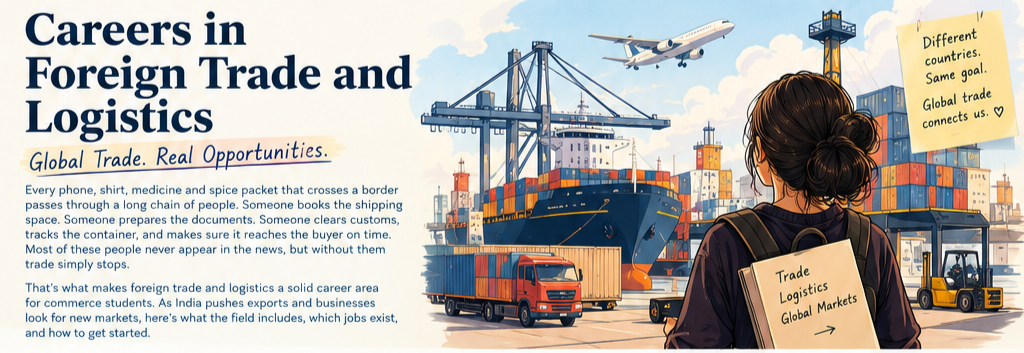
Every phone, shirt, medicine and spice packet that crosses a border passes through a long chain of people. Someone books the shipping space. Someone prepares the documents. Someone clears customs, tracks the container, and makes sure it reaches the buyer on time. Most of these people never appear in the news, but without them trade simply stops.
That’s what makes foreign trade and logistics a solid career area for commerce students. As India pushes exports and businesses look for new markets, trade roles tend to follow. Here’s what the field includes, which jobs exist, and how to get started.
What Foreign Trade and Logistics Actually Means
Foreign trade is the buying and selling of goods and services across countries, which means exports and imports. Logistics is the machinery that moves it all: transport, warehousing, documentation, customs and delivery.
The two are closely linked. An exporter can have a great product and a willing buyer, but if the paperwork is wrong or the shipment is delayed, the deal can fall apart. Companies need people who understand both the trade rules and the movement of goods.
Why Trade Roles Tie to Export Growth
When exports grow, the work grows with them. More shipments mean more documentation, more freight bookings, more customs clearances and more warehousing. Businesses that enter new markets also need people to handle compliance, buyer coordination and payments.
Government focus on exports, new trade agreements and the rise of e-commerce exporting have all added to this demand. It’s a field where hiring tends to rise and fall with how trade is doing, so it helps to follow trade news as you build your career.
For official information on India’s foreign trade policies and export procedures, visit the Directorate General of Foreign Trade (DGFT) website.
Roles You Can Aim For :
| Role | What you’d do |
| Export-import executive | Handle orders, documents, buyer coordination and shipment follow-up |
| Documentation executive | Prepare invoices, packing lists, shipping bills, certificates of origin |
| Customs / CHA executive | Work on customs clearance, duty classification and compliance (often with a Customs House Agent) |
| Freight forwarding executive | Book cargo space, coordinate carriers and track shipments |
| Logistics / supply chain executive | Plan transport, manage warehouses and keep deliveries on schedule |
| Procurement / sourcing executive | Find suppliers, negotiate and manage purchasing |
| Trade finance executive | Handle letters of credit, bank documents and export payments |
| Export marketing / business development | Find overseas buyers and build market relationships |
Many people start in documentation or operations and move into planning, management or specialist roles after a few years.
Skills That Help You Stand Out
Knowledge skills. Learn the basics of export-import procedures, Incoterms (the standard terms that decide who pays for what during shipping), customs and HS codes, and how letters of credit work. Understanding GST on exports and the main export promotion schemes is useful too.
Practical skills. Excel, clear email writing, attention to detail and comfort with documents. A small error in an invoice or shipping bill can hold up a shipment, so accuracy is valued more than people expect.
People skills. Trade involves constant coordination with suppliers, transporters, banks and overseas buyers across time zones. Calm communication and quick follow-up make you the person others rely on.
How to Get Started
Commerce, business, economics and management students are all a natural fit, but you don’t need a perfect background. A few practical steps help:
- Learn the basics early. Take a short course in export-import management, logistics or supply chain. Look at the Incoterms and the standard shipping documents.
- Look for internships. Freight forwarders, CHAs, exporters and logistics companies often take interns, and even a short stint teaches you how things actually work.
- Follow trade news. Know which sectors are exporting more, which markets are growing, and what policy changes are happening.
- Build a simple project. For example, map out the steps and documents involved in exporting a product to another country. It shows initiative and makes interview answers concrete.
- Connect with people in the field. Alumni, LinkedIn contacts and industry events can open doors faster than blind applications.
- Explore our career guidance resources. Discover more opportunities and develop industry-relevant skills.
Things to Know Before You Choose This Path
It’s a practical, detail-heavy field. Deadlines can be tight, especially when a shipment is waiting at a port. Hours can be irregular at times, and problems like delays or documentation errors need quick thinking. If you enjoy solving real-world puzzles and seeing goods actually move because of your work, that’s often part of the appeal.
Pay and growth vary by company, role and city, so it’s worth speaking to people already working in the sector rather than relying on a single number.
For Colleges and Institutions
Trade and logistics education works best when it’s close to the real thing. Colleges can invite industry practitioners for sessions, arrange visits to ports, warehouses or logistics hubs, and tie students up with freight and export companies for internships. Hands-on exposure, such as filling mock shipping documents or working through a sample export order, helps students move into jobs with more confidence.
FAQs
Which degree is best for foreign trade and logistics?
Commerce, business administration, economics and supply chain programmes are common routes, but people from other backgrounds can enter with the right skills and courses.
Do I need a certification?
It isn’t always compulsory, but short courses in export-import, logistics or customs procedures can help you stand out, especially for entry-level roles.
Is this a good career for freshers?
Yes. Documentation, operations and coordination roles are common starting points, and you learn quickly on the job.
What skills matter most?
Accuracy, knowledge of trade documents and Incoterms, Excel, communication and the ability to handle deadlines calmly.
Can I start my own export business later?
Many people do. Working in the field first gives you practical knowledge of buyers, suppliers, compliance and logistics, which helps if you start your own venture.
Final Thoughts
Foreign trade and logistics is a career built on real movement: goods, documents, money and deadlines. As exports grow, the need for capable, detail-oriented people grows with them. Start with the fundamentals, get some hands-on exposure, and keep an eye on where trade is heading. At Eve Consultancy, we help students, institutions and employers with career guidance, skill building and practical industry insights.