Introduction
IAM for startups is essential for protecting business applications, employee accounts and sensitive information from unauthorised access, even when IT budgets are limited.
Cybersecurity is a must-have for startups of all sizes in today’s digital business world. As more and more companies transition to the cloud and apply online collaboration and use of digital customer information, it’s a big issue to understand who is seeing what information. Identity and Access Management (IAM) is designed to keep the systems safe from unauthorized access of user and prevent them from accessing the resources that they are not authorized to access.
Startups with tighter budgets may find implementing IAM challenging, or even expensive. But, with proper tools and security methods, even small businesses can set up a reliable access management system even though they do not have to spend a lot of money.
5 Affordable IAM Best Practices for Startups
Any policies, technologies or processes used to manage digital identities and control access to applications, systems and data. It’s capable of verifying the identity of users and identifying what resources they can be allowed to access.
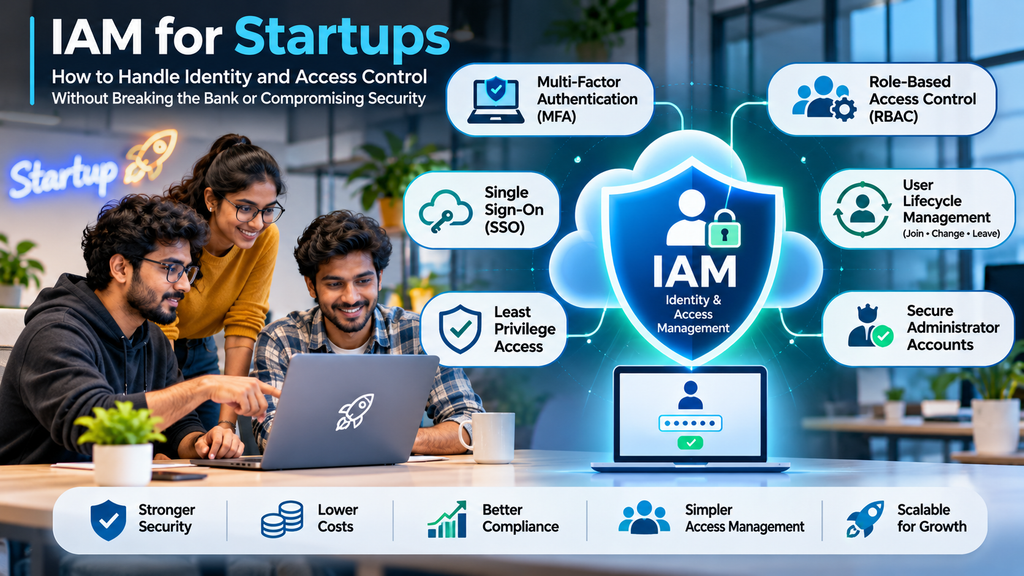
The robust IAM system will include multi-factor authentication, role based access control, single sign-on and user lifecycle management. These are designed to prevent unauthorized access, compromised accounts and data breaches.
For example, a startup may allow its finance team to access the accounting software, but not to access sensitive customer data which is not related to their role.
IAM is a must for startups. IAM is quite significant for start-ups.
Small teams, tight budgets on IT, and shifting job responsibilities are all a part of the startup environment. Several applications are available for staff to use, documents can be shared through the cloud, and staff can work remotely. This can result in a security risk if these activities are not controlled through access.
IAM can be a solution to some of the critical issues that can be faced by startups:
Authentication Controls: They help to prevent unauthorized access to business systems.
Decreased security risks: MFA provides an additional layer of authentication and will make stolen passwords less valuable to criminals.
Limited access permissions means that sensitive information won’t be exposed to the data of financial records, customers, or intellectual property.
Simplification of employee management: access can be granted while an employee is coming in and denied when the employee goes out.
Having robust access controls can help startups satisfy the security needs of enterprise clients and business partners.
Many larger companies are becoming aware of the cybersecurity of their suppliers and start-ups may even have to prove their systems meet the appropriate cyber security standards.
1.Making IAM solutions cost accessible to startups.
It isn’t necessary to have expensive enterprise software to provide a robust IAM environment. For startup companies, the first tools that they use can be added to to make the system more secure as the company expands.
Take advantage of the inbuilt identity management capabilities .Leverage identity management capabilities built-in.
Many cloud services and applications within an organization will include security within their own applications: such as MFA, user permissions, and administrator management. Existing subscriptions should be examined prior to buying more tools for startup companies.
For an organization using multiple cloud applications, an identity provider such as Microsoft Entra ID, Google Workspace or another suitable IAM application might be helpful to simplify user management. Specific features & pricing—Will vary by plan.
2. Enable Multi-Factor Authentication
Use MFA for emails, cloud storage, financial apps, administrator accounts, and for all business accounts. Passkeys, security keys and authentication apps will provide more security than passwords.
If feasible, especially for startups, phishing resistant admin and other high-risk account logins should be implemented.
3. Apply the policy of “least privilege”
All employees should only be granted what is required for their job. For example, a marketing employee may need to log in to the company’s advertising tools, but shouldn’t immediately be granted administrator access to the company’s financial systems.
These permissions can be simpler to control with role-based access control, and will be less damaging if compromised with a weak account.
4. Communicate the Clear Employee Access Process to all employees
It should be easy for employers at start-ups to hire and fire workers. Access should be provided to new employees, as appropriate, at the time of hire, and should be revoked when the employee no longer has a need for the access.
Frequent access reviews can help to find unused accounts, unneeded permissions and former contractors who might still have access to company resources.
5. Secure Administrator Accounts
Administrator accounts have a very large set of permissions – they need to be secured. Start-ups should avoid having too many administrators, use different accounts for regular and administrative uses and don’t share logins.
Additionally, recovery approaches should be protected and emergency access procedures be recorded.
These are some common mistakes when using IAM:
No matter how small your organization is, bad access management can compromise security. Common mistakes are employee sharing of passwords, unchecked access, failing to close out old employee accounts and insufficient checking of third party app access.
One of the common errors startups make is purchasing tools that they don’t need. A poor utilization of the complex system can result in unwanted expenses and issues.
Conclusion
One of the key aspects of a secure and trustworthy startup is its Identity and Access Management system. It protects business data, restricts access to it without permission and enables business security requirements.
Steps a startup should consider for implementing are enabling MFA, limiting permissions, securing administrator accounts and employee access management during the life cycle. Businesses can set up a cost-effective IAM strategy, one that expands as the business does, by selecting the right tools and by regularly checking the access.
The idea isn’t to spend the most money on a security platform, but to establish a uniform, maintainable security system to defend the company’s people, applications and information.
Startups adopting AI-powered applications should also understand LLM security and data protection to prevent unauthorised access and exposure of confidential business information.
REFRENCCES
1. NIST – Digital Identity Guidelines: NIST SP 800-63-4
Add this in the IAM definition or authentication section.
2. CISA – Implementing Phishing-Resistant MFA: CISA MFA guidance
Add this in the Multi-Factor Authentication section.
3. Microsoft – Microsoft Entra ID: Microsoft Entra ID
Add this in the affordable IAM solutions section.
4. Google Workspace – Security: Google Workspace Security
Add this in the built-in identity management section.
5. OWASP – Authorization Cheat Sheet: OWASP Authorization Cheat Sheet
Add this in the least-privilege section.