
Source: ChatGPT [ Open AI ]
Exam failure can feel discouraging after months of preparation, but one disappointing result does not define a student’s abilities, personal worth, or future opportunities.
For any business owner, keeping costs under control while making a reasonable profit is an everyday challenge. The price of raw materials, customer demand and competition all influence how a business performs. Taxes are another important part of this picture. With GST 2.0 bringing changes to India’s tax structure, businesses need to understand what these changes mean for their prices and profits.
1. Exam Failure: How to Learn From Mistakes and Move Forward
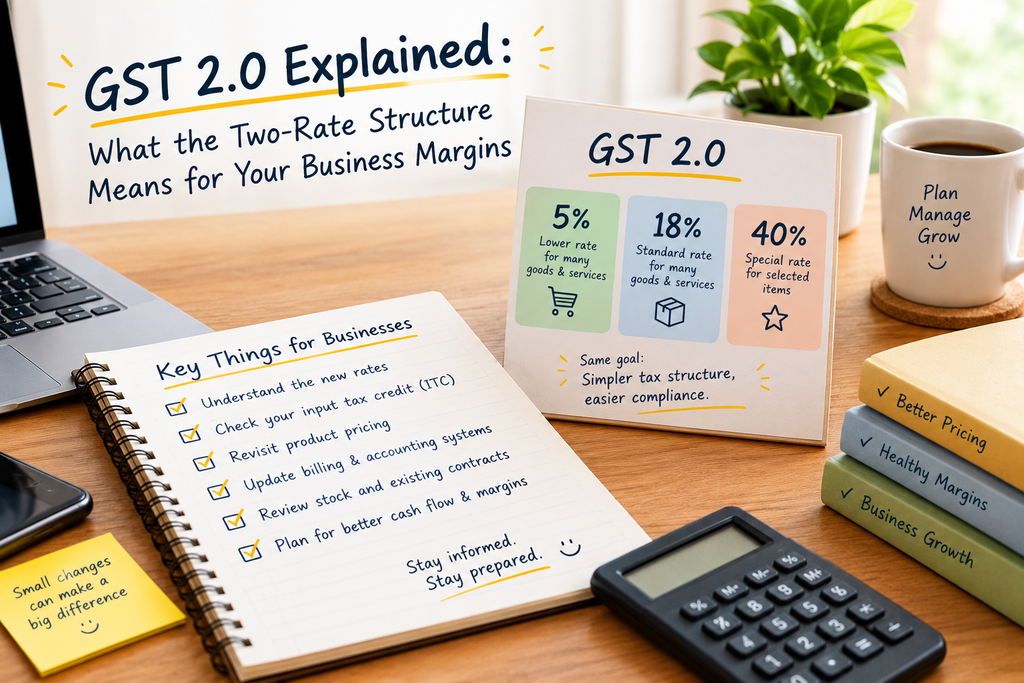
GST 2.0 introduced two main tax rates, 5% and 18%, for many goods and services, along with a special 40% rate for selected items. The revised rates came into effect on 22 September 2025. For businesses, this means checking the rates applicable to their products and updating their invoices and pricing wherever necessary.
2. Will Lower GST Put More Money in Your Pocket?
Not always. When GST decreases, a business may lower its selling price to make products more attractive to customers. This could help increase sales, but it may not necessarily increase the profit earned on each sale. The outcome depends on the business’s expenses, competition and how customers respond to the new prices.
3. Why Input Tax Credit Matters
GST is also paid on many business purchases, such as raw materials and packaging. Eligible registered businesses can claim Input Tax Credit (ITC) on qualifying purchases, subject to GST rules. However, when the tax on a finished product falls while the tax on its inputs remains higher, some businesses may accumulate unused credit. This can tie up working capital and make day-to-day financial management more difficult.
4. Finding the Right Selling Price
Consider a product priced at ₹1,000 before GST. At 18%, the customer pays ₹1,180. If the applicable GST rate falls to 5%, the final price becomes ₹1,050, provided the pre-tax price remains unchanged. This is a saving for the customer, but businesses must also consider their own expenses before deciding on a new price. A price that attracts more buyers is useful only if the business can still cover its costs.
5. Six Things Businesses Should Review
Businesses can make the transition easier by checking the correct GST rate for each product, recalculating profit margins, reviewing eligible input tax credits, updating billing systems, checking existing stock and informing customers about price changes. These steps may seem routine, but overlooking them can lead to billing mistakes or confusion later.
6. Planning Beyond GST
A change in tax rates is also a good time to take a closer look at business finances. Are certain products selling well? Are costs increasing? Are customers responding to price changes? Answering these questions can help business owners make better decisions. The benefits of GST 2.0 will vary across industries, so businesses should focus on what the changes mean for their own operations.
GST 2.0 may bring opportunities, but businesses will need more than a lower tax rate to improve their margins. They must understand their costs, price products carefully and keep track of eligible tax credits. In the end, good financial decisions come from knowing where the money is going and planning ahead. That is what can help a business remain competitive while keeping customers satisfied.
Students can use effective study techniques to review mistakes, strengthen weak topics, and build a more realistic preparation plan for their next exam.
References:
[1] GST 2.0 Explained: Changes, Transition, and Readiness, September 2025, Lexplosion [ Online ]
Available:
https://lexplosion.in/gst-2-0-explained-changes-transition-and-readiness
[2] GST 2.0 Reform 2025: Simplified Tax Slabs, Key Changes, and Industry Impact, Sage University, Bhopal [ Online ]
Available:
Reports:
AI Report

Plagiarism Report

Grammar Report
