The ROC annual compliance checklist helps companies in India track annual financial statement filings, annual returns, board reports, and applicable Registrar of Companies requirements.
INTRODUCTION: ROC Annual compliance is the mandatory annual submission of the financial statements and reports by registered companies to the Registrar of Companies (ROC) under the Ministry of Corporate Affairs (MCA) in India. The ROC checks the registrations, regulations and compliance of companies and Limited Liability Partnerships (LLPs) under the Companies Act, 2013. ROC annual filing is one of the most significant obligations for every registered company. Two of the most discussed annual filings are the AOC-4 and MGT-7.
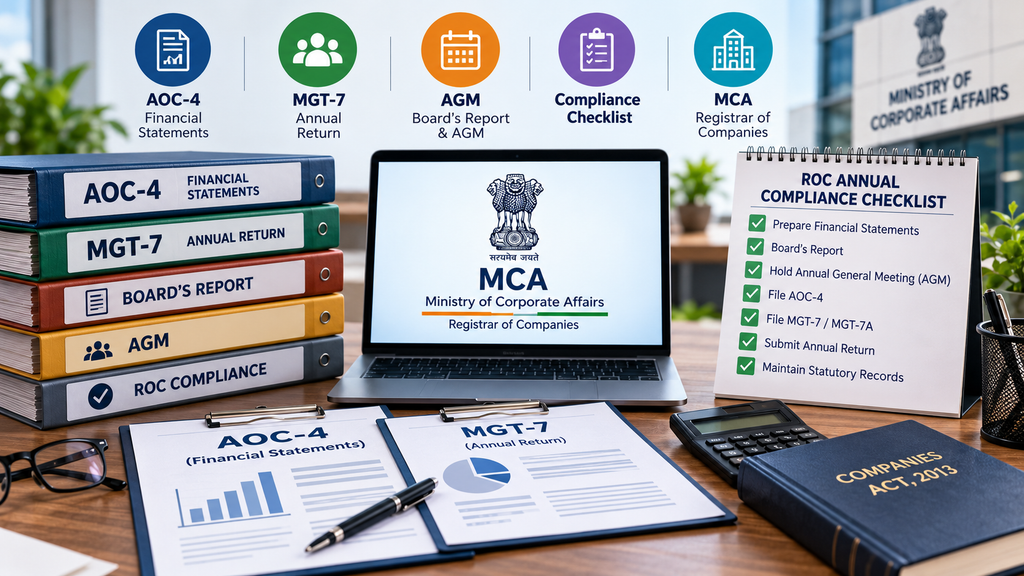
ROC Annual Compliance Checklist: Essential Filing Requirements
- It helps to regulate the formation, management and dissolution of companies under the LLP.
- It maintains accurate data and records and makes important company information accessible to stakeholders and the public, promoting trust.
- It safeguards investors by ensuring companies’ operational and financial information honestly.
- It legally recognises the companies and enables smooth and transparent business conduct with legal documentation.
BOARD’S REPORT AND ANNUAL GENERAL MEETING (AGM):
An annual general meeting and the Board’s report are core pillars of the annual ROC filings under the Companies Act, 2013.
The board’s report is prepared by the directors or the company’s financial performance, state of Affairs, corporate governance and extracts of annual returns. It should be reviewed and approved at a dedicated board meeting. The report should be attached to the financial statements when presented to shareholders and ultimately filed with the Registrar of Companies (ROC).
Whereas, the Annual General Meeting (AGM) must be held within 6 months from the close of the financial year, i.e 30th September. Not more than 15 months should elapse between the two AGMs. It involves considering the financial statements, the board’s report and appointing/re-appointing auditors or directors.
FILLING OF AOC-4:
AOC-4 is the statutory e-form under section 137 of the Companies Act, 2013. It is generally used to submit a company’s audited financial statements and reports to the Registrar of Companies (ROC). All registered private limited companies, public companies and One Person Companies (OPCs) in India should file the AOC-4 form, even if they have no active business operations.
Special Filing Variants (AOC-4XBRL)
Certain companies must file their financial statements in the specialised AOC-4 XBRL format under Rule 3 of the Companies Rules. Companies listed on any stock exchange in India and their Indian Subsidiaries. Companies with a paid-up capital of rupees 5 crore or more and turnover of 100 crore or more. Also, companies preparing their financial statements under Indian Accounting Standards (Ind AS).
FILING OF MGT-7 OR MGT-7A:
MGT-7 is an electronic annual return that registered companies in India must submit to the Registrar of Companies (ROC) under section 92 of the Companies Act, 2013. It provides a snapshot of the Company’s structure, management, and shareholding as of March 31st.
WHO NEEDS TO FILE MGT-7?
MGT-7 is mandatory for all the private limited and public limited companies, section 8 companies, producer companies and foreign companies operating in India.
One Person Companies (OPCs) and designated “small Companies” file the simpler Form MGT-7A.
It should be filed within 60 days from the annual General Meeting (AGM). Since the AGM must be held by September 30th the usual due date for filling MGT-7 is November 29th.
THE COMPLIANCE CHECKLIST:
Before completing the final ROC process, a company should check:
Financial statements and Audit completed
Boards’s Report and AGM
AOC-4 filed with prescribed period
MGT-7 filed within the given dates
Annual return filed with prescribed period
CONCLUSION:
ROC compliance is not limited to submitting forms on the MCA portal. It ensures a company’s financial and corporate records are accurate and consistent. AOC-4 focuses on company’s financial details while the MGT-7 provides information about the annual details of the company.
ROC is non-negotiable and required for all the active or dormant registered entities. It protects the core values by maintaining legal status and building institutional trust.
Understanding business tax compliance can help companies coordinate their annual filings and maintain accurate financial records.
REFERENCES-
[1] The Ministry of Corporate Affairs
[2] The Legal 500 www.legal500.com
[3] The Taxgarden www.taxgarden.com