Introduction
ESG data management software helps businesses collect, organise, verify and report sustainability information across environmental, social and governance activities.
Imagine a company preparing its annual sustainability report. The environmental team has electricity consumption records, the HR department maintains employee diversity data, the finance team tracks sustainability-related expenses, and suppliers provide information about their environmental impact.
Everything appears to be in place until the reporting team discovers that the numbers do not match. This is where Environmental, Social, and Governance (ESG) data management software becomes valuable. ESG reporting involves collecting, organising, analysing, and presenting information about a company’s environmental performance, social responsibilities, and governance practices.
Managing this information through spreadsheets and disconnected systems can make reporting time-consuming and increase the possibility of errors. As sustainability disclosures become more important to investors, regulators, customers, and business partners, companies need reliable ways to manage ESG information.
In India, the Securities and Exchange Board of India (SEBI) has established Business Responsibility and Sustainability Reporting (BRSR) requirements for listed entities, with additional provisions relating to BRSR Core disclosures and their assessment.
However, choosing ESG software should not simply be about purchasing a tool with the most features. Businesses need a system that fits their reporting requirements, improves data reliability, supports verification, and can grow alongside their sustainability goals.
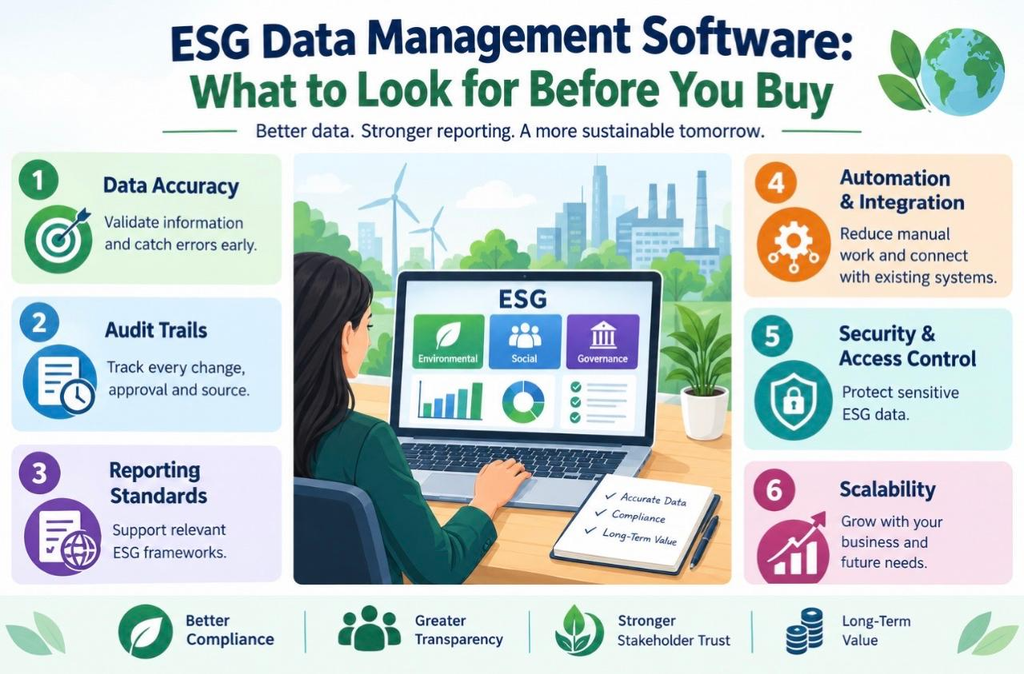
6 Essential Features to Look for in ESG Data Management Software
1. Data Accuracy Should Be the First Priority
ESG reports are only as reliable as the information behind them. Incorrect electricity consumption figures, incomplete employee records, or inconsistent emissions calculations can affect the quality of sustainability disclosures. Before purchasing software, businesses should check whether it can validate information, identify missing entries, flag unusual figures, and maintain consistent calculation methods. The system should also allow authorised employees to review and correct errors before information is included in a report.
For example, if a manufacturing company records its monthly electricity consumption at several facilities, the software should help identify missing months, inconsistent measurement units, or unexpected changes in consumption. What to look for: Automated validation, error detection, data-quality checks, and clear records of corrections.
2. Audit Trails Should Be Built Into the System
Collecting ESG information is only one part of the process. Businesses must also be able to explain where their reported figures came from and how those figures were calculated. An effective audit trail records important actions, including who entered information, when it was changed, who approved it, and which supporting documents were used.
This creates a clearer path from the original data to the final sustainability report. Consider a company reporting its greenhouse gas emissions. If a reviewer questions the reported figure, the company should be able to trace it back to the original activity data, calculation method, and relevant emission factors. This capability is particularly valuable when companies prepare disclosures that require external assessment or verification. SEBI’s BRSR Core framework addresses reporting metrics and the methods used to support their assessment. What to look for: Timestamped activity logs, document attachments, approval histories, and traceable calculations.
3. Check Compatibility With Reporting Standards
Not every business has the same ESG reporting obligations. Requirements can differ according to the company’s location, industry, size, stakeholders, and applicable regulations. For Indian listed companies, BRSR may be relevant. Businesses with international operations or investors may also need to consider frameworks such as the Global Reporting Initiative (GRI) Standards or the International Sustainability Standards Board’s IFRS Sustainability Disclosure Standards.
The GRI Standards provide a framework for reporting an organisation’s impacts on the economy, environment, and people. IFRS S1 and IFRS S2 address sustainability-related financial disclosures and climate-related disclosures, respectively. Before buying software, identify the frameworks relevant to your organisation. Then confirm whether the platform supports the required metrics, reporting formats, calculations, and disclosure requirements.
Do not assume that a software provider’s claim of being ESG-compliant means the software automatically makes your business compliant. The quality of the underlying information and the company’s reporting processes still matter. What to look for: Relevant reporting templates, configurable metrics, framework mapping, and support for changing disclosure requirements.
4. Automation and Integration Can Save Time
ESG information often comes from multiple departments and systems. Environmental data may come from utility bills and energy monitoring systems, while social data may come from HR platforms and governance information from corporate records.
Manually transferring information between these sources can create duplication, delays, and inconsistencies. ESG software that integrates with existing business systems can reduce repetitive work and improve the flow of information. For example, an integration with a company’s energy monitoring system could help transfer electricity consumption data into its ESG reporting workflow.
Similarly, connections with supplier systems may help collect relevant information across the value chain. CDP’s Disclosure API initiative illustrates how direct data transfers between software providers and a reporting platform can reduce manual data entry and streamline environmental disclosures. What to look for: API connectivity, integrations with existing systems, automated data imports, and fewer manual reporting steps.
5. Security and Access Controls Matter
ESG information can include sensitive business, employee, supplier, and operational data. Therefore, data security should be an essential part of the buying decision. Businesses should evaluate how the software controls access to information, protects stored data, and manages user permissions.
Not every employee needs access to every record, and sensitive information should only be available to authorised users. It is also worth examining backup arrangements, data retention policies, incident response procedures, and whether the provider can explain where information is stored and how it is protected.
Security becomes especially important when multiple departments, external consultants, suppliers, or assurance providers need access to the platform. What to look for: Role-based permissions, encryption, secure backups, access logs, and clearly documented security policies.
6. Choose Software That Can Grow With Your Business
A system that works for a small company today may become difficult to manage when the business expands into new locations, adds suppliers, or begins reporting additional sustainability metrics. Businesses should consider whether the platform can handle larger data volumes, multiple locations, different business units, and more complex reporting requirements.
It should also allow teams to adapt workflows as their sustainability programmes develop. Usability deserves equal attention. Even a feature-rich platform may deliver limited value if employees find it confusing or require extensive training to complete basic tasks. Before making a final decision, request a demonstration using realistic company data.
Ask the provider to show how the software handles a missing data point, a correction, an approval, and the preparation of a report. What to look for: Scalable features, flexible workflows, straightforward dashboards, useful training, and responsive technical support.
Conclusion
Choosing ESG data management software is not simply a technology purchase; it is a decision about how a business will manage and demonstrate its sustainability performance. The right platform should help organisations maintain accurate records, establish clear audit trails, automate repetitive tasks, protect sensitive information, and prepare disclosures aligned with their reporting needs.
Businesses should also evaluate integration capabilities, usability, implementation costs, and the provider’s long-term support. Most importantly, companies should look beyond impressive demonstrations and long feature lists. A practical evaluation should include the quality of the data, the ease of verifying reported figures, and the system’s ability to support real reporting workflows.
The best ESG software is not necessarily the one with the most features. It is the one that helps your business turn reliable data into transparent reporting and better-informed sustainability decisions.
Businesses adopting digital reporting tools can also explore how an AI operating model helps organise workflows, improve accountability and support data-driven decisions.
References
[1] Securities and Exchange Board of India (SEBI), “BRSR Core – Framework for Assurance and ESG Disclosures for Value Chain,” sebi.gov.in. [Online]. Available: https://www.sebi.gov.in/legal/circulars/jul-2023/brsr-core-framework-for-assurance-and-esg-disclosures-for-value-chain_73854.html
[2] Securities and Exchange Board of India (SEBI), “Industry Standards on Reporting of BRSR Core,” sebi.gov.in, Dec. 20, 2024. [Online]. Available: https://www.sebi.gov.in/legal/circulars/dec-2024/industry-standards-on-reporting-of-brsr-core_90091.html
[3] Global Reporting Initiative (GRI), “GRI Standards,” globalreporting.org. [Online]. Available: https://www.globalreporting.org/standards/
[4] IFRS Foundation, “IFRS S1 General Requirements for Disclosure of Sustainability-related Financial Information,” ifrs.org. [Online]. Available: https://www.ifrs.org/issued-standards/ifrs-sustainability-standards-navigator/ifrs-s1-general-requirements/
[5] IFRS Foundation, “Introduction to the ISSB and IFRS Sustainability Disclosure Standards,” ifrs.org. [Online]. Available: https://www.ifrs.org/sustainability/knowledge-hub/introduction-to-issb-and-ifrs-sustainability-disclosure-standards/
[6] Greenhouse Gas Protocol, “Standards and Guidance,” ghgprotocol.org. [Online]. Available: https://ghgprotocol.org/standards-guidance
[7] Greenhouse Gas Protocol, “Standards,” ghgprotocol.org. [Online]. Available: https://ghgprotocol.org/standards
[8] CDP, “CDP Launches 2025 Disclosure API,” cdp.net, Apr. 24, 2025. [Online]. Available: https://www.cdp.net/en/insights/cdp-launches-2025-disclosure-api
AI Detection
Plagiarism

Proofreading