Introduction
Circular economy in manufacturing helps Indian businesses reduce production waste, reuse valuable materials, improve resource efficiency and build more sustainable operations.
What if the waste left behind by a manufacturing process could become the raw material for the next production cycle? What if factories could reduce disposal costs, use fewer virgin resources, and create additional value from materials they already purchase? These questions lie at the heart of the circular economy—an approach that aims to keep materials and products in use for as long as possible instead of following the traditional model of taking resources, making products, and discarding waste.
For Indian manufacturers, circular economy strategies offer an opportunity to rethink how materials, energy, water, packaging, and industrial by-products are managed. Rising input costs, growing environmental expectations, and increasing attention to waste management are encouraging businesses to look beyond production volumes and consider the full lifecycle of their resources.
India has also introduced circular economy action plans and waste-management rules covering areas such as electronic waste, batteries, used oil, waste tyres, and other material streams. These developments make resource recovery and responsible waste management increasingly relevant to manufacturers. However, adopting a circular model does not necessarily mean rebuilding an entire factory.
Businesses can begin with practical improvements, such as reducing production scrap, repairing equipment, reusing packaging, and finding productive applications for materials that would otherwise be discarded. The real opportunity is to make sustainability part of everyday manufacturing decisions while improving resource efficiency and controlling costs.
6 Powerful Circular Economy Strategies for Indian Manufacturers
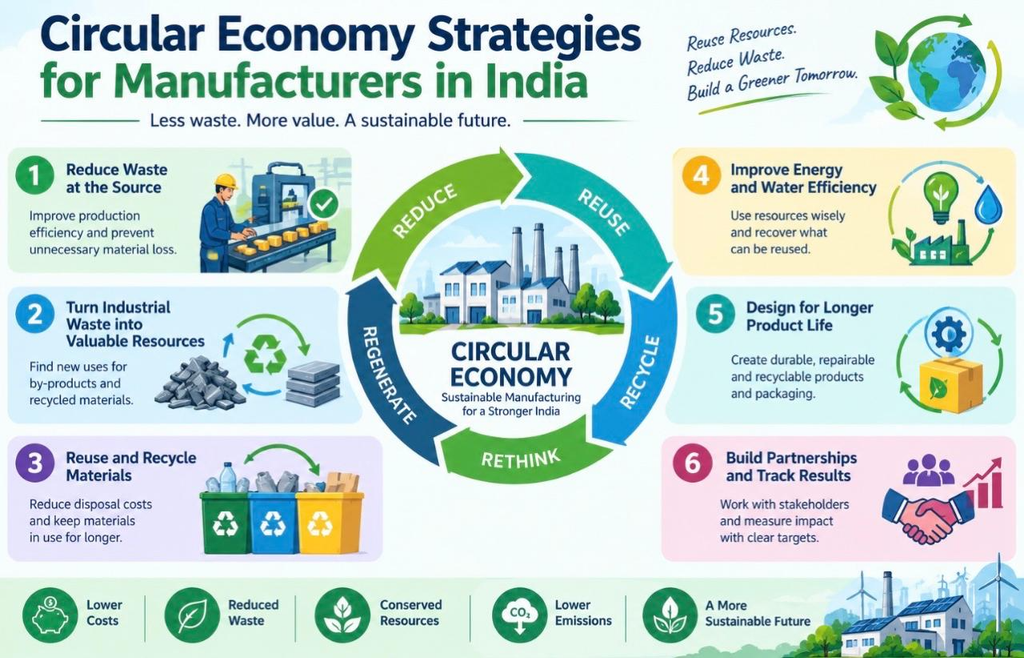
1. Reduce Waste at the Source
The most effective way to manage waste is to prevent it from being generated in the first place. Manufacturing facilities often lose materials through cutting errors, defective products, inefficient machine settings, damaged packaging, and inaccurate production planning.
Although these losses may appear small individually, they can become expensive when repeated across thousands of production cycles. Manufacturers can start by examining where raw materials are wasted and identifying the causes. Better production planning, preventive maintenance, employee training, and quality-control checks can help reduce unnecessary material consumption.
For example, a textile manufacturer can optimise fabric-cutting patterns to reduce leftover fabric. Similarly, an engineering company can improve metal-cutting processes to minimise scrap. The key strategy is simple: prevent avoidable waste before investing in ways to manage it.
2. Turn Industrial Waste into Valuable Resources
One company’s waste can sometimes become another company’s raw material. Manufacturing processes generate by-products such as metal scrap, plastic offcuts, sawdust, waste heat, and rejected materials. Instead of automatically sending these materials for disposal, businesses can investigate whether they can be reused internally or supplied to another industry.
A metal fabrication unit, for instance, can segregate its scrap by material type and send it to an appropriate recycling facility. A food-processing plant may explore suitable applications for certain organic by-products, subject to safety and quality requirements. Industrial collaboration can make these opportunities more practical. Manufacturers operating in the same industrial area can exchange information about available by-products and the materials they need.
The United Nations Industrial Development Organization (UNIDO) promotes resource-efficient manufacturing and circular solutions that recover materials, reduce pollution, and minimise waste across industrial processes. The key strategy is to treat recoverable industrial by-products as potential resources rather than automatically classifying them as waste.
3. Reuse and Recycle Materials Wherever Possible
Recycling is an important circular economy strategy, but reuse should also be considered wherever it is safe and practical. Manufacturers can introduce reusable transport containers, returnable pallets, refillable packaging systems, and recovery programmes for selected production materials. These measures can reduce repeated purchases and lower the volume of waste generated during operations.
For example, a component manufacturer supplying products to another factory could use durable returnable crates instead of disposable packaging. If the crates are returned and reused many times, the business may reduce packaging purchases and disposal requirements. Recycling also helps recover valuable materials.
India has established waste-management rules and extended producer responsibility mechanisms for several categories, including plastic packaging, batteries, electronic waste, and waste tyres. The exact obligations depend on the relevant rules, product category, and role of the business. Manufacturers should therefore assess both the commercial benefits and any applicable compliance requirements before implementing recovery programmes. The key strategy is to prioritise safe reuse, establish effective material segregation, and send recyclable materials to appropriate recovery channels.
4. Improve Energy and Water Efficiency
Circular manufacturing is not limited to solid waste. It also involves using energy and water more efficiently and recovering resources that would otherwise be lost. Factories can begin by monitoring electricity consumption, identifying compressed-air leaks, improving equipment maintenance, and recovering waste heat where technically and economically feasible.
Water-intensive businesses can examine opportunities to reuse treated process water for suitable applications, subject to applicable standards and process requirements. For example, a manufacturing facility may recover waste heat from industrial equipment to support another process that requires lower-temperature heat. This can reduce energy demand, although the feasibility depends on the facility’s equipment, operating conditions, and investment costs.
UNIDO’s green manufacturing initiatives highlight energy efficiency, renewable energy, waste reduction, and circular resource use as important components of cleaner industrial production. The key strategy is to measure resource consumption, identify avoidable losses, and prioritise efficiency improvements with a clear business case.
5. Design Products for Longer Life and Easier Recovery
Circular economy thinking should begin before a product reaches the factory floor. Product design influences how much material is required, how long a product lasts, whether components can be repaired, and how easily materials can be recovered at the end of its useful life. Manufacturers can explore durable designs, modular components, repair-friendly construction, and materials that are easier to separate and recycle.
Packaging can also be redesigned to reduce unnecessary material use without compromising product protection. For example, an equipment manufacturer could design a machine with replaceable components instead of requiring customers to discard the entire unit when one part fails. Such changes may require engineering adjustments and supplier coordination, but they can create opportunities for repair services, spare-parts sales, refurbishment, and product take-back programmes. The key strategy is to consider a product’s entire lifecycle from raw material selection to repair, reuse, and eventual recovery.
6. Build Partnerships and Track Results
Circular economy initiatives become more effective when manufacturers collaborate with suppliers, recyclers, customers, and other businesses. Suppliers can help identify recycled or lower-impact materials. Recycling partners can advise on material specifications and recovery options. Customers can support returnable packaging, equipment refurbishment, or product take-back arrangements.Manufacturers should also measure the results rather than relying on general sustainability claims.
Useful indicators include: Material efficiency: Raw material used per unit produced. Waste reduction: Waste generated per unit of production. Recycling rate: The proportion of eligible waste sent for recycling. Resource recovery: The amount of material reused or recovered. Cost savings: Changes in material purchases, energy use, and waste disposal costs. India’s Economic Survey 2024–25 identifies resource efficiency, material recovery, and reduced dependence on virgin resources as important circular economy objectives.
It also discusses the potential economic benefits of greater resource circularity. Manufacturers should establish a baseline, set achievable targets, and review performance regularly. This helps management identify which initiatives deliver measurable environmental and financial benefits. The key strategy is to turn circular economy goals into measurable operational improvements.
Conclusion
Circular economy strategies offer Indian manufacturers a practical way to rethink production, reduce avoidable waste, and make better use of valuable resources. From improving material efficiency and reusing packaging to recovering industrial by-products and designing longer-lasting products, businesses have several ways to begin the transition.
The most successful approach is not necessarily the one involving the largest investment. Often, meaningful progress starts with understanding where materials are lost, which resources can be recovered, and which production processes can be improved. Manufacturers should begin with a resource audit, identify the most costly sources of waste, and test practical solutions before expanding them across the organisation.
Manufacturers can also explore cost optimisation for Indian SMEs to identify practical ways to reduce operational waste, control expenses and improve resource efficiency.
References
[1] Government of India, Press Information Bureau, “Govt Driving Transition from Linear to Circular Economy,” pib.gov.in, Mar. 18, 2021. [Online]. Available:
[2] Government of India, Press Information Bureau, “Circular Economy Action Plans for 10 Waste Categories,” pib.gov.in. [Online]. Available:
[3] Ministry of Environment, Forest and Climate Change, Government of India, “Rules and Regulations,” moef.gov.in. [Online]. Available:
[4] Ministry of Finance, Government of India, “Economic Survey 2024–25: Circular Economy and Resource Efficiency,” indiabudget.gov.in, 2025. [Online]. Available:
[5] United Nations Industrial Development Organization (UNIDO), “Green Manufacturing,” unidoindiaprogramme.org. [Online]. Available:
[6] United Nations Industrial Development Organization (UNIDO), “Cleaner Production and Circular Economy,” unido.org. [Online]. Available:
Government of India — Circular Economy — Introduction.
UNIDO — Green Manufacturing — Section 2 or 4.
Ministry of Environment, Forest and Climate Change — Section 3.
India Economic Survey — Section 6.
AI Detection
Plagiarism

Proofreading