
Uncategorized

Uncategorized

How GST Refunds Affect Business Cash Flow and Working Capital

GST Refunds and Cash Flow This article examines how delays and timing of Goods and Services Tax (GST) refunds influence the cash flow and working capital position of businesses, with particular focus on exporters, who are among the most exposed to this issue. Evidence from India’s GST rollout is used to illustrate the practical consequences of refund timing on firm-level liquidity. The above given picture is generated by ChatGPT I. Introduction: GST Refunds and Cash Flow When people talk about GST, the conversation usually stops at tax rates or filing deadlines. What gets discussed far less is what happens after a business pays that tax and is owed money back. A GST refund sounds like a formality, but in practice, the gap between paying tax upfront and actually receiving the refund can quietly strain a company’s cash position, sometimes badly enough to affect day-to-day operations. GST Refunds and Cash Flow II. The Cash Flow Problem: GST Refunds and Cash Flow Under GST, exporters are typically required to pay tax on inputs first and then apply for a refund later, rather than being exempted upfront as under earlier tax regimes [1]. Although exporters are meant to receive 90% of their input tax refund within seven days of filing, the actual process has often taken far longer, with some firms waiting months for money that was rightfully theirs. This is not a minor accounting inconvenience — it directly determines how much cash a company has on hand to pay suppliers, wages, and short-term obligations. GST Refunds and Cash Flow The scale of the problem becomes clearer when looking at real numbers. One estimate placed roughly ₹95,000 crore of exporters’ working capital as locked up nationally at a given point, tied up for four to six months between purchasing raw materials and finally receiving the refund [2]. For firms operating on thin margins, that is money that could otherwise fund the next production cycle.  III. Who Feels It Most: GST Refunds and Cash Flow Larger firms with strong balance sheets can usually absorb a delayed refund by dipping into reserves or short-term borrowing. Smaller and medium enterprises rarely have that cushion. Refund delays disproportionately affected labor-intensive and MSME sectors, since these businesses depend heavily on turning inventory into cash quickly and have limited access to affordable credit [3]. In several documented cases, companies described being pushed to consider scaling back operations simply because a large share of their funds was sitting with the government rather than in their own accounts [4]. GST Refunds and Cash Flow There is also research suggesting a broader economic ripple effect. Sectors with higher working capital requirements experienced sharper dips in export performance during periods of refund backlogs, and export growth only recovered once government measures eased the refund bottleneck [1].  IV. Timing as a Strategic Variable: GST Refunds and Cash Flow What this really points to is that a GST refund isn’t just “money owed” — it’s a timing problem. A business that expects ₹10 lakh back in refunds in a given quarter may plan working capital around that assumption. If the refund arrives late, that plan breaks, and the company may need to borrow at commercial rates just to bridge the gap, adding an indirect cost to what should have been a simple reimbursement. V. Conclusion:GST Refunds and Cash Flow GST refunds are often treated as a background compliance detail, but the timing of these refunds has a real and measurable effect on business liquidity, particularly for exporters and smaller firms. Faster, more predictable refund processing would reduce the need for costly stopgap financing and let businesses plan cash flow with more confidence. GST Refunds and Cash Flow References [1] S. Tomar, S. Mathur, and S. Ghosh, “Working Capital Constraints and Exports: Evidence from the GST Rollout,” RBI Mint Street Memo, no. 10, Feb. 2018. Press Releases | Official Website of Reserve Bank of India [2] “Chemexcil News,” Chemical Export Promotion Council, Aug.–Sep. 2017.Basic Chemical Export Promotion Council, Dyes, Intermediates Exporters India-chemexcil.in [3] “Refund Delay Worsens Firms’ Woes,” The Tribune, India.Refund delay worsens firms’ woes – The Tribune [4] “Working Capital Costs Set to Rise Due to GST Issues,” Business Standard, Oct. 2017. Working capital costs set to rise due to GST issues [5] Internal Link: Add Post ‹ Eve Consultancy — WordPress
Uncategorized

Understanding GSTR-3B, GSTR-1, and Other Key GST Return Deadlines This Month

Trend: September 2026 GST filing deadlines range from the 10th through the 28th  GST Return Deadlines If you have ever sat with a GST portal tab open at 11:58 PM on the 20th, refreshing the page and praying it doesn’t time out, you already understand why GST deadlines matter more in practice than they do on paper. As someone tracking compliance data this semester, I found September particularly instructive, it packs almost every kind of GST return into one calendar month, which makes it a useful case study for understanding how the filing system is structured. GST Return Deadlines are essential for businesses to manage their tax responsibilities and maintain GST compliance in India. Filing returns such as GSTR-1 and GSTR-3B on time helps businesses report sales, calculate tax liabilities, and claim eligible input tax credits. Understanding the important GST filing dates can help taxpayers avoid late fees, maintain accurate financial records, and ensure smooth business operations. Businesses should regularly check the official GST portal for updated due dates and filing requirements. Why September Is a Crowded Month : GST Return Deadlines Unlike months with a single dominant deadline, September 2026 spreads obligations across the 10th through the 28th for forms including GSTR-1, GSTR-3B, GSTR-5, GSTR-6, GSTR-7, GSTR-8, and GSTR-11. This spread is not incidental; it reflects how GST separates taxpayers by role deductor, collector, non-resident, regular filer rather than applying one blanket date to everyone.GST Return Deadlines GST Return Deadlines GSTR-1: Reporting Sales First : GST Return Deadlines GSTR-1 reports details of all outward supplies, or sales, and is due on the 11th of the following month for monthly filers. This return exists to give the tax department (and downstream buyers) visibility into what was sold before any tax liability is settled. For quarterly filers under the QRMP scheme, the equivalent submission, the Invoice Furnishing Facility (IFF) falls due around the 13th. GST Return Deadlines GSTR-3B: Where the Tax Is Actually Paid : GST Return Deadlines GSTR-3B is the summary return covering sales, purchases, tax liability, and Input Tax Credit claims, due on the 20th of the following month. This is the return most businesses treat as the real deadline, since it is where actual cash liability gets settled. In 2026, this date carries an added wrinkle worth noting for research purposes: both the 13th and 20th of September fall on a Sunday, and GST due dates do not automatically shift to the next working day, though the portal does accept filings over the weekend. The catch is banking infrastructure, not the portal high-value payment windows may not function on a Sunday, so any cash liability under GSTR-3B is best arranged a day or two early. GST Return Deadlines The Supporting Cast: GSTR-5, 6, 7, 8, and 11: GST Return Deadlines The other forms serve narrower audiences. GSTR-6, for Input Service Distributors, is due by the 13th, while GSTR-7 (TDS deductors) is due by the 10th. GSTR-7 and GSTR-8 share the 10th, though they apply to different TDS and TCS reporting obligations for e-commerce operators. GSTR-11, filed by embassies, UN bodies, and similarly notified entities claiming input tax refunds, falls due on the 28th. GST Return Deadlines QRMP Filers Follow a Different Rhythm : GST Return Deadlines Not everyone files monthly. Taxpayers with turnover up to ₹5 crore can opt into the Quarterly Return Monthly Payment scheme, filing GSTR-1 and GSTR-3B quarterly while still paying tax monthly via the PMT-06 challan. For August 2026, the second month of the July–September quarter, this PMT-06 payment is due on the 25th of September, even though the actual quarterly GSTR-3B doesn’t get filed until October. Why This Matters Beyond Compliance : GST Return Deadlines From a research standpoint, what stands out is how the deadline structure encodes the government’s priorities: sales data first (GSTR-1), tax settlement second (GSTR-3B), and niche categories filed around the edges. Missing any of these isn’t just an administrative slip late filing attracts a fee of ₹50 per day for returns with tax liability, and ₹20 per day for nil returns, alongside interest on unpaid tax. Tracking a single busy month like this made the logic of GST’s return architecture click for me in a way that reading the statute never quite did. GST Return Deadlines play an important role in helping businesses stay organized and meet their tax obligations without delays. Returns like GSTR-1 and GSTR-3B allow taxpayers to report outward supplies, declare tax liabilities, and manage eligible input tax credits. By tracking monthly and quarterly filing schedules, businesses can reduce the risk of penalties, improve financial planning, and maintain compliance with GST regulations. Regularly checking official GST updates ensures that businesses stay informed about changes in filing dates and requirement References [1] DMI Finance, “GST Return Due Dates 2026: Monthly, Quarterly & Annual Calendar,” 2026. Online Accounting Software for India | Zoho Books [2] TaxReply, “GST Due Dates for September 2026,” 2026. GST Due Dates for September 2026: Complete Filing Calendar | GST Consultancy [3] Ebizfiling, “GST Compliance Calendar September 2026: Due Dates,” 2026.GST compliance calendar September 2026: Due Dates | Ebizfiling [4] TaxSlabs, “Tax Due Dates September 2026: Complete Expert Guide,” 2026. https://taxslabs.com/tax-due-dates-september-2026/ [5] Mark IT Solutions, “GST Return Due Date Finder 2026,” 2026.GST Return Due Date Finder 2026 | Mark IT [6] Internal Link: Add Post ‹ Eve Consultancy — WordPress

Uncategorized

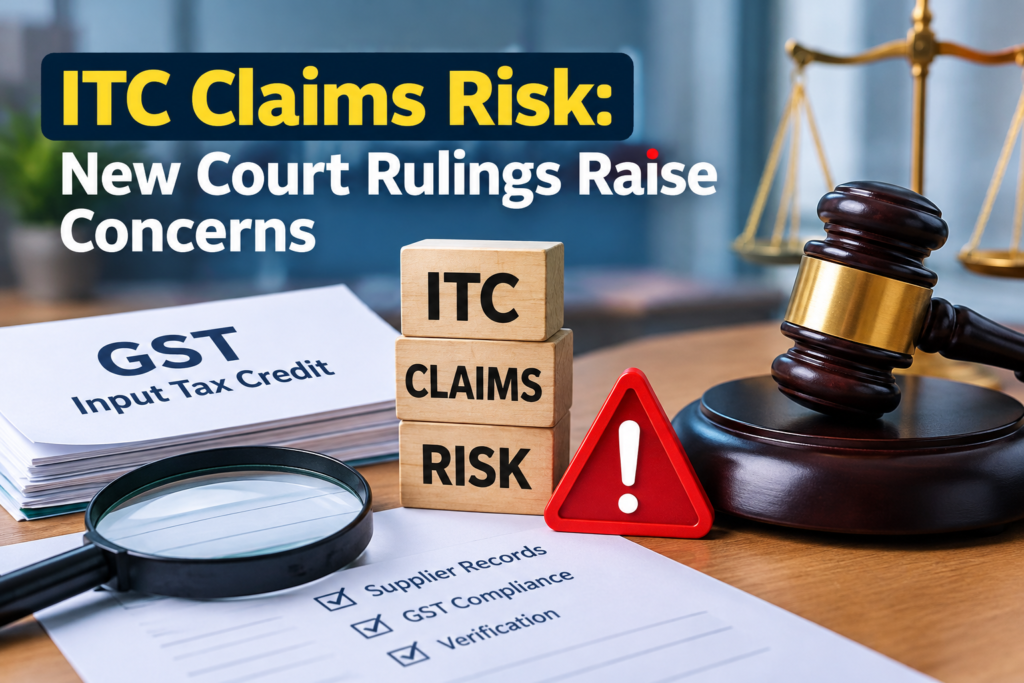
Why ITC Claims Now Carry Greater Risk for Buyers Under Recent Court Rulings

Abstract: ITC Claims Risk ITC Claims Risk Input tax credit (ITC) is a central feature of India’s Goods and Services Tax (GST) framework because it reduces cascading of taxes by allowing eligible businesses to offset tax paid on inputs against output tax liability. However, recent judicial developments have increased the compliance risk faced by buyers when their suppliers fail to discharge the corresponding GST liability. Section 16(2)(c) of the Central Goods and Services Tax (CGST) Act, 2017 makes ITC conditional on the tax charged on a supply being actually paid to the Government. In July 2026, the Supreme Court in Bhandari Scrap Traders v. Union of India upheld the constitutional validity of this condition and declined to read it down. A Rajasthan High Court decision in August 2026 subsequently treated supplier tax payment as a mandatory condition for ITC. This article explains the legal position, the resulting input tax credit risk for buyers, and practical compliance considerations. I. How to Reduce ITC Claims Risk Under GST GST operates through a value-added tax mechanism in which eligible businesses generally receive credit for input tax, subject to statutory conditions. For purchasers, an invoice alone does not establish an unconditional right to ITC. Section 16(2) of the CGST Act specifies conditions that must be satisfied before credit can be claimed. Among them, Section 16(2)(c) requires the tax charged on the relevant supply to have been actually paid to the Government, either in cash or through admissible input tax credit, subject to the statutory framework. ITC Claims Risk Input Tax Credit (ITC) claims have become a greater concern for buyers under recent court rulings in India. Businesses must ensure that their suppliers issue valid GST invoices, report transactions correctly, and comply with GST regulations. If suppliers fail to meet these requirements, buyers may face difficulties claiming ITC, along with potential tax demands, interest, or penalties depending on the circumstances. Therefore, buyers should regularly verify supplier details, maintain accurate purchase records, reconcile invoices with GST returns, and monitor supplier compliance. Taking these precautions can help businesses reduce ITC claims risk, avoid unnecessary disputes, and maintain proper GST compliance. Common ITC Claims Risk Factors for Buyers ITC Claims Risk The importance of this requirement has increased following recent court rulings. The Supreme Court’s July 2026 decision in Bhandari Scrap Traders reinforced the validity of Section 16(2)(c), while subsequent High Court decisions have applied the provision in disputes involving supplier defaults. These developments mean that buyers need stronger vendor and transaction controls when claiming ITC. II. LEGAL BASIS OF ITC ELIGIBILITY:ITC Claims Risk Section 16(2) of the CGST Act establishes multiple conditions for ITC. In addition to possession of prescribed tax documents and receipt of goods or services, the statutory framework includes the requirement that the tax charged on the supply be actually paid to the Government. The courts have therefore treated ITC as a statutory benefit subject to compliance with the conditions prescribed by Parliament. ITC Claims Risk Section 155 of the CGST Act is also relevant because it places the burden of proving eligibility for ITC on the person claiming the credit. Consequently, disputes may require the recipient to substantiate the underlying transaction and its compliance with the applicable ITC conditions. III. RECENT COURT RULINGS:ITC Claims Risk In Bhandari Scrap Traders v. Union of India, decided on July 24, 2026, the Supreme Court dismissed the challenge to Section 16(2)(c) and upheld the Gujarat High Court’s approach. The Court did not accept the request to declare the provision unconstitutional or to read it down. This development is significant because some earlier High Court decisions had adopted a more protective approach toward bona fide purchasers where the supplier had failed to remit tax. The divergence in earlier cases is important for understanding the present position. The Tripura High Court in Sahil Enterprises had held that Section 16(2)(c) should not operate to deny ITC in a bona fide transaction merely because the supplier defaulted, while other courts had taken a stricter view. The Supreme Court’s 2026 ruling strengthened the latter statutory interpretation. In M/s Shree Karni Electrovision v. Union of India, decided by the Rajasthan High Court on August 17, 2026, the Court held that Section 16(2)(c) is a mandatory condition, subject to the statutory provisions, and observed that ITC cannot be claimed as a matter of right unless the relevant conditions are satisfied. The decision further emphasized that the clauses of Section 16(2) are to be read together. IV. WHY BUYERS FACE GREATER INPUT TAX CREDIT RISK: ITC Claims Risk The recent rulings shift greater practical attention toward supplier compliance. A buyer may have a genuine invoice, receive the goods or services, make payment to the supplier, and record the transaction correctly, yet still face an ITC dispute if the supplier does not discharge the corresponding tax liability. The purchaser therefore faces a risk that is partly dependent on conduct outside its direct control. ITC Claims Risk This does not mean that every supplier default automatically establishes fraud by the purchaser. The legal issue is whether the statutory conditions for ITC have been fulfilled. Buyers should therefore distinguish between transaction-level evidence, supplier-level compliance, and allegations of fraud or collusion. V. BUSINESS IMPACT:ITC Claims Risk The principal business impact is potential reversal or denial of ITC, together with associated interest or other consequences where applicable under the GST framework. For businesses with high input-tax volumes, even a small proportion of disputed credits can affect working capital and tax costs. The rulings also increase the importance of vendor selection and monitoring. Procurement teams may need to consider GST compliance as part of supplier due diligence rather than treating tax documentation as a purely accounting function. ITC Claims Risk VI. COMPLIANCE MEASURES FOR BUYERS ITC Claims Risk Businesses can reduce input tax credit risk by strengthening controls around supplier onboarding and ongoing monitoring. Important measures include: (1) verifying supplier GST registration and core business details; (2) matching purchase invoices with GST records and available credit statements; (3) confirming receipt

Uncategorized

Cash Flow versus Revenue: Why Actual Money Wins Over Profits in Growing Companies

Cash Flow vs Revenue is an important financial concept for growing companies because strong revenue does not always mean that a business has enough actual money available. Revenue represents the total income earned from selling products or services, while cash flow shows the actual movement of money into and out of the business. A company may report high revenue or even profits but still face financial difficulties if customers delay payments or operating expenses are high. Monitoring cash flow helps businesses maintain liquidity, pay employees and suppliers on time, manage daily operations, and prepare for future investments. Therefore, understanding the difference between cash flow and revenue allows growing companies to make better financial decisions and maintain long-term financial stability. New Cash Flow: Cash Flow vs Revenue: When a company is growing quickly, revenue usually gets all the focus. Sales numbers and rising top-line results often judge success. Behind many exciting growth stories is a hidden truth: revenue alone does not keep the business running. Cash flow the movement of money in and out of bank accounts is what keeps a growing company stable, strong, and ready for long-term success. Cash Flow vs Revenue: The main problem is the time difference between making a sale and getting the money. With accounting rules, revenue is recorded as soon as a deal is made or a service is provided. In real life, customers often take weeks or even months to pay their bills. When orders increase quickly, a company needs cash away buying more stock, hiring more people, and increasing production to meet demand. This situation creates a cash gap, leaving a company with high sales numbers on paper but little money in the bank waiting for payments to come in. Cash Flow vs Revenue: This difference often leads to a problem called overtrading. Growing a business needs money up front. Landlords, electricity companies, and workers do not accept promises of money or unpaid invoices; they need real cash now. A company can be very popular. Show profits on a financial statement but still fail because it ran out of money before customers paid. When money runs out, growing companies often have to take expensive loans or give away company shares just to stay afloat. Steady cash flow gives freedom to run a business. When a company makes cash from its main activities, it can expand without depending on outside investors or too much debt. It also has the power to get better prices from suppliers, handle sudden market changes, and invest in new chances as they appear. Watching how quickly money comes in from customers ensures that sales are turning into money instead of just numbers on a page. Cash Flow vs Revenue: Revenue shows that customers like what a company sells, but cash flow makes sure the company stays alive enough to meet that demand. While sales numbers show how much people want a product, real financial strength comes from handling money. For any company that wants to grow, making sales is only part of the job. Converting those sales into real cash is what keeps the business going. Reference: [1] Cash Flow vs. Revenue: Key Differences Explained [2] The Difference Between Cash Flow, Revenue, and Profit [3] Internal link: Add Post ‹ Eve Consultancy — WordPress

Uncategorized

How Businesses Can Use Financial Data to Make Better Strategic Decisions

Financial Data for Strategic Decisions When you run a business,it feels easy to treat data like a rearview mirror. You end up looking at a pile of papers every month that show where your money went after you already spent it. I think modern leaders should look at data differently. Leaders should treat metrics like a steering wheel rather than just a scorecard. When leaders really look at statements, leaders can see market changes early. This helps leaders invest with confidence and make choices based on what’s actually happening instead of just guessing. Where Financial Data Makes the Biggest Impact: Financial Data for Strategic Decisions Using metrics to guide business is not about worrying over every cent. Business is about watching the parts of business that actually make business move forward. Four Core Metrics Every Leader Should Track: Financial Data for Strategic Decisions Do not get lost in spreadsheets. Just focus on numbers that show if business is healthy: Implementation Steps:Financial Data for Strategic Decisions You do not need a team of experts to use insight every day. Just try these four steps: Traps to Avoid: Financial Data for Strategic Decisions At the end of the day financial data is more than math, for taxes. It is the story of business. ffWhen business stops using words and starts using reporting to make decisions, business stops just reacting to things and starts driving business toward the future. Refference [1]. Financial Data Makes the Biggest Impact: Big Data in Finance: Benefits, Use Cases, and Examples [2] Four Core Metrics Every Leader Should Track: KPI Dashboard Essentials: Metrics Every Leadership Team Should Track – New Life CFO [3] Internal Link: Add Post ‹ Eve Consultancy — WordPress

Uncategorized

WHY DOES CORPORATE EARNINGS MATTER SO MUCH TO INVESTORS

ABSTRACT  Corporate earnings are the primary source of stock market prices when invested. This article will clarify why earnings reports are important, how they impact the market valuations, and why investors in India pay close attention to earnings every quarter to determine whether a stock is a good buy or overvalued.  INTRODUCTION  Public companies publish financial statements each quarter, indicating the income they generated and the profits they retained. Analyst views are often featured in news publications such as The Economic Times during earnings season or when stocks are being valued. Corporate earnings for investors are far more than a page of numbers—the only true measure of reality. Having a high-quality product, brand and big promises are great, however profits will show the success of the business. WHY EARNINGS DRIVE THE MARKET  Profits are used by investors to gauge whether a stock is cheap or expensive in relation to its price. The P/E ratio is the price of the share divided by the earnings per share. The more the profits get better, the more legit the stock price becomes. When the bottom falls out of the stock, it suddenly becomes too expensive.  The stock market is a place of anticipation. Analysts believe that the company will earn a profit of ₹100 crore, but it earns ₹80 crore, the stock price typically drops (even though the profit of ₹80 crore is healthy enough). On the other hand, when estimates are beaten, there is a strong buying demand.  In an active market such as India, valuations in the mid-cap and small-cap groups can be at record highs, so it is essential for them to have robust earnings growth to sustain a high share price. “Market corrections happen when corporate earnings do not meet the rosy visions of its investors, and stock valuations reflect this reality. CONCLUSION  In the end, stock prices move in sync with company earnings. Even though the market hype or overall economic news may impact price in the short-term, long-term wealth building is based on consistent profit growth. Investors can track quarterly earnings to distinguish between good businesses and bad investments, and create a strong investment plan.  REFERENCES 

Uncategorized

DECODING ECONOMIC HEALTH : FIVE KEY FINANCIAL INDICATORS TO UNDERSTAND INDIA’S ECONOMY 

ABSTRACT  Looking through the headlines to clear financial signals is essential to understanding a fast-growing, complex country such as India. The article explains five basic economic indicators – Gross Domestic Product (GDP), Consumer Price Index (CPI), Repo Rate, Current Account Deficit (CAD) and the Purchasing Managers’ Index (PMI). These five numbers tell us what’s going fast in India, what’s happening with prices and how sound is the economic edifice is in India.  INTRODUCTION  India’s economy is certainly the fastest growing in the world, but keeping track of what is really going on can seem daunting. Central bank meetings, trade reports and growth data statistics are constantly being cited in news articles. Luckily, it’s not an economics degree required to assess where things are going. Through monitoring these five key economic indicators, we can read the health of the Indian market and make better decisions while saving and running businesses.  THE FIVE KEY ECONOMIC INDICATORS  GDP is a measure of the total economic value generated by activities that occur within the country. Economic expansion is indicated by a high real GDP growth rate, which indicates growing businesses, job growth, and increased consumption.  The CPI, released by the Ministry of Statistics and Programme Implementation (MoSPI), measures price fluctuations for products and services regularly consumed by the population, such as food, fuel and health. Rising inflation reduces the purchasing power of the household and high inflation lowers savings.  The interest rate at which Reserve Bank of India (RBI) lends money to commercial banks is termed as repo rate. When RBI cut rates: Loans for cars, houses and business expansion become more affordable as RBI lowers rates. When RBI raises rates: It will make borrowing more expensive to curb inflation and spending. CAD records the gap between India’s export earnings (from foreign trade) and the import expenditures (such as crude oil imports). A lower deficit means that the rupee is stable and dependency on foreign debt is reduced.  PMI is a survey of business executives in manufacturing and services industries, conducted once a month. The PMI exceeding 50 is a sign that economy is expanding, providing a preview of GDP trends in the coming months.  CONCLUSION  When you put these five signals together, it makes more sense of the economic news in the headlines. GDP and PMI indicate the growth rate of the economy, while CPI inflation and RBI Repo Rate provide insights into cost of living and interest rates respectively. These are considered along with foreign trade health (CAD), to provide a wholesome picture of India’s eco.  REFERENCES 

Uncategorized

HOW DIVERSIFICATION CAN PROTECT AN INVESTMENT PORTFOLIO DURING UNCERTAIN MARKETS

ABSTRACT  During volatile economic times, diversification is essential because it is highly risky to hold all your money in a single account. This article will explain why spreading your investments (investing in a variety of investments) is important to protecting your savings. You can distribute your investments into stocks, bonds and other securities to minimize risk and maximize growth over time. INTRODUCTION  Being invested in uncertain times can be stressful. The prices fluctuate and news updates are fast changing, and it is difficult to guess the future. Smart investors don’t guess at which investment will perform best, they use a balanced approach. The idea is simple: don’t put all your eggs in one basket. If you distribute your investments amongst various markets, then a falling market in one will not wipe you out.  HOW THIS STRATEGY WORKS The main goal of diversification is to lower your risk. If you invest in totally different asset classes, they’re not always going to move in the identical direction at the same time. The investor should also aim to broaden their investment mix. Invest in a variety of things such as stocks, bonds, cash, real estate, and/or gold. Stocks typically offer the most chances for long-term growth, but bonds and cash can hold their value during a declining stock market. Don’t just go for stocks from one company in each group or one industry in each group. Vary your assets across industries (healthcare, tech, energy and more), across company size (large established companies, smaller growing companies and more), and across countries.  EXAMPLE ASSET MIX Standard Model Alternative Model KEEPING YOUR PLAN ON TRACK It’s not a one-time process to create a balanced investment strategy. It’s important to sustain it in time in order to keep your risk low. Some investments will grow more than others over time. Rebalancing involves from time to time selling a little of what is doing well and purchasing more of what is behind to restore your balance to normal. Don’t take a chance on One Star: No one company is too good to be true so don’t invest too much in one stock. Distribute the bad news so that it’s not all from one company and you don’t have to scrap your plan.  CONCLUSION  Strategic asset allocation does not guarantee that you will make profits in all investments, however, it does prevent the demise of your wealth from a single negative event. “A diverse investment mix helps safeguard your assets against market fluctuations and ensures you reach your long-term objectives.  REFERENCES 

Uncategorized

What Investors Should Know About Market Volatility Before Making Decisions

â… . Introduction Investing helps people grow their money over time, but prices are frequently subject to market volatility.. They can rise and fall because of economic condition, company performance, interest rates, political events, and also the change are coming in the investor expectations. This action is known as market volatility. Volatility is not automatically a sign that an investment is bad. It normally showing that prices would be chang in the market. The important thing is how the investor reacts on this particular change and how they take a good decision to avoid unnecessary loss to their business.  â…¡. What Is Market Volatility  Market volatility explain how much and how quickly the price of an investment should be changes. When prices will move sharply in a short period of time, that market condition is considered more volatile. For example, a stock may rise from ₹100 to ₹110 and then fall to ₹95 within a short period. Such movements can make investors confused about what to do next and that is good. Volatility can increase because of change in economic condition, market interest-rate decisions, company performance, social & political developments, global events, and changes in investor sentiment. â…¢. What Investors Consider Before investing, a investor should know about the purpose of the investment. The goal of retirement, education, buying a house, or building long-term wealth. A clear goal makes it easier to choose correct decision in investment strategy. Time horizon means how long an investor plans to keep the money invested. Investors with longer time horizons can make more ability to handle short-term market movements. Investors who need their money soon may need to take less risk. Every investor has a different ability and willingness to accept losses. An investor will be able to know about, how comfortable they are with price movements before choosing an investment. Diversification means investing money in different investments instead of depending on only one. It can reduce the effect of poor performance and risk from a single investment, although it cannot be able to remove completely investment risk. â…£. Approached Of Volatile Markets Investors can follow a few basic steps to avoid losses: A disciplined approach can help investors manage uncertainty more effectively and give better result of investment. â…¤. Conclusion Market volatility is a normal part of investing. Investors cannot control & handle every market condition, but they can control how they can respond in it. Before making an investment decision, it is necessary to understand their goals, time horizon, risk tolerance, and portfolio diversification. In my view, a good investor should be focus more on a clear investment plan than on daily market condition. Staying informed and making decisions properly can be more useful than trying to predict every short-term market condition. References Proofreading

Uncategorized

Why Gold Prices Matter to Indian Households, Investors and Businesses

â… . Introduction Gold is more than a precious metal in India. It is also connected & related with Indian family while is a part of savings, festivals gifts, weddings rituals and investment for their future requirement. When the Gold Price rises, the value of existing gold also increases in the particular market. However, buying new gold becomes more expensive to their potential customers. According to the World Gold Council, Indian gold demand reached 131 tonnes in Q2 2026, while spending on gold reached a record ₹1,979 billion for the quarter.  Gold as a jewellery and as a investment in india. â…¡. Importance Indian Households For many Indian families, gold is a form of long-term saving & investment. Jewellery may be purchased for weddings and festivals, but it can also treat as an investment policy and provide financial support in future whenever it is needed. High gold prices are able to increase the value of old jewellery in the gold market. At the same time, families are not able to purchase the stock of new gold because it was out of the range to buy that gold its price was too expensive. This shows that the Gold Price can able to influence household wealth and also its spending decisions. â…¢. Importance to Investors Investors thinks that gold was useful for diversification. Gold can able to treat assets such as shares and bonds, so some investors include the gold in their portfolio. In Q1 2026, investment demand for gold in India increased strongly, with bars, coins and ETFs contributing to the rise.  However, gold prices also be change quickly there was not any certain time period. With the change in gold price also impact their need and use in the market. Therefore, investors should consider proper investigation towards their financial goals and risk before investing such assets. â…£. Importance To Businesses Gold prices also affect the businesses. Jewellery companies in the market have to manage their inventory, customer demand and pricing carefully at the time when change in the price of gold. When prices of gold rise sharply, customers may buy smaller quantities or exchange their old jewellery instead of purchasing the new gold. Gold is also used as collateral for loans. India’s gold-loan market has grown rapidly, they were show how gold can support businesses and households whenever they required funds to invest.  â…¤. Conclusion Gold always be an important part of India’s financial and social life. A small change in the Gold Price can affect the household savings, investment decisions and business activity. The Indian Gold Market is always be an important part because gold continues to be used as jewellery, savings and a financial asset. For Indian consumers and investors, understanding the gold prices are important and also able to help them to take a correct decision making regarding their financial decisions. References Proofreading

Scroll to Top