By Divyanshi | Research and Promotion Intern, EvePaper
If you want to see how quickly India’s offshore story has changed, start with one number. In FY2026, India hosted 2,117 global capability centres, spread across 3,728 individual units and employing roughly 2.36 million professionals [1]. Not long ago, most people still called these places back offices.
That label no longer fits. Companies like JPMorgan Chase, McDonald’s and Nvidia now use their Indian centres for finance, software development and research and development [2]. So the question for most boards has shifted. It is no longer whether to go for a GCC setup in India. It is how to do it without burning two years and a large budget on avoidable mistakes.
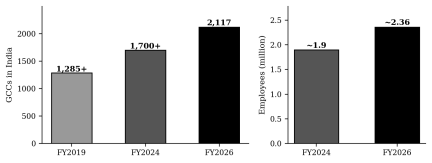
Fig. 1. India’s GCC base: number of centres and workforce. FY2019 and FY2024 centre counts from [8] (FY2024 is “1,700+”); FY2026 from [1]; FY2024 workforce of about 1.9 million from [3].
This article walks through five decisions that shape that “how”. None of them is glamorous. All of them are cheaper to get right at the start than to fix later.
5 Powerful Decisions for a Successful GCC Setup in India
A global capability centre (GCC) is a unit that a multinational owns and runs in another country to do work for the parent company. You will also hear the term captive centre used for the same idea.
The key word is owns. An outsourcing vendor serves many clients. A GCC serves one. And unlike a small sales office, it does real, ongoing work: engineering, analytics, finance operations, cybersecurity and more.
Why India keeps winning
The latest Zinnov-Nasscom landscape puts India’s GCC market revenue at an estimated $98.4 billion, and the number of centres has grown 32 percent since FY2021 [1]. The same report says nearly half of the GCCs set up since FY2021 had AI as a core focus from day one [1].
Cost still matters too. One industry estimate puts India’s overall cost advantage at 40 to 60 percent against comparable technical centres in the US, UK or Western Europe [6]. That figure comes from a service provider, so treat it as a ballpark rather than a promise.
Then there is talent. India turns out a large number of engineers, data professionals, finance specialists and management graduates every year [3]. For a company planning to hire hundreds of
1
people, that pipeline is hard to match.
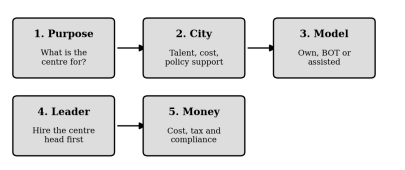
But a strong market does not make your setup automatic. Here are the five decisions that matter. Fig. 2. The five decisions covered in this article.
Decision 1: Be clear about what the centre is for
This sounds obvious. It is also the step most teams rush.
A centre built to cut costs on support work will look very different from one built to own a product line or an AI platform. The first needs process discipline and scale. The second needs senior engineers, design authority and real decision rights.
Write the charter in plain language before anything else. What work moves to India in year one? What moves in year three? Who in the parent company is willing to hand over ownership, and who is not?
If the headquarters team cannot answer those questions, the centre will drift. It will end up doing whatever lands on its desk.
Decision 2: Choose the city with your eyes open
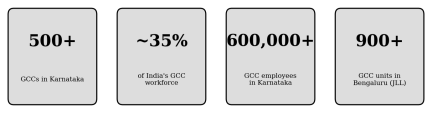
Bengaluru is the default for good reason. Karnataka’s own figures put the state past 500 GCCs, with about 35 percent of India’s GCC workforce and more than 600,000 employees, and JLL counts over 900 GCC units in Bengaluru alone [3].
That depth helps you hire and find vendors fast. It also means you are competing with everyone else for the same engineers.
Fig. 3. Karnataka and Bengaluru at a glance. Source: [3].
Other states are pushing hard to change this. Karnataka’s 2024 to 2029 GCC policy targets 500 new centres and 350,000 new jobs [3]. Gujarat and Tamil Nadu have their own GCC policies or schemes as well [3].
2
A simple way to think about it: a mature hub gives you speed and a deep talent pool at a higher cost and with more churn. A newer city can mean less competition, but a thinner supply of senior leaders. Neither is wrong. Pick based on the roles you need to fill in the first twelve months.
Decision 3: Pick the setup model that matches your appetite for risk This is the decision that shapes everything else. Broadly, there are three routes:
• Wholly owned (do it yourself): you set up the entity, hire the team and run the centre from day one.
• Build-Operate-Transfer (BOT): a partner builds and runs the centre for a period, then hands it over.
• Assisted build and operate: you own the centre from day one, while a partner helps with design and launch.
Zinnov frames it well. Every model trades off three things: control, speed and the execution risk the company carries [4]. You cannot maximise all three.
Fig. 4. The three setup routes compared. Based on [4] and [5].
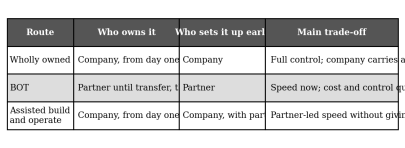
A wholly owned centre suits companies that have done this before and have leaders who know India well [4]. BOT is growing fast. Everest Group data, as cited by one consultancy, suggests BOT-style setups have gone from under 10 percent to about 40 percent of new GCC setups in India [5].
If you are new to India, the speed of a partner-led route is tempting. Just remember that cost and control questions come back at the handover stage.
Decision 4: Hire the leader before you hire the team
People often assume the building, the laptops and the legal entity come first. In practice, the centre head is the real starting point.
A good head knows the parent company’s culture and India’s hiring market. They can build the first team, set the tone and push back on headquarters when needed. Even partner-led launches usually cover location, entity setup, centre head hiring and the first team as core steps [4].
If the head is weak, the best location and the cleanest legal structure will not save the centre.
Decision 5: Do the money and compliance maths early
Setting up a GCC is a multi-year investment, not a one-quarter project [6]. Budget for the visible costs such as salaries, offices and technology, and also for the quieter ones: legal entity setup, tax planning, employment rules and ongoing compliance.
3
India’s GCCs sit under a web of legal, regulatory and tax requirements, and these are worth studying before you commit [7].
Scale changes the answer too. One cost analysis suggests a direct captive setup tends to become more economical once the team passes roughly 20 to 50 engineers, while smaller teams may be better off with a phased route [6]. Again, this comes from a vendor, so run your own numbers.
Three mistakes to avoid
First, copying a competitor. Their reasons for choosing a model may have nothing to do with yours.
Second, optimising only for speed or cost. Zinnov notes that teams who start there often end up restructuring later [4].
Third, forgetting the long game. A centre that starts with 50 people may need 500. Ask whether your choices of city, model and leadership can stretch that far.
A quick checklist before you begin
• Can you explain the centre’s purpose in two sentences?
• Do you know which roles you must hire in the first six months?
• Have you compared at least two cities on talent, cost and policy support?
• Have you chosen a setup model and understood what it costs at handover? • Is there a named leader, or a clear plan to hire one?
Conclusion
GCC setup India decisions look technical on paper, but they are really about clarity. What is the centre for, where will it sit, who will run it, and how much control do you want to keep?
India’s numbers speak for themselves: 2,117 centres, about 2.36 million professionals and a market approaching $100 billion [1]. The opportunity is real. The companies that benefit most will be the ones that treat the first five decisions as strategy, not paperwork.
Companies building a global capability centre can also explore how an AI operating model helps structure workflows, define accountability and improve operational performance.
References
[1] “Global Capability Centers in India see strong growth in 2026,” NewsOrbit, Aug. 2026. [Online]. Available: https://newsorbit.it.com/?p=2442. Accessed: Oct. 20, 2026.
[2] “India offshore tech revenue hits $98.4B in FY26, Nasscom,” Communications Today, 2026. [Online]. Available: https://www.communicationstoday.co.in/?p=406894. Accessed: Oct. 20, 2026.
[3] “Global capability centers: Statistics,” Flexiple, 2026. [Online]. Available: https://flexiple.com/gcc/statistics. Accessed: Oct. 20, 2026.
[4] Zinnov, “Which GCC setup model is right for your India center?” [Online]. Available: https://zinnov.com/which-gcc-setup-model-is-right-for-your-india-center/. Accessed: Oct. 20, 2026.
[5] Alp Consulting, “BOT vs in-house GCC,” Dec. 2025. [Online]. Available:
https://alp.consulting/bot-vs-in-house-gcc/. Accessed: Oct. 20, 2026.
[6] MetaDesign Solutions, “GCC setup cost in India: Full breakdown from entity registration to operations.” [Online]. Available: https://metadesignsolutions.com/blog/gcc-setup-cost-in-india-full-breakdown-operations. Accessed: Oct. 20, 2026.
[7] “Models of GCC in India,” Mondaq. [Online]. Available: https://www.mondaq.com/pdf/1585920.pdf. Accessed: Oct. 20, 2026.
[8] “India’s position as ‘GCC Capital of the World’: Nasscom and Zinnov study,” ThePrint, Sep. 2024. [Online]. Available:
4