
The BOT model for GCCs allows companies to build and operate an Indian global capability centre with a partner before taking full ownership through a planned transfer.
A few years ago, very few companies set up their Indian centres through a partner. Today it is common. Everest Group data, as cited by one consultancy, suggests BOT-style setups have risen from under 10 percent to roughly 40 percent of new GCC setups in India [4].
That is a big jump, and it raises an obvious question. Is the BOT model GCC route really that good, or is it just fashionable?
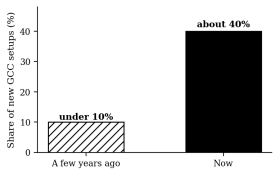
Fig. 1. Share of new GCC setups in India using BOT-style models (approximate). Based on Everest Group data cited in [4]. “Under 10%” is shown at its upper bound.
The honest answer is that it depends on your size, your experience and your patience. This article breaks the model down into six lessons, with the pros and the pitfalls side by side.
6 Powerful Lessons on the BOT Model for GCCs
BOT stands for Build-Operate-Transfer. A service provider sets up your offshore unit, runs it for an agreed period, and then hands full ownership to you.
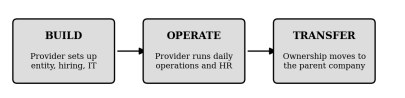
The three phases are simple on paper [2]:
• Build: the provider handles the location, legal compliance, hiring and IT infrastructure. • Operate: the provider manages daily operations, security, HR and knowledge transfer. • Transfer: the infrastructure, the team and the operations move to the parent company, usually with some support afterwards.
Fig. 2. The three phases of a BOT engagement. Based on [2].
The alternative is the in-house route, where the parent company sets up a captive centre itself and owns every step from day one. A captive centre, in plain terms, is simply a centre the company owns
1
outright.
So BOT is a way of reaching a captive centre without carrying all the early risk yourself.
Lesson 1: The partner carries the early risk
This is the biggest selling point. If your company has never operated in India, you face a long list of unknowns: entity registration, local hiring, payroll, office space, regulatory filings.
With BOT, the partner takes these on. One provider argues that BOT can be more cost-effective for organisations that lack local expertise and would otherwise lose 12 months or more in unproductive setup time [2]. That claim comes from a vendor who sells BOT, so read it with some care. Still, the logic holds. A team that already knows the terrain moves faster than one learning it for the first time.
Lesson 2: Control is limited until the handover
Here is the trade-off nobody should skip over. During the operate phase, control sits mostly with the partner. Full control arrives only after the transfer [4].
In an in-house GCC, the parent company has full control from day one [4]. That matters if your centre will handle sensitive data, core intellectual property or work that needs tight integration with headquarters.

Fig. 3. BOT versus in-house GCC on control and long-term cost. Based on [4].
So ask yourself early: how much of this work can sit with a partner for two or three years without making you uncomfortable?
Lesson 3: The transfer is where things get hard
Most BOT conversations focus on the build. Experienced advisers say the transfer deserves just as much attention.
Zinnov puts it bluntly: the cost of BOT arrives at transfer, and companies should plan the handover from day one so it does not turn into a second setup [1]. Another provider calls the transfer phase the most critical and often the most underestimated part of a BOT engagement [2].
Think about what moves in a handover. People, contracts, tools, processes, and the knowledge in the heads of the team. If any of those are fuzzy, the transfer drags on.
A smart company agrees on the transfer terms before the build starts. That includes timelines, pricing, who gets hired by whom and what happens to key staff.
Lesson 4: The numbers are a ballpark, not a quote
Costs are the next question everyone asks. One provider estimates that a BOT engagement for a 50-person team over three years typically costs $3 million to $5 million [2].
2
The same company says a direct captive setup generally becomes more economical once a team grows beyond roughly 20 to 50 engineers [3]. For teams under 30, it says the BOT route is consistently more cost-effective on a risk-adjusted basis [3].
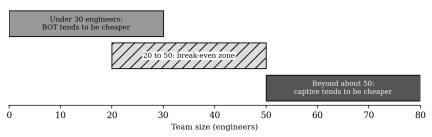
Fig. 4. Rough team-size guide from a BOT provider’s cost analysis [3]. Vendor estimates; treat as indicative only.
These are useful reference points, but notice who is saying them. Both come from a firm that offers BOT services. Use them to frame your questions, and then ask two or three providers for their own numbers.
Also remember that long-term costs can look different. Post-transfer costs can end up high in a BOT arrangement, while an in-house centre tends to have lower long-term operating costs [4].
Lesson 5: Size and stage decide the fit
BOT tends to work best in a few situations:
• You are entering India for the first time and have no local team.
• You want to start fast, with a small team, and prove the case before investing heavily. • You lack leaders with experience of setting up centres in India.
It tends to work less well when you are already large, already know India, or need full control from the start [4]. A company with an experienced India leadership team may find the partner layer adds cost without adding much value.
A practical rule: the more you already know about India, the less you need to pay someone to teach you.
Lesson 6: There is a middle path
BOT is not the only partner-led option. Zinnov is seeing a clear shift toward what it calls Assisted Build and Operate, where the company owns the centre from day one and a partner helps with design, implementation and governance through launch [1].
That covers things like location, entity setup, hiring of the centre head and the first team [1]. The company keeps ownership and avoids a painful transfer later.
This route also works when different capabilities, locations or growth stages need different levels of support. If part of your work could wait for a later transfer, BOT can stay on the table for that part alone [1].
Questions to ask before signing a BOT contract
• What exactly transfers, and when? Get this in writing.
• What does the transfer cost, and is it fixed or negotiated later?
• Who owns the intellectual property created during the operate phase?
3
• What happens to the team? Will key people stay after the handover?
• Who is accountable for regulatory compliance during the build and operate phases? [6] If a provider is vague on any of these, treat that as information.
A note on the sources
A lot of the public material on BOT comes from companies that sell BOT services. That does not make it wrong, but it does mean the numbers lean optimistic. Where possible, compare vendor claims with neutral commentary from advisers or industry bodies, and ask for case examples [5].
Conclusion
The BOT model GCC route is neither a shortcut nor a trap. It is a trade. You give up some control and accept a handover cost, and in return you get speed and a partner who has done this before.
It makes the most sense for first-time entrants and smaller teams. For experienced companies, an in-house or assisted model may serve better. Whichever way you lean, plan the transfer on day one, ask hard questions about cost, and remember that the real test of a GCC is not how fast it launches, but how well it runs once it is truly yours.
Before choosing a build-operate-transfer arrangement, companies should understand the key decisions involved in GCC setup in India, including location, leadership, operating models and compliance.
References
[1] Zinnov, “Which GCC setup model is right for your India center?” [Online]. Available: https://zinnov.com/which-gcc-setup-model-is-right-for-your-india-center/. Accessed: Oct. 20, 2026.
[2] MetaDesign Solutions, “Understanding the Build-Operate-Transfer (BOT) model for offshore operations.” [Online]. Available: https://metadesignsolutions.com/blog/understanding-the-build-operate-transfer-bot-model for-offshore-operations. Accessed: Oct. 20, 2026.
[3] MetaDesign Solutions, “GCC setup cost in India: Full breakdown from entity registration to operations.” [Online]. Available: https://metadesignsolutions.com/blog/gcc-setup-cost-in-india-full-breakdown-operations. Accessed: Oct. 20, 2026.
[4] Alp Consulting, “BOT vs in-house GCC,” Dec. 2025. [Online]. Available:
https://alp.consulting/bot-vs-in-house-gcc/. Accessed: Oct. 20, 2026.
[5] ANSR, “Build an offshore team in India with the BOT model.” [Online]. Available: https://ansr.com/?p=59820. Accessed: Oct. 20, 2026.
[6] “Models of GCC in India,” Mondaq. [Online]. Available: https://www.mondaq.com/pdf/1585920.pdf. Accessed: Oct. 20, 2026.
4
