Introduction
AI agents in consulting help teams streamline research, analyze business data, automate repetitive tasks and improve project delivery while keeping human experts involved.
A consulting project is rarely about the recommendation as such. Before proposing a certain action plan, consultants need to investigate the client’s business and industry, consider possible options, and share their conclusions. It takes time, effort, and co-ordination to perform each step correctly.
AI agents can be programmed to perform multiple connected tasks in a coherent manner. Instead of carrying out isolated activities, like searching for information, an AI agent consulting team can be composed of separate workers that collect, organise, and evaluate research findings.
Businesses are interested in how such software can help in delivering projects more efficiently, and enterprise AI software is seeing a significant increase in investment. There are already several startups working on related concepts, such as Ema. From a consulting perspective, the essential idea is to leverage AI to make project delivery smoother, reduce repetitive tasks, and give employees more time to focus on actual problems.
7 Powerful Ways AI Agents Are Transforming Consulting Delivery
Consultants may waste a lot of time pulling together relevant reports, articles, market statistics, and other data that they will use for supporting their recommendation. After gathering relevant facts, analysts may need to spend plenty of time organizing and presenting the results comparing one fact to another.
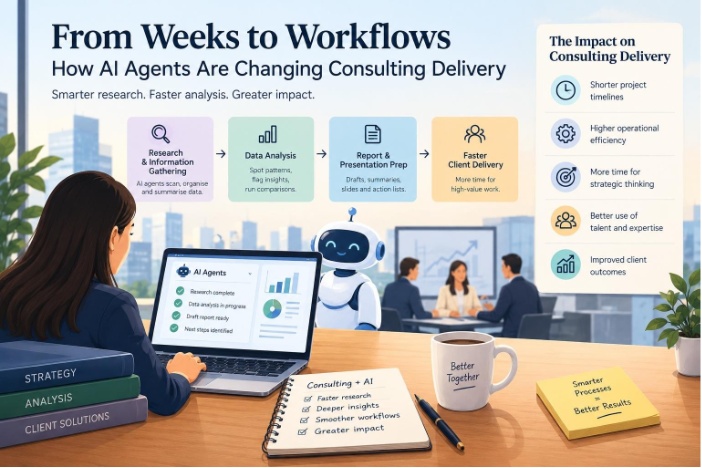
An AI agent consulting team can be trained to search the web, gather reports from different sources, analyze and present preliminary conclusions. Various agents can be employed to monitor general tendencies, the level of competition, buyer demands, and other relevant data. The results can be presented in a report showcasing the industry outlook answering the consulting question. Overall, it can be concluded that the described approach might spare consultants a lot of time spent on completing reports. However, analysts should always make sure that the data retrieved by agents are relevant and credible.
Find More Meaningful Information Faster
Most consulting projects produce plenty of reports regarding finances, performance, staffing, and other crucial topics. However, finding outliers in the data and examining performance patterns take time and effort. Software could be used to sift through available reports and find the most interesting bits.
For example, an AI agent could be used to look for patterns in logistics company operations during a project about supply chain optimisation. Multiple workers could look through delivery records to find days or months with particularly poor performance. Then, an agent or human worker could be used to determine why it happened, what specific circumstances led to delays or disruptions, and how the issue could be resolved.
Reduce Time Spend On Meeting’s Coordination, Report Writing And Other Tasks Essay
Consultants have to devote too much time to monitoring the progress of their project, updating clients, setting action items, recording decisions approved at meetings, and other activities like these apart from their primary tasks. Although this activity is essential, it is also very time-consuming as it is for a small crew of workers.
The task could be automated using AI agents that would be able to organize the information from presentation records or project reports into general outlines, summarize the results, remind of the upcoming deadlines, and perform other simple operations. In combination with one another, the agents would make the process of progressing faster and decrease the amount of time spent on it significantly. In addition, if the programs are interconnected, they would be able to utilize data collected by others rather than collect it twice, which would make them faster and more efficient.
For example, one AI agent could use the results collected by another to build a presentation and report outline. However, the information would still have to be reviewed by people to ensure that it is correct and does not have errors.
Re-Design The Project Workflow
The ability to make small and large tasks repeatable and automated is what can fundamentally impact how a company operates. When designing a project around AI capabilities, organisations should think about when these workers could be actively used to make a real difference.
If there are multiple AI agents involved in the project, they usually do not operate on a single task before moving on to the next. Instead, they are programmed to operate on multiple stages at once. For example, research agents could operate on an independent but connected tasks to compile findings into a list of relevant information, while analysts look through datasets for patterns and outliers. Once the analysts have gathered enough data, they can move on to the interpretation and presentation stage.
This approach may reduce many of the project’s idle periods. However, businesses must understand that not everything can be adjusted to make one employee seem like ten. Clients, software, and operations can dictate when a certain stage starts and ends. A company should be realistic when streamlining its operations and only optimise those tasks which are actually impacted by AI.
Keep Everything Trustworthy And Accountable
When searching for ways to improve the efficiency of a project, most company representatives tend to neglect the importance of maintaining quality control. Few clients would be interested in receiving an end result that is produced faster but is of worse quality. Even more importantly, businesses should be aware that human error may become an integral part of the new production process.
To begin with, consultancies should ensure that all the data and programs that contain confidential, sensitive, and secret information are protected and only accessible by one individual or software that is supposed to use or edit them. Wherever possible, one should use databases that have been tried and tested and only use documents that are encrypted. Consultants should always be able to go through reports to check for inconsistencies, grammatical mistakes, and improper formatting. One should remain wary of mistakes and focus on eliminating them while working on the assumption that processes ought to be made faster but not easier.
In my opinion, the capacity to measure and observe changes is the best way of making sure that there are faster outcomes without compromising the quality of work done. For example, one should be able to contrast the time taken, number of changes, costs incurred, and customer satisfaction. In this case, then, only by evaluating and analyzing such indicators can one say that a change has led to a form of stasis or progress.
Finally, I think that it is critical to train employees to operate with automatic functions and control the time they spend working on a particular task. In addition, wherever possible, they should ask questions and only accept answers that seem correct to them. Most importantly, consultants should adhere to the principle of responsibility when performing their work.
Conclusion
AI agents allow consulting companies to offer new ways to generate reports, use data, and operate projects. In doing so, they address many activities at different levels, making the whole process more efficient and reliable. It must also be noted that, in any consulting activity, these factors can only be used to good effect if the appropriate data, methods, and personnel are involved.
After all, it is the combination of automation and human experience that will allow the firm to become more efficient and, therefore, more attractive to customers. In any case, consulting companies are intermediaries that make human work shorter, more comfortable, and more productive. In the future, the critical factor in the development of any company will be not so much quantity as quality. This is because the ability to perform one’s work better than others will be the primary competitive advantage of any business. In turn, for consulting firms, such a competitive advantage will be provided by the application of AI agents.
From Weeks to Workflows: How AI Agents Are Changing Consulting Delivery Essay
Introduction
A consulting project is rarely about the recommendation as such. Before proposing a certain action plan, consultants need to investigate the client’s business and industry, consider possible options, and share their conclusions. It takes time, effort, and co-ordination to perform each step correctly.
AI agents can be programmed to perform multiple connected tasks in a coherent manner. Instead of carrying out isolated activities, like searching for information, an AI agent consulting team can be composed of separate workers that collect, organise, and evaluate research findings.
Businesses are interested in how such software can help in delivering projects more efficiently, and enterprise AI software is seeing a significant increase in investment. There are already several startups working on related concepts, such as Ema. From a consulting perspective, the essential idea is to leverage AI to make project delivery smoother, reduce repetitive tasks, and give employees more time to focus on actual problems.
- Turn Research Into A More Streamlined Task
Consultants may waste a lot of time pulling together relevant reports, articles, market statistics, and other data that they will use for supporting their recommendation. After gathering relevant facts, analysts may need to spend plenty of time organizing and presenting the results comparing one fact to another.
An AI agent consulting team can be trained to search the web, gather reports from different sources, analyze and present preliminary conclusions. Various agents can be employed to monitor general tendencies, the level of competition, buyer demands, and other relevant data. The results can be presented in a report showcasing the industry outlook answering the consulting question. Overall, it can be concluded that the described approach might spare consultants a lot of time spent on completing reports. However, analysts should always make sure that the data retrieved by agents are relevant and credible.
- Find More Meaningful Information Faster
Most consulting projects produce plenty of reports regarding finances, performance, staffing, and other crucial topics. However, finding outliers in the data and examining performance patterns take time and effort. Software could be used to sift through available reports and find the most interesting bits.
For example, an AI agent could be used to look for patterns in logistics company operations during a project about supply chain optimisation. Multiple workers could look through delivery records to find days or months with particularly poor performance. Then, an agent or human worker could be used to determine why it happened, what specific circumstances led to delays or disruptions, and how the issue could be resolved.
- Reduce Time Spend On Meeting’s Coordination, Report Writing And Other Tasks Essay
Consultants have to devote too much time to monitoring the progress of their project, updating clients, setting action items, recording decisions approved at meetings, and other activities like these apart from their primary tasks. Although this activity is essential, it is also very time-consuming as it is for a small crew of workers.
The task could be automated using AI agents that would be able to organize the information from presentation records or project reports into general outlines, summarize the results, remind of the upcoming deadlines, and perform other simple operations. In combination with one another, the agents would make the process of progressing faster and decrease the amount of time spent on it significantly. In addition, if the programs are interconnected, they would be able to utilize data collected by others rather than collect it twice, which would make them faster and more efficient.
For example, one AI agent could use the results collected by another to build a presentation and report outline. However, the information would still have to be reviewed by people to ensure that it is correct and does not have errors.
- Re-Design The Project Workflow
The ability to make small and large tasks repeatable and automated is what can fundamentally impact how a company operates. When designing a project around AI capabilities, organisations should think about when these workers could be actively used to make a real difference.
If there are multiple AI agents involved in the project, they usually do not operate on a single task before moving on to the next. Instead, they are programmed to operate on multiple stages at once. For example, research agents could operate on an independent but connected tasks to compile findings into a list of relevant information, while analysts look through datasets for patterns and outliers. Once the analysts have gathered enough data, they can move on to the interpretation and presentation stage.
This approach may reduce many of the project’s idle periods. However, businesses must understand that not everything can be adjusted to make one employee seem like ten. Clients, software, and operations can dictate when a certain stage starts and ends. A company should be realistic when streamlining its operations and only optimise those tasks which are actually impacted by AI.
- Keep Everything Trustworthy And Accountable
When searching for ways to improve the efficiency of a project, most company representatives tend to neglect the importance of maintaining quality control. Few clients would be interested in receiving an end result that is produced faster but is of worse quality. Even more importantly, businesses should be aware that human error may become an integral part of the new production process.
To begin with, consultancies should ensure that all the data and programs that contain confidential, sensitive, and secret information are protected and only accessible by one individual or software that is supposed to use or edit them. Wherever possible, one should use databases that have been tried and tested and only use documents that are encrypted. Consultants should always be able to go through reports to check for inconsistencies, grammatical mistakes, and improper formatting. One should remain wary of mistakes and focus on eliminating them while working on the assumption that processes ought to be made faster but not easier.
In my opinion, the capacity to measure and observe changes is the best way of making sure that there are faster outcomes without compromising the quality of work done. For example, one should be able to contrast the time taken, number of changes, costs incurred, and customer satisfaction. In this case, then, only by evaluating and analyzing such indicators can one say that a change has led to a form of stasis or progress.
Finally, I think that it is critical to train employees to operate with automatic functions and control the time they spend working on a particular task. In addition, wherever possible, they should ask questions and only accept answers that seem correct to them. Most importantly, consultants should adhere to the principle of responsibility when performing their work.
Conclusion
AI agents allow consulting companies to offer new ways to generate reports, use data, and operate projects. In doing so, they address many activities at different levels, making the whole process more efficient and reliable. It must also be noted that, in any consulting activity, these factors can only be used to good effect if the appropriate data, methods, and personnel are involved.
After all, it is the combination of automation and human experience that will allow the firm to become more efficient and, therefore, more attractive to customers. In any case, consulting companies are intermediaries that make human work shorter, more comfortable, and more productive. In the future, the critical factor in the development of any company will be not so much quantity as quality. This is because the ability to perform one’s work better than others will be the primary competitive advantage of any business. In turn, for consulting firms, such a competitive advantage will be provided by the application of AI agents.
Consulting firms adopting AI agents can also explore how an AI operating model helps redesign workflows, define accountability and measure business outcomes.
External links to add
Add these relevant links within the article content: