
Six New Unicorns in 9M 2026:
Common Traits Founders Can Copy
A data-led article on capital efficiency, startup traits, and India’s changing funding climate
| KEY TAKEAWAY India’s first-nine-month 2026 unicorn cohort reportedly reached the $1 billion valuation milestone after raising an average of $101 million before the unicorn round—less than half the $205 million average reported for the comparable 2025 period. The lesson is not simply “raise less”; it is to prove value earlier and deploy capital more deliberately. |
7 Powerful Startup Traits Founders Can Learn From India’s Unicorns in 2026
Unicorns 2026 highlight how Indian startups can build investor confidence through capital efficiency, repeat customer demand, strong unit economics, and disciplined growth.
India’s startup market is showing a split signal: total technology funding increased, but investors participated in fewer deals and became more selective. Tracxn’s India Tech 9M 2026 data, reported on September 24, puts funding at $10.3 billion for January–September 21, up 7% year on year, while funding rounds declined 38% to 1,134. In the same period, six new unicorns were reported—50% more than the four in 9M 2025.
The defining signal is capital efficiency. The six-company cohort reportedly raised an average $101 million before its unicorn round, versus $205 million for the comparable 2025 cohort. That is approximately 51% lower. This does not prove that every company had better economics, nor does valuation guarantee long-term success. It does suggest that a stronger case for scale can be built with less accumulated capital when customer demand, execution, and investor confidence line up.
For founders, the practical message is to build evidence before scale: solve a narrow, costly problem; measure repeat usage; make revenue quality visible; watch unit economics; and use funding to accelerate a working engine rather than to search for one.
At a glance: the headline numbers
| Indicator | 9M 2026 | Year-on-year signal |
| India tech funding | $10.3 billion | +7% |
| Funding rounds | 1,134 | −38% |
| New unicorns | 6 | 4 in 9M 2025; +50% |
| Average capital raised before unicorn round | $101 million | vs $205 million in 9M 2025 |
| Seed funding | $698 million | −37% |
| Early-stage funding | $4.2 billion | +27% |
| Late-stage funding | $5.4 billion | Broadly steady |
Source: Tracxn India Tech 9M 2026 figures as reported by ETCIO/IANS and Business Standard. Period covered is January 1 to September 21, 2026; percentages are reported year-on-year comparisons.
Chart 1. More unicorns, less pre-unicorn capital
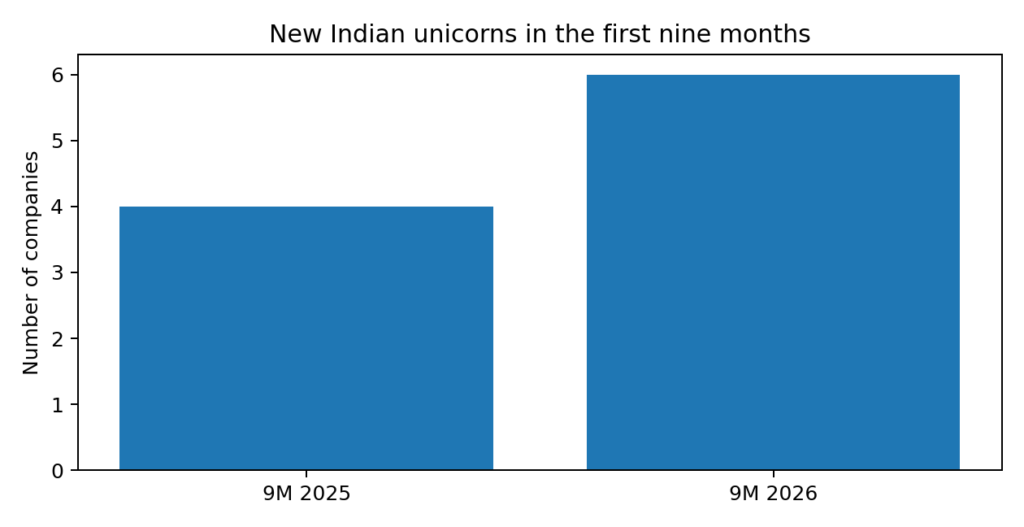
The reported count rose from four to six. This is a small cohort, so it should be treated as a directional signal rather than proof of a permanent trend.
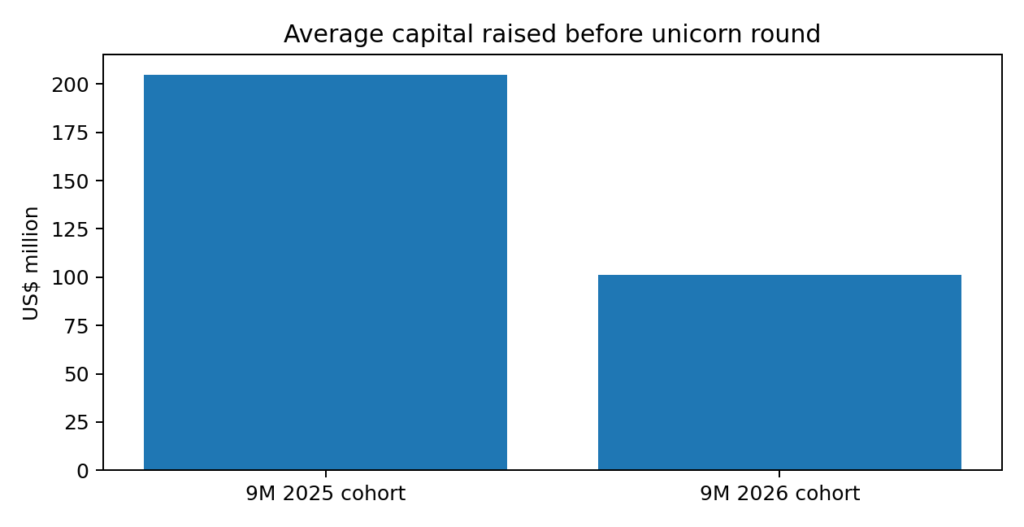
The average pre-unicorn capital figure fell by about 51% ($104 million lower). “Before the unicorn round” is a specific measure; it is not the total lifetime capital raised by these businesses and should not be interpreted as a direct measure of profitability.
What changed in India’s funding market?
1. Investors are making fewer, more concentrated bets
Funding rounds fell 38% even as total dollars increased 7%. The market therefore appears to be concentrating money in fewer, larger transactions. Reports cited 18 rounds of $100 million or more during the period. This rewards startups that can show clear traction, credible execution, and a large opportunity—not just an ambitious pitch.
2. Capital is flowing toward later proof points and infrastructure
Seed funding fell 37% to $698 million, while early-stage funding rose 27% to $4.2 billion and late-stage funding was broadly steady at $5.4 billion. Enterprise Applications, FinTech, and Enterprise Infrastructure were among the stronger areas. Enterprise Infrastructure funding reportedly rose 436% to $1.6 billion, while Enterprise Applications attracted $3.5 billion and FinTech $2.2 billion.
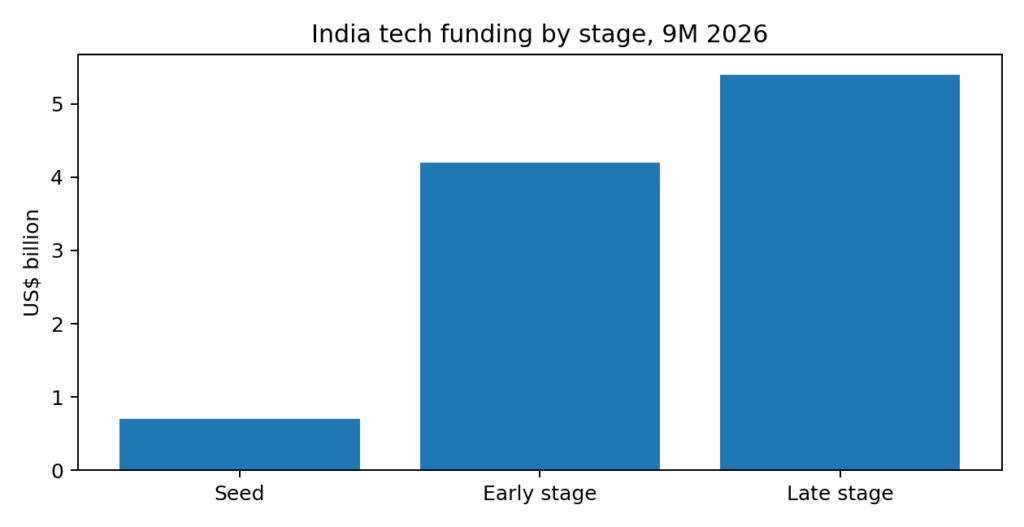
Note: the chart uses reported funding amounts. Stage categories and totals may not sum to the headline total because reports may classify rounds or categories differently.
3. Speed matters—but sustainable speed matters more
The reported average time for the new unicorns to cross the $1 billion funding milestone after Series A fell to 4.9 years, from 6.6 years in the comparable prior-year cohort. Faster progress can indicate stronger product-market fit or a more focused scaling path. It can also reflect sector mix, funding-round timing, and private-market valuation conditions; it is not by itself proof of durable business quality.
Six startup traits founders can copy
1. Start with a painful, specific customer problem
Pick a problem customers already spend money or time trying to solve. Interview users, observe their workflow, and identify what is slow, risky, expensive, or unreliable. A narrow initial market can make product decisions and sales messaging sharper.
2. Prove repeat demand before expanding
Track retention, repeat purchase, weekly/monthly active use, renewal rates, and customer referrals. Early demand is more convincing when customers return without constant discounts or founder-led persuasion.
3. Make unit economics visible
Know gross margin, contribution margin, customer acquisition cost (CAC), payback period, churn, and lifetime value (LTV). These metrics reveal whether growth creates value or merely consumes cash.
4. Use capital against milestones
Connect each funding tranche to measurable milestones—such as product reliability, paid conversions, repeat usage, regulatory readiness, or a proven acquisition channel. Avoid hiring and marketing ahead of evidence.
5. Build a repeatable distribution engine
Find one or two channels that consistently reach the right buyers. Test partnerships, founder-led sales, content, referrals, integrations, or product-led growth; scale the channels only after measuring conversion and payback.
6. Create trust as a competitive advantage
Protect customer data, explain pricing, deliver reliable service, and handle complaints quickly. In regulated or high-stakes categories, compliance and risk management are product features, not paperwork.
7. Keep the operating model simple
Automate repetitive work, keep a short list of company-level metrics, and assign clear owners to each target. A lean organisation can learn faster when decisions and feedback loops are clear.
Founder playbook: from problem to scalable business
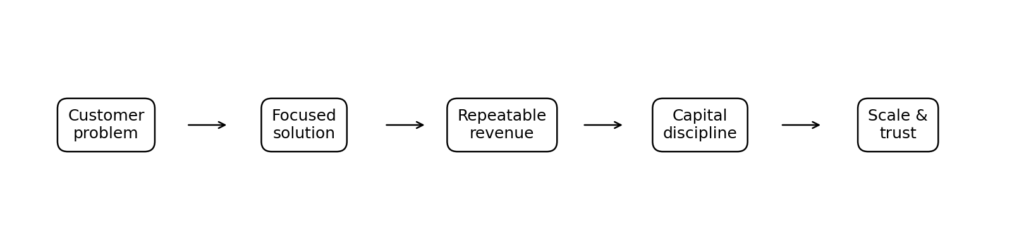
Use this as a sequence, not a rigid formula. If customers do not return or the economics are weak, go back to the problem, product, or pricing before adding more capital.
A practical 90-day plan
- Days 1–30: Validate: Interview 15–25 target customers; document the top three pain points; test a landing page, prototype, or manual service; define one primary success metric.
- Days 31–60: Prove repeatability: Run a small paid pilot; track activation, repeat use, conversion, gross margin, and support issues; identify why customers stay or leave.
- Days 61–90: Improve economics: Test pricing and acquisition channels; calculate CAC and payback where possible; remove low-value features and expenses; set the next milestone and capital requirement.
What founders should measure every month
| Area | Suggested measures |
| Demand | Qualified leads, conversion rate, active customers, retention, repeat purchase, renewal rate |
| Revenue quality | Recurring revenue, gross margin, revenue concentration, refunds, overdue payments |
| Efficiency | CAC, CAC payback, contribution margin, burn rate, runway, revenue per employee |
| Customer value | Time to value, satisfaction, support resolution time, referral rate |
| Execution | Milestone completion, product reliability, sales cycle length, forecast accuracy |
Important caution: unicorn valuation is not the finish line
A unicorn is a privately held startup valued at $1 billion or more. The label reflects a financing or valuation event, not necessarily profitability, cash generation, or a successful exit for all shareholders. Market reports can also differ in timing, company inclusion, and definitions.
For example, Tracxn-based reporting cited six new unicorns through September 21, while Inc42’s tracker reported seven by August 2026 and described a broader list that included Juspay, Sarvam, KreditBee, Skyroot Aerospace, Emergent, Square Yards, and Astrotalk. This apparent mismatch likely reflects differences in source methodology, cutoff dates, or what each tracker counts as a unicorn event. For a published article, use the six figure specifically as the Tracxn 9M 2026 finding and avoid presenting a company-by-company list as definitive without checking the original dataset.
Founders should therefore aim for durable customer value, sound governance, transparent reporting, and resilient economics—not the label alone.
Conclusion
The central story behind “unicorns 2026” is not that capital no longer matters. It is that capital is increasingly expected to follow evidence. India’s six reported new unicorns in the first nine months of 2026 reached the milestone after raising materially less pre-unicorn capital on average than the comparable 2025 cohort. Founders can learn from the pattern by proving a real problem, earning repeat customers, measuring unit economics, and scaling only what works. The best startup trait to copy is disciplined learning: use every customer interaction and every rupee spent to reduce uncertainty.
Founders can strengthen their investment readiness by applying startup fundraising strategies that connect funding milestones with customer validation, capital efficiency, and sustainable business growth.
SEO details
Primary keyword: unicorns 2026
Secondary keyword: startup traits
Suggested meta description: India added six new unicorns in 9M 2026 while average pre-unicorn capital fell. Explore the startup traits founders can copy to grow efficiently.
Suggested URL slug: six-new-unicorns-9m-2026-startup-traits
Suggested image alt text: Bar charts comparing India’s new unicorn count and average pre-unicorn capital in 9M 2025 and 9M 2026.
References
- ETCIO / IANS, “India’s tech funding rises 7% to $10.3 billion in 2026 so far” (published September 24, 2026). Core 9M data: funding, rounds, stage split, unicorn count, average pre-unicorn capital. — https://cio.economictimes.indiatimes.com/news/investments/india-tech-funding-rises-7-pc-to-10-3-billion-in-2026-so-far/134459109
- Business Standard, “India tech funding rises 7 per cent to $10.3 billion in first nine months of 2026” (September 24, 2026). Funding concentration and unicorn comparison. — https://www.business-standard.com/industry/news/india-tech-funding-rises-7-per-cent-to-10-3-billion-in-first-nine-months-of-2026-126092400606_1.html
- Fortune India, “India tech funding hits $10.3 billion in 9M 2026 as capital shifts to bigger bets.” Sector and funding-stage context. — https://www.fortuneindia.com/technology/india-tech-funding-hits-103-billion-in-9m-2026-as-capital-shifts-to-bigger-bets/160921
- Fortune India, “Is India’s unicorn boom losing steam? Valuations reset, fewer billion-dollar startups as profitability takes priority” (August 20, 2026). Context on unicorn valuation status and investor focus. — https://www.fortuneindia.com/startups-news/is-indias-unicorn-boom-losing-steam-creation-falls-to-single-digits-as-10-startups-lose-billion-dollar-status/154857
- Inc42, “Indian Unicorn Tracker: Funding, Investors, Revenue And More” (August 15, 2026). Broader tracker context and differing cohort counts. — https://inc42.com/features/indian-unicorn-tracker-funding-investors-revenue-and-more/
Editorial note: Statistics and company-count comparisons reflect the cited sources and their stated time windows. Recheck source pages immediately before publication, especially if updating the article beyond September 2026.
Reports — Reference Screenshot Layout
The following report screenshots were supplied by the user and have been added to match the requested layout. Please confirm that these scores were generated from this article before presenting them as article-specific results.
GRAMMARLY — Writing performance and word count
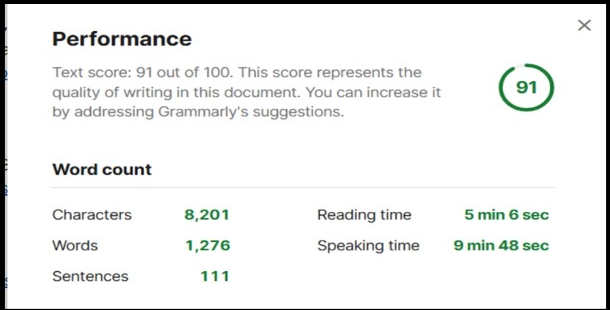
The reference screenshot shows a text score of 91/100, 1,276 words, 111 sentences, 5 min 6 sec reading time, and 9 min 48 sec speaking time. Verify these figures in Grammarly against the final article.
PLAGIARISM REPORT — Similarity and originality

The reference screenshot shows 3% exact match, 0% partial match, and 97% unique/original content. Similarity results depend on the tool and its database; verify them on the final article.
AI DETECTION REPORT — AI/GPT estimate

The reference screenshot shows 4.5% AI GPT and labels the text “Human written.” AI detectors can produce false positives and do not conclusively establish authorship. Run the final article through the same detector if an article-specific result is required.