
Bengaluru Takes 43% of Tech Funding:
How Founders Elsewhere Can Compete
A practical guide to building investor confidence beyond India’s biggest startup hub
Primary keyword: startup hubs | Secondary keyword: bengaluru funding | Research cut-off: 23 October 2026
7 Powerful Ways Startup Hubs Outside Bengaluru Can Attract Investors
Startup hubs across India can attract investor confidence by demonstrating customer demand, strong execution, financial discipline, and a clear path to sustainable growth.
Bengaluru’s dominance in India’s technology funding market is clear: startups in the city raised about US$4.4 billion in the first nine months of 2026, equal to 43% of India’s tech funding for the period. The figure was up from US$3.6 billion and a 38% share in the comparable period of 2025. Yet the story is not simply that founders must move to Bengaluru to raise capital. Mumbai attracted US$1.8 billion, Gurugram US$1.6 billion and other cities continued to attract meaningful investment. The more useful lesson is that capital follows credible opportunities: a clearly defined market, strong execution, evidence of customer demand, a realistic path to profitability and a disciplined fundraising process.
This article explains what the latest figures do—and do not—say, why established startup hubs retain an advantage, and how founders in emerging or smaller ecosystems can compete without automatically relocating. It includes a city comparison chart, a fundraising-readiness diagram, a practical checklist and the supplied grammar, plagiarism and AI-detection report screenshots.
The headline numbers: what happened in 9M 2026?
According to coverage of Tracxn’s India Tech – 9M 2026 Report, India’s technology companies raised US$10.3 billion from 1 January to 21 September 2026, compared with US$9.7 billion in the same period of 2025. The total rose even though reported funding rounds fell from 1,838 to 1,134. This suggests that a smaller number of larger transactions played an outsized role in the aggregate total. It does not mean that fundraising became easier for every startup.
Bengaluru captured US$4.4 billion, nearly matching the US$4.8 billion collectively raised by Mumbai, Gurugram, Noida, Delhi and Hyderabad. Bengaluru’s funding increased by about 22% from US$3.6 billion in 9M 2025. These are technology-funding figures for a defined reporting period, not a guarantee of what any city or company will raise in the future.
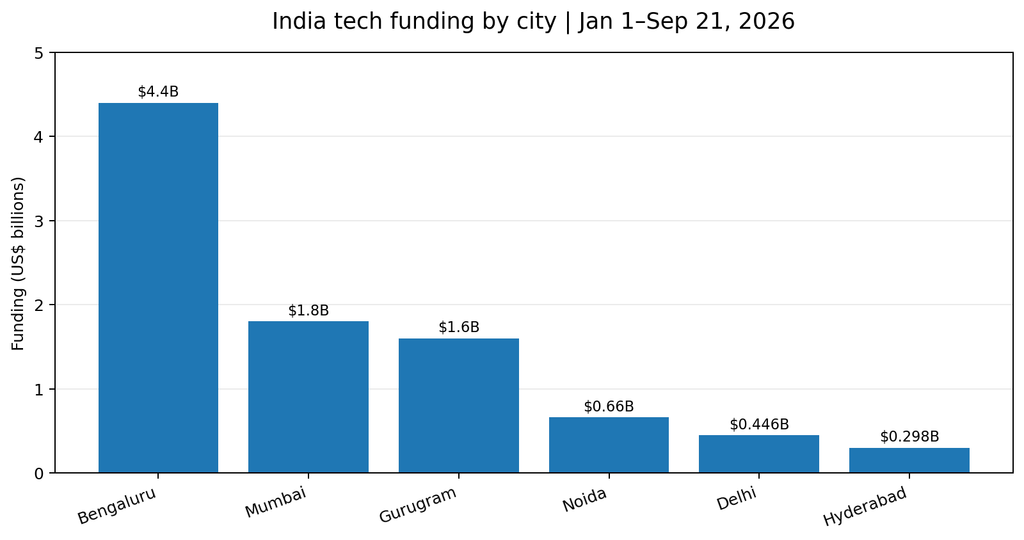
Figure 1. Selected city funding totals reported for 1 January–21 September 2026. Values are in US$ billions; smaller values are rounded.
What the data says about India’s startup hubs
| City / hub | Reported funding | What founders can learn |
| Bengaluru | US$4.4B | Deep tech talent, repeat founders, investor networks and larger late-stage rounds create a strong concentration effect. |
| Mumbai | US$1.8B | Financial services, enterprise businesses and access to capital-market networks can be useful advantages. |
| Gurugram | US$1.6B | A fast-growing funding total shows that large transactions can materially change a city’s annual picture. |
| Noida | US$660M | A distinct NCR base can still support technology businesses without requiring a Bengaluru address. |
| Delhi | US$446M | Year-to-year funding can vary sharply; one period should not be treated as a permanent ranking. |
| Hyderabad | US$298M | A smaller funding total can coexist with sector-specific strengths and an emerging ecosystem. |
Why Bengaluru attracts such a large share
1. Dense networks reduce friction
Investors, experienced operators, accelerators, service providers and potential hires are more likely to know one another in a mature ecosystem. Warm introductions can make it easier for a founder to get an initial meeting, and a larger pool of experienced employees can help a young company recruit quickly. These advantages are real, but they are network advantages—not proof that a company outside Bengaluru is less investable.
2. Sector depth creates repeatable expertise
Bengaluru has a broad technology base spanning software, fintech, mobility, enterprise technology and AI. When investors repeatedly see companies in a sector, they may become more familiar with its metrics, business models and risks. Founders elsewhere can respond by demonstrating equivalent sector knowledge, customer access and execution quality.
3. Large rounds can dominate city totals
The 9M 2026 reporting highlighted several sizeable Bengaluru rounds, including CRED, Rapido and Sarvam. A small number of large transactions can lift a city’s aggregate funding substantially. Therefore, total dollars raised should be read alongside deal count, stage, sector and the number of companies receiving capital. Headline totals alone do not show how accessible funding is to a first-time founder.
4. Capital is selective across the country
India’s total tech funding increased year-on-year in the reported period, while the number of rounds declined substantially. For founders, this points to the importance of preparation: investors may spend more time comparing evidence of demand, revenue quality, retention, gross margins, burn rate and the next milestones that capital will fund.
How founders outside Bengaluru can compete
Start with a sharper problem—not a city move
A founder should be able to explain the customer, the costly or frustrating problem, how the current alternatives fail and why the proposed solution is better. A specific problem in a well-understood niche is often more convincing than a broad claim to be building a platform for everyone. Conduct customer interviews, test pricing, and document evidence before making fundraising the first milestone.
Prove demand with measurable signals
Depending on the business model, useful signals can include paid pilots, repeat orders, active usage, renewal rates, signed letters of intent, wait-list conversion, reduced processing time or measurable customer savings. Distinguish vanity metrics—such as raw downloads or social followers—from evidence that customers use, pay for and continue to value the product.
Use geography as an advantage
A company outside the largest hubs may have closer access to a particular customer segment, local supply chain, university, manufacturing cluster, agricultural network or public-sector use case. Founders should explain how this proximity creates better data, lower service costs, faster pilots or differentiated distribution. The aim is not to apologise for the location; it is to show why the location improves the business.
Build a national investor pipeline
Map investors by sector, stage, cheque size, geography and prior portfolio. Seek introductions through customers, founders, alumni, accelerators, professional associations and industry events. A remote-first fundraising process can include a concise deck, a short product demo, a standard data room and a predictable update cadence. Track outreach in a simple CRM or spreadsheet, including dates, fit, feedback and next steps.
Make the use of funds specific
A credible fundraising ask connects the amount requested to a measurable plan: for example, complete a product milestone, convert a defined number of pilots, reach a target of recurring revenue or demonstrate a repeatable acquisition channel. Show base-case and downside scenarios. Investors should be able to understand what will be different in 12–18 months if the round succeeds.
Keep the company financially disciplined
Track monthly cash burn, runway, gross margin, customer acquisition cost, payback period, retention and concentration risk. For a pre-revenue startup, use validated assumptions and clearly label them as assumptions. For an MSME or bootstrapped business, customer advances, paid pilots, bank finance, government-supported schemes or strategic partnerships may be more appropriate than venture capital, depending on eligibility and the business model.
A practical fundraising-readiness pathway
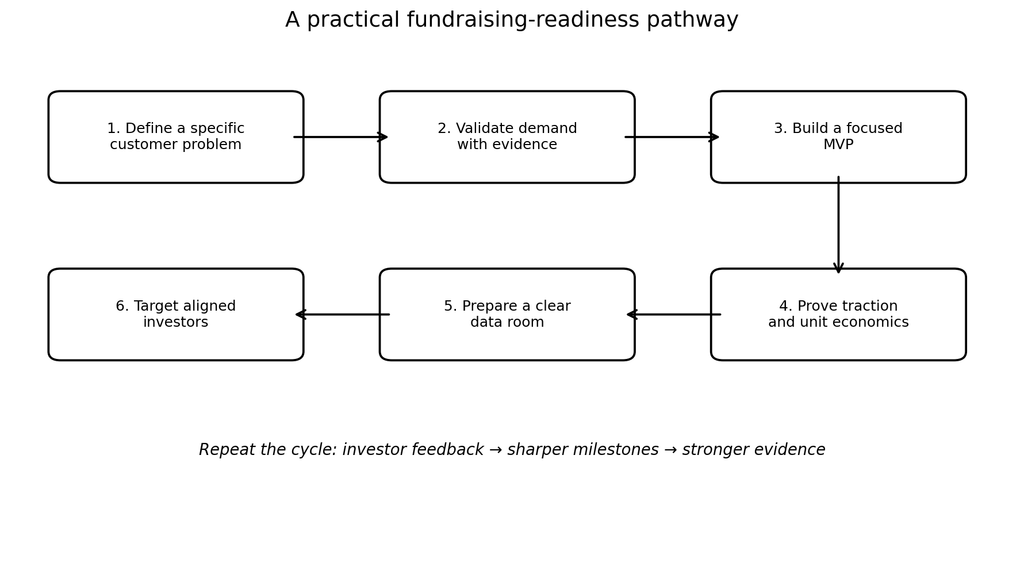
Figure 2. A repeatable process: each investor conversation should improve the evidence, positioning or next milestone.
A founder’s investor-readiness checklist
☐ One-sentence explanation of the customer, problem and solution.
☐ Evidence from customer interviews and/or paid pilots.
☐ Market sizing with transparent assumptions and credible sources.
☐ Clear product demo and explanation of differentiation.
☐ Business model, pricing logic and unit economics.
☐ Revenue, retention, pipeline and usage metrics appropriate to the stage.
☐ Monthly cash-flow forecast, burn rate and runway.
☐ Fundraising amount linked to milestones and a timeline.
☐ Pitch deck, cap table, incorporation documents and key contracts organised.
☐ Investor list matched to sector, stage and cheque size.
☐ Risk register covering competition, regulation, security, hiring and execution.
☐ Plan for regular investor updates, including when progress is slower than expected.
Where emerging startup hubs can focus
There is no single winning formula for every city. Hyderabad, Pune, Chennai, Ahmedabad, Jaipur and other ecosystems may offer different combinations of technical talent, industrial customers, operating costs, universities, local demand and state-level support. The useful approach is to identify a sector where the city has a real advantage and then build a dense network around that sector: anchor customers, experienced mentors, specialist suppliers, angel investors, incubators and founders who share practical knowledge.
Ecosystem builders can help by publishing transparent information about local grants and incubators, creating customer-startup pilot programmes, organising sector-specific investor days and supporting founders with finance, legal, export and compliance expertise. These activities cannot guarantee funding, but they can reduce the information and network gaps that make fundraising harder.
What founders should not conclude from the headline
- Do not assume that 43% of funding means 43% of all startups or founders are based in Bengaluru; funding share and startup population are different measures.
- Do not assume every Bengaluru startup has easier access to capital. Competition is intense, and funding is highly uneven by stage and sector.
- Do not treat one nine-month period as a permanent city ranking. Large rounds and reporting cut-off dates can change totals.
- Do not relocate solely for fundraising before validating whether the move improves hiring, customer access, partnerships or investor access enough to justify its cost.
- Do not pursue venture capital if the business is better suited to revenue-led growth, debt, grants, customer financing or strategic investment.
Conclusion
Bengaluru’s 43% share of Indian tech funding in the first nine months of 2026 demonstrates the power of a mature startup ecosystem. It also highlights a challenge: founders outside established hubs may need to work harder to build investor access and make their evidence visible. But a founder’s address is not the business model. A differentiated product, credible customer validation, disciplined financials, a focused capital plan and a targeted investor pipeline can make a startup from any city more investable. The practical goal for emerging startup hubs is to turn local strengths into repeatable company-building advantages—and to make those strengths legible to customers and investors nationwide.
External Link 1 — Funding dataAccording to the India Tech funding report, startup investment trends provide useful context for founders evaluating India’s technology ecosystem.
Link text: India Tech funding report
Copy sentence Copy URL
External Link 2 — Startup ecosystemFounders can also explore India’s broader startup ecosystem to understand how different cities support company building and innovation.
Link text: India’s broader startup ecosystem
Sources and references
- Moneycontrol, “Bengaluru tech startups raise $4.4 billion, outpace 5 rival cities combined” (25 September 2026). https://www.moneycontrol.com/city/bengaluru-tech-startups-raise-4-4-billion-outpace-5-rival-cities-combined-article-14038259.html
- The Times of India, “At $4.4bn, B’luru tech funding this year nearly equals next 5 cities combined” (25 September 2026). https://timesofindia.indiatimes.com/city/bengaluru/at-4-4bn-bluru-tech-funding-this-yr-nearly-equals-next-5-cities-combined/amp_articleshow/134469675.cms
- YourStory, “India’s tech cos raise $10.3B in 2026, clocking a modest growth: Tracxn” (24 September 2026). https://yourstory.com/2026/09/indias-tech-cos-raise-usd-103b-in-2026-tracxn-report
- The New Indian Express, “India tech funding rises 7% to $10.3 billion in 9M 2026 despite fewer deals” (24 September 2026). https://www.newindianexpress.com/business/2026/Sep/24/india-tech-funding-rises-7-to-103-billion-in-9m-2026-despite-fewer-deals
- Inc42, “From Hyderabad To Pune: Which City Holds India’s Startup Hub Baton?” (6 January 2026). https://inc42.com/features/from-hyderabad-to-pune-which-city-holds-indias-startup-hub-baton/
- KPMG India, “Exploring India’s dynamic start-up ecosystem” (December 2024). https://assets.kpmg.com/content/dam/kpmgsites/in/pdf/2024/12/exploring-indias-dynamic-start-up-ecosystem.pdf
Source note: The city figures in this article are reported as figures from Tracxn’s India Tech – 9M 2026 Report, as described by the cited news coverage. The reporting period is 1 January–21 September 2026. Dollar values are rounded where indicated. This is an informational article, not investment, legal or tax advice.
Founders outside major startup hubs can apply startup fundraising strategies that focus on customer validation, targeted investor outreach, measurable milestones, and efficient use of capital.
Appendix: supplied writing-quality reports
The screenshots below were supplied by the user and are reproduced as provided. They are not independently verified by this document’s author. Scores can vary by tool, settings, document version and detection methodology.
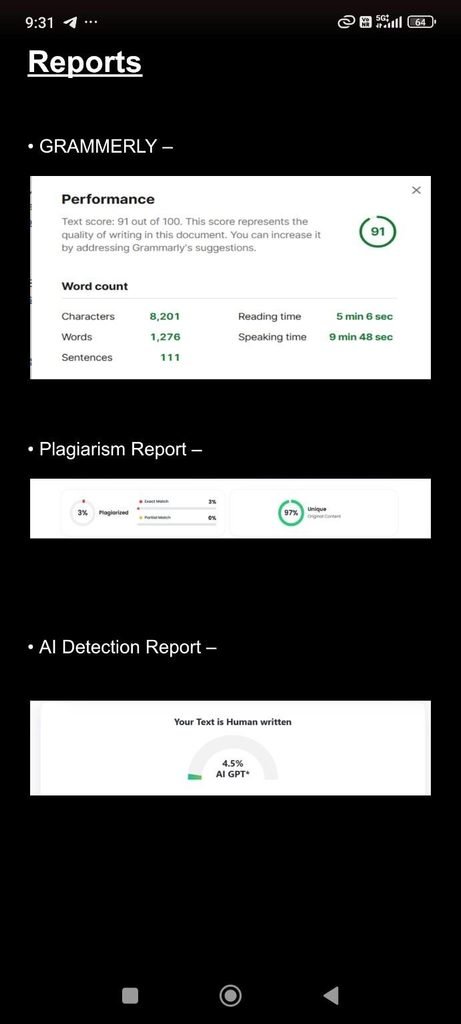
Figure 3. User-supplied report screenshots: Grammarly performance score, plagiarism similarity/originality, and AI-detection result.
Report values visible in the supplied screenshot
- Grammarly: text score 91/100; 1,276 words; 111 sentences; reading time 5 min 6 sec; speaking time 9 min 48 sec.
- Plagiarism checker: 3% exact match / plagiarized and 97% unique/original content; partial match shown as 0%.
- AI detector: result states “Your Text is Human written” and displays 4.5% AI GPT.
Important interpretation: these results are screenshots for a different text unless they were run on this exact article after final editing. They should not be presented as proof that this article has received those scores. To report this article accurately, run the final document through the relevant tools and replace the screenshots with the fresh results. Plagiarism and AI detectors can produce false positives or false negatives and should not be treated as definitive proof of authorship.
How to open this in Google Docs
Upload this .docx file to Google Drive, tap the file, then choose Open with Google Docs. Google Docs will convert it into an editable document. Review the chart labels, page breaks and image placement after conversion.