
Tax deductions for small business in India can help eligible business owners reduce taxable income by claiming legitimate business expenses, depreciation, staff costs, and other deductions allowed by law.
Most small businesses in India pay more tax than they need to. The catch is that nobody explains which costs the law lets you deduct.
A quick note on the law before we start. From 1 April 2026, your income falls under the Income-tax Act, 2025, so Tax Year 2026-27 has new section numbers. Still filing for FY 2025-26? That year stays under the 1961 Act. Each deduction below shows the current section number, with the old 1961 Act number in brackets.
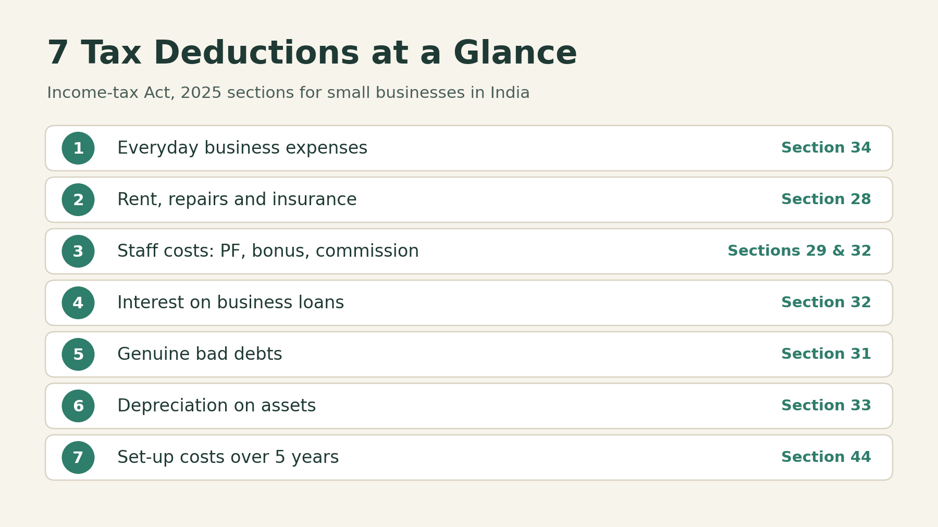
Image source: original illustration created with AI (Claude) for this article.
Tax Deductions for Small Business in India: 7 Key Claims
Claim Everyday Business Expenses (Section 34)
Section 34 (old Section 37(1)) is the general rule for deductions. If the money went into the business and only the business, you can write it off. Ads, professional fees, electricity and water, internet, phone, software subscriptions, work travel: all of that counts.
Just be careful with anything you also use personally. A phone you use for work and home, say. Claim only the business part, not the whole bill.
2. Rent, Repairs and Insurance (Section 28)
Most of what it costs to run a shop, office or workshop falls under Section 28 (old Sections 30 and 31). Rent and municipal taxes count. Insurance premiums count too, and so do routine repairs to your premises, machinery, plant and furniture.
Paperwork trips people up here. If an officer comes asking, the first thing they’ll want is your rent agreement and proof that you paid. Keep the two together.
3. Deduct Staff Costs: PF, Bonus and Commission (Sections 29 and 32)
Employer contributions to a recognised fund, an approved superannuation fund and a gratuity fund are covered by Section 29. Genuine bonuses or commissions paid for services are covered by Section 32. A bonus must be real pay, not a disguised profit share.
Timing is where people slip. Under Section 37 (old Section 43B), employer PF and ESI contributions, bonus, and leave encashment can be deducted only in the year you actually pay them. Pay before your return date, and you can still claim them for the earlier year. The PF and ESI you deduct from employees’ salaries is separate. It must be deposited by its own due dates.
4. Deduct Interest on Business Loans (Section 32)
Interest on money you borrowed for the business is deductible under Section 32 (old Section 36(1)(iii)). There’s one catch. If the loan was for buying an asset, interest from the day you borrowed until the asset is first used can’t be deducted as interest.
5. Write Off Genuine Bad Debts (Section 31)
When a customer will never pay, Section 31 (old Section 36(1)(vii)) allows you to deduct the debt as an irrecoverable loss.
Two conditions apply: you’ve written the debt off in your books, and you already counted that sale as income. A general provision for bad debts you might have doesn’t count for ordinary businesses, and if you recover the money later, it becomes taxable.
6. Claim Depreciation on Business Assets (Section 33)
This is the deduction owners miss most, probably because no cash leaves the account. Section 33 (old Section 32) lets you deduct a percentage of the written-down value (cost minus what you’ve already claimed) every year, instead of the full price at once. Common rates are:
- Buildings: 5% for residential and 10% for other buildings
- Furniture and fittings: 10%
- Plant and machinery: 15%, as the general rate
- Computers and software: 40%
- Patents, trademarks and similar intangible assets: 25%
Some assets have special rates, so check which block yours falls in. Land doesn’t qualify at all.
7. Spread Set-Up Costs Over Five Years (Section 44)
Specified costs that you incur before the business starts or when you expand into a unit are deducted in five equal parts under Section 44 (old Section 35D). That means one-fifth is deducted in each of five tax years.
Depreciation Write Off: Buying or Selling Assets Mid-Year
Depreciation is calculated on the whole block, not on each asset. Suppose your opening WDV is ₹60,000. In July you buy a ₹50,000 laptop and sell an old computer for ₹10,000. That puts the block at ₹1,00,000, and 40% of it is ₹40,000.
Now move the laptop purchase to December. The older assets are worth ₹50,000 (₹60,000 minus ₹10,000), and they still earn ₹20,000. The laptop has been in use for under 180 days, so it gets half the rate, which is ₹10,000. That’s ₹30,000 in total, ₹10,000 less than in the July case.
If you sell for more than the block is worth, you lose depreciation on that block for the year. The excess is taxed as a short-term capital gain.
The schedule is in Appendix I of the Income-tax Rules, 2026 (Rule 25, notified 20 March 2026). It also caps depreciation at 40% of a block’s WDV, and reportedly that includes taxpayers under the concessional regime. Ask your accountant whether it applies to you.
Expenses That Can Be Disallowed
Cash Payments Over ₹10,000 (Section 36)
Pay one person more than ₹10,000 in cash in a single day, and Section 36 (old Section 40A(3)) lets the department disallow the expense. Note that it’s the day’s total. Two ₹8,000 payments on the same day to the same person is ₹16,000, so splitting the bill gets you
nowhere. Goods carriage hire has a higher limit of ₹35,000. The easy way out: bank transfer, UPI or an account payee cheque.
Late Payments to Micro and Small Suppliers (Section 37, old Section 43B(h))
Pay a small supplier later than the MSME law allows, and your deduction slides to the year you actually pay. With no written agreement you get 15 days. With one, up to 45. Paying before your return date doesn’t rescue the claim, and medium enterprises aren’t covered.
Everything hinges on the supplier’s category, which has been in force since 1 April 2025. Micro means investment under ₹2.5 crore and turnover under ₹10 crore. Small goes up to ₹25 crore and ₹100 crore. Medium tops out at ₹125 crore and ₹500 crore. Cross either ceiling and the enterprise moves up a category.
Ask suppliers for their Udyam Registration Certificate and check it on the Udyam portal. Pure traders are generally outside the protection, so confirm with your accountant.
Presumptive Taxation: Less Bookkeeping, No Itemised Deductions
Presumptive taxation (Section 58, old Section 44AD) is a trade. You keep fewer books, but you lose flexibility. It’s for individuals, HUFs and partnership firms other than LLPs. Turnover has to stay under ₹2 crore, or ₹3 crore if cash receipts are within 5%. Your profit is then taken as 8% of turnover, or 6% for money that comes in through banking or digital payments. Earn commission or agency income? If you earn commission or agency income, you usually can’t use this scheme at all.
Professionals get their own version. Your profit is counted as half of what you receive, as long as your receipts are up to ₹50 lakh. That goes up to ₹75 lakh if no more than 5% of your receipts come in cash.
If you run a profit margin well under the presumed rate, proper books and regular deductions might work out better for you. Declaring a profit below the presumed rate can invite an audit. Once you opt out, you generally cannot come back for five tax years.
A tax audit, under Section 63 (old Section 44AB), becomes mandatory when business turnover goes past ₹1 crore or ₹10 crore if cash receipts and payments both stay within 5%. For professionals, the trigger is receipts crossing ₹50 lakh. If you are running more than one business, selling off major assets, or you have gotten a notice, that is the point where it makes sense to call an accountant.
Keep Your Paperwork in Order
Every deduction needs the bill and proof you paid it. That means GST invoices, bank or UPI records, your rent agreement, salary registers with PF and ESI challans, loan interest certificates and an asset register.Pay business expenses from a business account. Sharing a phone or a car? Settle the business-use percentage at the start of the year and keep a logbook.
Lost a bill? Call the supplier and ask for a duplicate. If it’s an e-invoice, ask for the copy with the IRN and QR code on it. If they can’t help, dig up whatever else shows the purchase happened: your bank or UPI statement, the purchase order, the contract, the delivery challan, any emails, proof you received the goods. Then write a short note on what happened and when, and keep it with the rest. That can support the deduction. It won’t
replace the GST input tax credit, which needs the actual invoice. And never recreate or backdate a bill.
Accurate financial records help business owners track expenses, support eligible tax deductions, and prepare their income tax returns.
Which Act Covers Your Expense
Which Act applies depends on when you incurred the expense, not when you paid. If it was incurred on or before 31 March 2026, the 1961 Act applies and it goes in the FY 2025-26 return, even if you pay in April. If it was incurred from 1 April 2026, the 2025 Act applies and it goes in the Tax Year 2026-27 return.
Insurance and anything else that covers both years is trickier. Ask your accountant how to split it.
Audit reports work the same way. For FY 2025-26 you still use Forms 3CA/3CB and 3CD, with the old section numbers. From Tax Year 2026-27, it’s Form 26. Your accounting software also needs the new TDS section codes for anything dated 1 April 2026 or later, so run a test TDS return before the real one.
This article provides information only and is not tax advice. The team at Eve Consultancy can assist in determining which deductions apply to your business.
References
[1] S. Gupta, “ITR Filing for Proprietors, Partners & Directors AY 2026-27: What’s New Under the Income Tax Act 2025?,” CAclubindia, Jun. 29, 2026. [Online]. Available: https://www.caclubindia.com/articles/itr-filing-for-proprietors-partners-directors-ay-2026-27-what-s-new-under-the-income-tax-act-2025–55805.asp
[2] TaxGuru, “Income from Business under the New Income-tax Act, 2025: Sections, New ITR Forms and Practical Compliance for Tax Period 2026-27,” TaxGuru, Apr. 14, 2026. [Online]. Available: https://taxguru.in/income-tax/income-business-income-tax-act-2025-sections-itr-forms-compliance-ay-2026-27.html
[3] Patron Accounting, “Depreciation Rules 2026: Rates, Block of Assets & Appendix I/II Explained,” Patron Accounting, Apr. 6, 2026. [Online]. Available: https://www.patronaccounting.com/blog/depreciation-rules-2026-rates-block-assets
[4] TaxGuru, “CBDT Notifies Income-tax Rules 2026 and Income Tax Forms,” TaxGuru, Mar. 21, 2026. [Online]. Available: https://taxguru.in/income-tax/cbdt-notifies-income-tax-rules-2026-income-tax-forms.html
[5] Busy, “Section 43B(h) MSME Payment Rule in India | 2026 Guide,” Busy, Aug. 12, 2026. [Online]. Available: https://busy.in/tds/section-43bh-msme-payment-rule-and-45-day-limit-explained/
[6] Tally Solutions, “MSME Limit Explained: Classify Your Business Easily,” Tally Solutions, Apr. 7, 2026. [Online]. Available: https://tallysolutions.com/business-guides/msme-turnover-investment-limits-classification-india/
[7] TaxGuru, “Section 58 Presumptive Taxation Under Income Tax Act 2025,” TaxGuru, May 29, 2026. [Online]. Available: https://taxguru.in/income-tax/section-58-presumptive-taxation-income-tax-act-2025.html
[8] AI Accountant, “India Month-End Mastery: Fix Missing Invoices Fast,” AI Accountant, Jan. 29, 2026. [Online]. Available: https://www.aiaccountant.com/blog/gst-compliance-missing-invoices-india
REPORTS
GRAMMAR REPORT

AI REPORT

PLAGIARISM REPORT
