
While starting a business is an exhilarating journey, the process of legal registration in India can be daunting if you don’t know where to begin. From tech startups to e-commerce businesses or consulting firms, it is essential to establish a legal entity for your business, gain investor trust, and safeguard your personal assets.
In this guide, we will be discussing the complete process of Company Registration in India along with the essentialities, documents required, step-by-step process and the subsequent steps after registration.
CHOOSING THE RIGHT BUSINESS STRUCTURE
Company Registration in India You should decide on the legal form of your business that will help you reach your goals before you start the application process:
- Private Limited Company (Pvt Ltd): This is best for companies that are in initial stages and wish to expand and take in funding. Is independent of its owners, has limited liability and must have two directors.
- Limited Liability Partnership (LLP): Best suited for service providers and professional partnerships. Limited liability protection for partners and low compliance cost.
- One Person Company (OPC): This is the right company for the one person entrepreneur who prefers having limited liability protection when he is the only owner.
- Sole Proprietorship: It is suitable for small local businesses. Easy to use, personal liability unlimited.
Note: Private Limited Company (Pvt Ltd) continues to be the preferred business structure for high growth startups and tech businesses.
KEY PREREQUISITES FOR COMPANY REGISTRATION
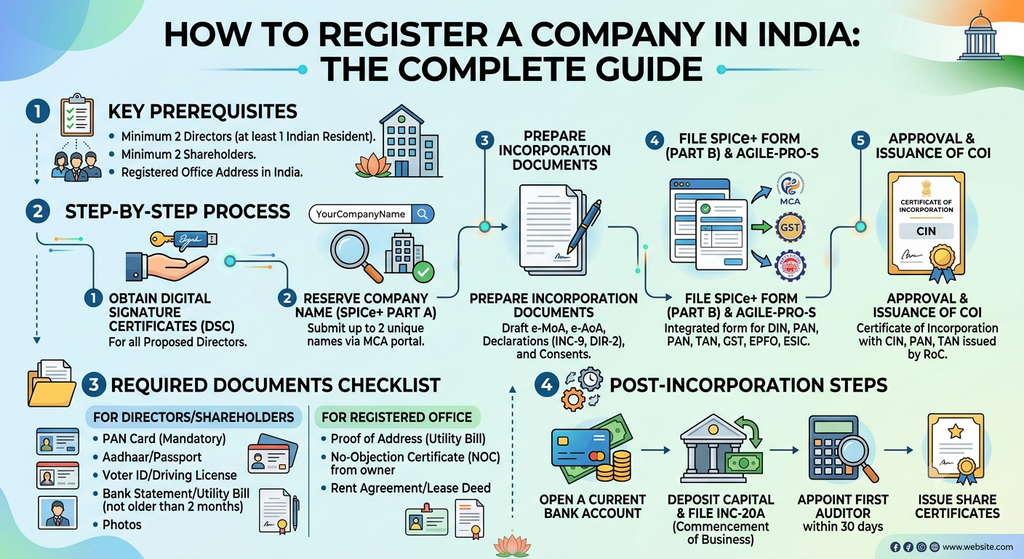
Company Registration in India If you wish to register a Private Limited company in India through the Ministry of Corporate Affairs (MCA), make sure you have the following minimum requirements:
- A minimum of 2 Directors: Minimum 2 directorship (one of the Directors should be a resident who has stayed in India for at least 182 days in the last financial year).
- At Least 2 Shareholders: Minimum 2 shareholders (directors can also be shareholders).
- Registered Address in India: It is an address at which official documents can be delivered or sent in India.
- Minimum Capital Not required: Small capital required, can be started with any small amount of share capital (e.g., ₹10,000) authorized.
The documents needed for incorporation are as follows:
Company Registration in India To prevent delays in processing, collect all the required paperwork before completing the online application forms.
For Directors and Shareholders
- Identity Proof: PAN Card (for Indian nationals) or Passport (for Foreign nationals) (mandatory).
- Address Proof: Aadhaar Card, Passport, Voter ID or Driving License.
- Financial Proof: Bank statement/ electricity bill/ mobile bill (not more than 2 months old).
- Photographs: Passport size photos of all proposed directors.
In the case of the Registered Office
- Credit Score: Credit score (no more than 2 months old) for property owner and not the tenant.
- NOC (No Objection Certificate): Document form letter of permission from property owner to allow the business to use the address.
- Deed of Title / Lease: Rental agreement (lease) or property deed (ownership).
STEP-BY-STEP PROCESS TO REGISTER YOUR COMPANY ONLINE
The Ministry of Corporate Affairs (MCA) has simplified incorporation process using the web form called SPICe+ (Simplified Proforma for Incorporating Company Electronically Plus) on the MCA v3 portal. Company Registration in India
Step- 1 Obtain Digital Signature Certificates (DSC) Company Registration in India.
All the proposed Directors need to have a Digital Signature Certificate (DSC) as the entire application is digital. The DSC is used to digitally sign the e-forms submitted to MCA. You can obtain a DSC from registered Certifying Authorities. Company Registration in India.
Step -2 Reserve your company name (SPICe + Part A ) Company Registration in India.
Go to the MCA v3 Portal and upload Part A of the SPICe+ form:
- You can submit upto 2 proposals in order of preference.
- Describe the primary business object (activity) clearly.
- Make sure the name is available, represents your brand and isn’t similar to existing company names or registered trademarks.
Step -3 Prepare constitutional documents: Company Registration in India.
The process of reserving the name should be followed by the drafting of the key legal documents:
e-MOA (Memorandum of Association): It defines the basics of a company, its scope of work, and its capital structure.
e-AOA (Articles of Association): Establishes internal rules and regulations and the principles of management.
Declarations (INC-9 & DIR-2): Signed declarations and consents of all proposed directors and subscribers.
Step- 4 Complete SPICe+ Part B and AGILE-PRO-S: Company Registration in India
Complete Part B of the SPICe+ – a single form for multiple government registrations at once
DIN Allocation: Assigns DINs to new directors.
PAN & TAN Application: Automatically generates PAN and TAN for the company.
The process of AGILE-PRO-S Integration includes registering your company for Goods and Services Tax Identification Number (GSTIN), Employees’ Provident Fund Organisation (EPFO), ESIC (Employees’ State Insurance Corporation), Professional Tax Registration (where applicable) and opening a corporate bank account.
Send the necessary paperwork, sign the forms digitally with the DSCs and pay the stamp duty and statutory fees.
Step 5: Approval and Issuance of Certificate of Incorporation (COI): Company Registration in India
The last step in the procedure is to approve and issue the Certificate of Incorporation (COI).
The Registrar of Companies (RoC) examines your application and documents that you have submitted. Upon successful verification: Company Registration in India
- The Certificate of Incorporation (COI) is issued by the RoC.
- Your Corporate Identification Number (CIN) and the date of incorporation are available on the COI.
- The company’s PAN and TAN are forwarded to the individual with the certificate by e-mail.
POST INCORPORATION MANDATORY STEPS
Company Registration in India. When you get your Certificate of Incorporation, your company has been born, but there are a few steps you need to take following incorporation before you can start your business activities:
Open a Current Bank Account: Fill out the current account opening process with your chosen bank on the incorporation documents and with your PAN.
Deposit Capital & File Declaration of Commencement (INC-20A): Declaration of commencing of share capital is filed in 180 days from incorporation. Later, it is necessary to file Form INC-20A on the MCA portal to get the permission to start a business.
Appoint First Auditor: Board of Directors shall designate the auditor of the Company (Chartered Accountant) within 30 days of incorporation (filing Form ADT-1).
Share Certificate: Issuing Share Certificate to Subscribers within 60 days of incorporation.
FINAL THOUGHTS
The government has made it easier to register a company in India and digitally made it easier to update MCA through various efforts. You can get your documents ready in advance and follow the SPICe+ process to incorporate your company within 7-10 working days. Company Registration in India
Reference Link:
- HOW TO REGISTER A COMPANY IN INDIA: THE COMPLETE STEP-BY-STEP GUIDE FOR ENTREPRENEURS: Private Limited (Pvt Ltd) Company Registration | Process & Fees
2. STEP-BY-STEP GUIDE FOR ENTREPRENEURS : Form a Wyoming LLC: Company Formations by Attorney
3. HOW TO REGISTER A COMPANY IN INDIA: Private Limited Company Registration | RegisterKaro
4. Internal Link: Add Post ‹ Eve Consultancy — WordPress