
INTRODUCTION: THE APPROACHING
Compliance shockwave
The logistics and taxation landscape is about to experience an unstoppable shockwave. For years, companies have navigated standard transportation compliance with relative ease, treating documentation as a mere administrative afterthought. However, that era of leniency is officially dead. Based on the current GST development around changes to e-way bill requirements from Aug 2026 (as highlighted by Business Standard), the regulatory authorities are unleashing a ruthless digital transformation.
If your supply chain relies on outdated, manual documentation, your entire operation is at severe risk of grinding to a halt. The upcoming August 2026 mandates are not just minor bureaucratic tweaks; they are a revolutionary overhaul designed to eradicate tax evasion, seal revenue leaks, and force absolute, real-time transparency across every single transit route. To survive
this shift, businesses must aggressively upgrade.
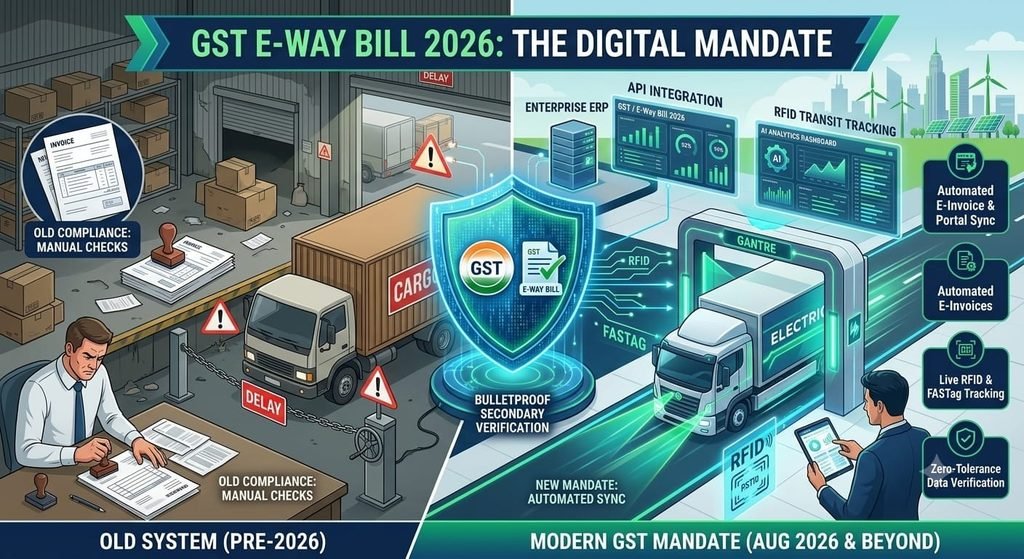
7 CRITICAL CHANGES BUSINESSES MUST CHECK BEFORE AUGUST 2026
1. THE UNFORGIVING INTEGRATION OF E-INVOICING
The days of generating an e way bill in isolation are over. The new 2026 mandates are aggressively forcing the seamless integration of e-invoicing with the transportation portal. Businesses must check that their ERP systems automatically sync these two data points. Any mismatch between your GST invoice data and your transit documentation will trigger an instantaneous red flag, causing immediate shipment delays and targeted tax audits.
2. MANDATORY REAL-TIME RFID TRACKING
The regulatory net is tightening with the relentless enforcement of FASTag and RFID integration. Authorities are no longer relying on manual checkpoint inspections. Instead, commercial vehicles will be tracked in real-time. Businesses must ensure that their logistics partners have fully upgraded their fleets. If an e way bill does not perfectly align with the vehicle’s digital footprint at toll plazas, the system will automatically flag the shipment for interception.
3. AGGRESSIVE THRESHOLD REDUCTIONS
Previously, small-scale shipments could often fly under the radar without formal documentation. The August 2026 changes are expected to completely obliterate these loopholes by aggressively lowering the monetary threshold limits for mandatory generation, particularly for intra-state movement. Companies must completely overhaul their dispatch protocols, as failing to generate an e way bill for even minor consignments will result in devastating financial penalties.
4.INSTANTNEOUS PORTAL BLOCKING FOR NON-FILERS
The government is weaponizing the digital portal to force absolute GST compliance. Under the new developments, if a business fails to file its recent tax returns, the system will execute a ruthless, automated block on their ability to generate any new transit bills. You must meticulously check your internal filing schedules; a single missed deadline could completely paralyze your entire outbound supply chain overnight.
5. BRUTAL FINANCIAL PENALTIES FOR DISCREPANCIES
The margin for human error has been reduced to zero. The 2026 framework introduces crushing financial penalties for any discrepancies found between the physical cargo and the digital e way bill. Businesses need to implement a bulletproof secondary verification system on their loading docks. Even minor typographical errors regarding vehicle numbers or HSN codes will be treated as deliberate tax evasion, resulting in massive fines or immediate confiscation of goods.
6. THE DEATH OF MANUAL DATA ENTRY
Relying on manual data entry clerks to generate transit documents is now an obsolete and highly dangerous strategy. The upcoming changes demand high-speed, API-driven generation directly from your accounting software. Businesses must aggressively audit their current tech stack. If your system cannot generate a flawless, digitally signed e-way bill in seconds without human intervention, you will be physically unable to keep up with the blistering pace of modern compliance.
7. ADVANCED AI AND DATA ANALYTICS SCRUTINY
The tax authorities are no longer manually reviewing paperwork; they have deployed powerful artificial intelligence to analyze supply chain data. The new 2026 system will constantly cross-reference your e way bill generation history against your declared GST input tax credits. Businesses must proactively check their historical data for anomalies, because the government’s AI will mercilessly hunt down and expose irregular trading patterns, circular trading, and mismatched inventory levels.
CONCLUSION
The August 2026 mandates mark the end of the era of passive compliance and the beginning of a permanent, high-transparency, digital-first environment. This shift is not a temporary adjustment but a fundamental transformation of how businesses must operate within the GST framework. Moving forward, manual processes are no longer just inefficient—they are a liability. To ensure operational continuity and protect against devastating financial and regulatory risks, businesses must transition immediately from observation to active, automated integration. In this new landscape, rapid adaptation is not merely a strategic advantage; it is an absolute necessity for survival.
REFERENCES
[1.] “ E way bill changes from 1Aug 2026’’, clear.[Online]. Available: E-Way Bill Changes from 1st August 2026: Mandatory Ship-To GSTIN and New EWB Closure Facility
[2.] ‘’E-Invoice & E-Way Bill Changes from August 2026’’,CAC.[Online].Available:E-Invoice & E-Way Bill Changes from August 2026: GSTN API Updates Explained – CAC
[3.] ‘’GST e way bill rules changes 2026’’, CMAknowledge.[Online].Available:GST E-Way Bill Rules Change 2026 – CMA Knowledge
[4.] AI image references from Gemini.
REPORTS
AI DETECT REPORT: