
(Source of Image : CHATGPT)
Table of Contents
Sole Proprietorship vs LLP: Which Business Structure Should You Choose?
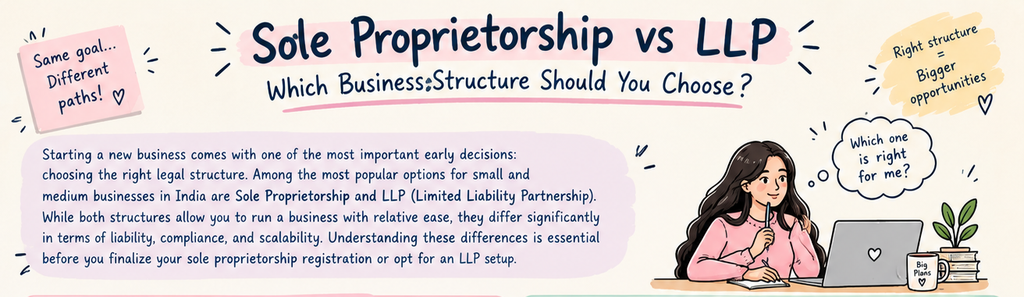
Starting a new business comes with one of the most important early decisions: choosing the right legal structure. Among the most popular options for small and medium businesses in India are Sole Proprietorship and LLP (Limited Liability Partnership). While both structures allow you to run a business with relative ease, they differ significantly in terms of liability, compliance, and scalability. Understanding these differences is essential before you finalize your sole proprietorship registration or opt for an LLP setup.
Sole Proprietorship vs LLP: Key Differences in India
A Sole Proprietorship is the simplest form of business structure, owned and managed by a single individual. There is no distinction between the owner and the business — legally, they are one and the same. This makes sole proprietorship registration quick, affordable, and largely free of complex paperwork, which is why it’s a popular choice for freelancers, small traders, and first-time entrepreneurs.
However, this simplicity comes with a major drawback: unlimited liability. Since the business has no separate legal identity, the owner is personally responsible for all debts and losses. If the business fails to meet its financial obligations, personal assets — savings, property, or other investments — can be used to settle them. Sole proprietorships also tend to have limited access to funding, as banks and investors often view them as higher risk due to the lack of structural separation between owner and business.
What is an LLP (Limited Liability Partnership)?
An LLP combines the operational flexibility of a partnership with the liability protection of a company. It is a separate legal entity, meaning the business can own assets, enter contracts, and sue or be sued independently of its partners. Most importantly, partners’ liability is limited to their agreed contribution, protecting personal assets from business risks.
LLPs are registered with the Ministry of Corporate Affairs (MCA) and require more documentation than a sole proprietorship — including an LLP agreement, digital signatures, and compliance filings. While this makes the setup process longer and slightly costlier, it also lends the business greater credibility, making it easier to attract investors, secure loans, and enter into larger contracts. Additionally, an LLP continues to exist even if a partner exits or changes, ensuring business continuity.
Sole Proprietorship vs LLP: Key Differences
| Features | Sole Proprietorship | LLP |
| Legal Status | No separate legal entity | Separate legal entity |
| Liability | Unlimited personal liability | Limited to capital contribution |
| Compliance | Minimal | Moderate (MCA filings required) |
| Registration Cost | Low | Moderate |
| Credibility with Investors/Banks | Lower | Higher |
| Business Continuity | Ends with owner | Continues despite partner changes |
| Ideal For | Sole entrepreneurs, small-scale operations | Multi-Partner, -oriented businesses |
Which One Should You Choose?
The right choice depends on your business goals. If you’re a solo entrepreneur looking to start small with minimal compliance and cost, a Sole Proprietorship offers a fast, low-friction entry point. But if you’re planning to scale, bring in partners, or need liability protection and credibility for raising funds, an LLP is the more sustainable long-term option.
Every business is different, and this business entity comparison is only the starting point. At Eve Consultancy, we help entrepreneurs evaluate their specific needs — from risk tolerance to growth plans — and guide them through the entire registration process, whether it’s a sole proprietorship or an LLP, so they can build their business on the right legal foundation from day one.
Before choosing a business structure, entrepreneurs should understand the importance of business registration and compliance to establish a strong legal foundation.
Factors to Consider Before Registering Your Business
Before deciding between a sole proprietorship and an LLP, consider your business’s ownership, financial risks, expected growth, and compliance requirements. A sole proprietorship may suit an individual who wants to operate independently with relatively simple administration. An LLP may be more suitable when two or more partners want to run a business with a separate legal identity and limited liability protection.
Also consider ongoing filing obligations and professional costs, not just the initial registration fee. Since legal and tax requirements vary depending on the business, consult a qualified professional before completing your registration.