

( Source of the Image – ChatGPT)
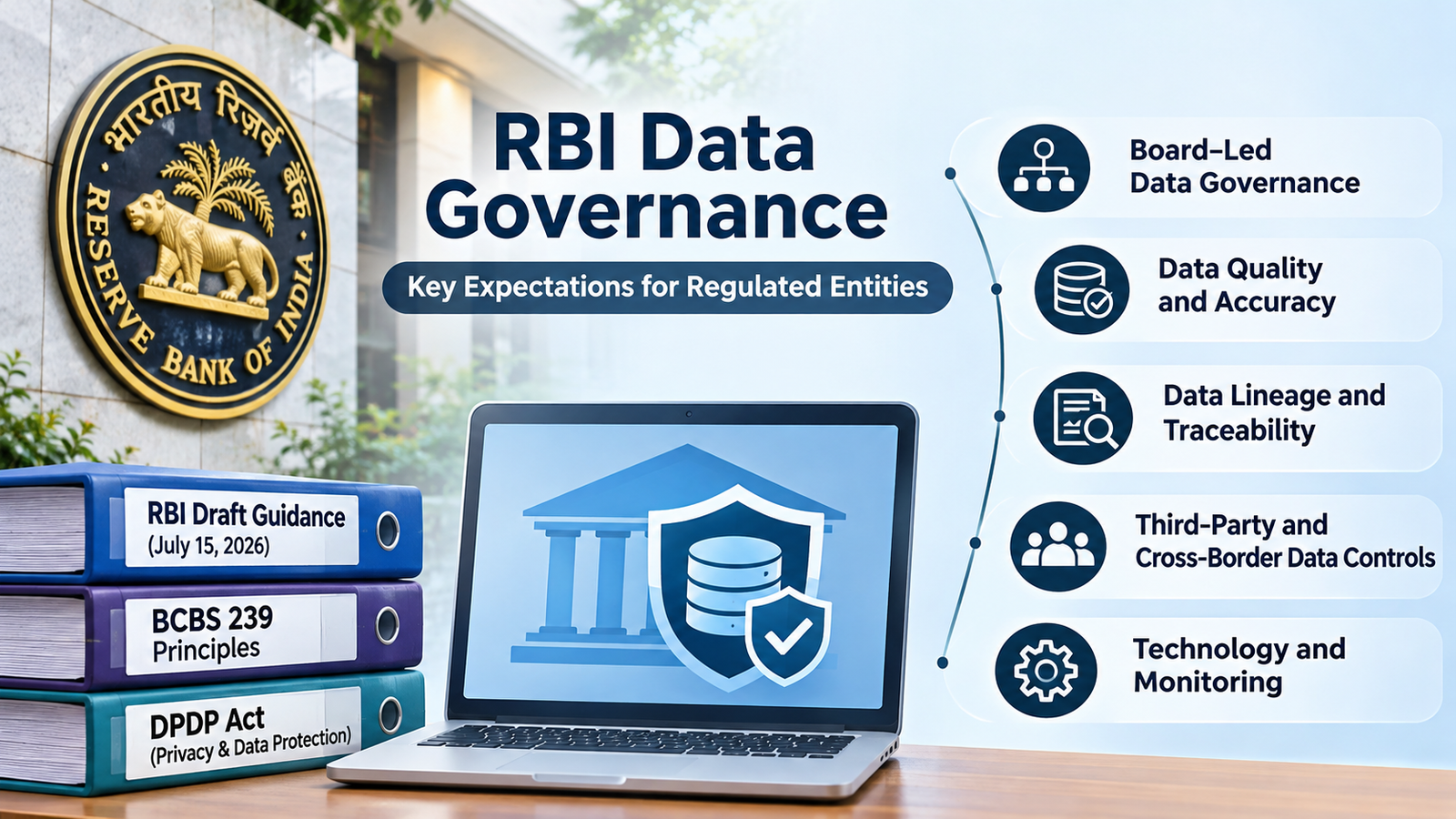
RBI data governance is becoming a key priority for regulated entities as the Reserve Bank of India strengthens expectations around data quality, accountability and risk management.
RBI Data Governance Is No Longer Just an IT Problem
Not long ago, data was something the tech team handled quietly in the background. That’s changing fast. On July 15, 2026, the RBI released a draft “Guidance on Regulatory Expectations for Data Governance” and opened it up for public comments.
The comment window ran until August 17, 2026, so it has now closed. Regulated entities have a window to get their house in order before the final version arrives.
Read our guide on RBI compliance directions to understand how banks can strengthen regulatory compliance, governance and risk management practices.
7 Essential Steps to Prepare for RBI Data Governance Requirements
Indian banks and NBFCs aren’t new to data-related rules. There are already directions on IT governance, outsourcing, cybersecurity and returns submission. But this draft isn’t just one more circular on the pile. It’s the first time the RBI has put together a single, enterprise-wide statement of what it expects on data.
It leans heavily on BCBS 239 principles and lines up with the DPDP Act, which means privacy, governance and supervision are now being looked at together.
Who Needs to Pay Attention?
Almost everyone in regulated finance. The draft covers eleven categories of regulated entities, from commercial banks to non-banking financial institutions.
That includes small finance banks, payments banks, regional rural banks, co-operative banks and NBFCs, along with asset reconstruction companies and credit information companies. If you handle regulated financial data, it’s safest to assume this applies to you.
What the RBI Is Actually Asking For?
A Data Governance Framework the Board Owns
Every entity must build a Data Governance Framework that covers all its data and fits its size, complexity and business model. The board approves it, and it has to be reviewed at least once a year. The draft also describes a three-tier governance structure, so the responsibility clearly reaches beyond the IT department.
Knowing Where Your Data Came From
Entities should document how data flows and be able to trace it from origination all the way to reporting. The same analysis points to a “single source of truth” for critical data elements. If your reports still depend on scattered spreadsheets and undocumented fixes, that will be hard to defend.
Data Quality as a Real Control
Data needs to be accurate, complete and good enough to be useful, and the framework has to fit with the entity’s wider risk management. In plain terms, data quality stops being a nice-to-have and becomes something you can be held accountable for.
Third Parties and Cross-Border Data
This is where many institutions will feel the pinch. Data sourced from outside has to meet the same standards as your internal data. Third parties should get access only on a need-to-know basis, contracts need confidentiality terms, and cross-border processing, storage and transfer risks have to be managed. Contracts with overseas group entities and offshore service providers will likely need to be amended too.
How to Get Ready Without Waiting for the Final Rules?
The final text may shift a little. But the obligations it points to are unlikely to go away. Here’s a sensible way to start:
Do an honest gap check. Compare what you do today with each theme in the draft, then build a prioritised, cost plan to close the gaps.
Put names against responsibilities. Decide who owns which data, and make sure the board and senior management know what they’re accountable for.
Find your critical data. Know what matters most, where it lives and how it moves. Lineage and a single source of truth both start here.
Look at your tooling. Tracking lineage by hand won’t scale. These requirements are likely to push more spending on metadata repositories and governance tools.
Revisit vendor and group contracts. Check access rights, confidentiality clauses and cross-border terms now, not after the deadline is announced.
Join up DPDP and RBI efforts. Running two separate programmes wastes money and effort. One control framework is easier to manage and audit.
Keep the board in the loop. Share the gaps, timelines and owners early so approvals don’t slow you down later.
The Bigger Message: Show You’re in Control
The direction is hard to miss. Supervisors don’t just want policies written down. They want proof that your data is governed, traceable and owned by real people. Institutions that start early will meet the final timeline calmly, while those who wait may end up in a costly scramble.
Final Thoughts
The RBI’s draft on data governance tells us that data quality, lineage and accountability are about to become routine supervisory topics. So don’t wait for the final circular. Check your gaps, assign owners, fix third-party contracts and invest in the right tools. Do that, and what looks like a compliance burden today can become a real advantage in trust, risk management and decision-making.
References
[1]Reserve Bank of India. RBI issues draft “Guidance on Regulatory Expectations for Data Governance” (Press Release, July 15, 2026). https://rbi.org.in/Scripts/BS_PressReleaseDisplay.aspx?prid=63155
[2]Reserve Bank of India. Draft Guidance on Regulatory Expectations for Data Governance (PDF). https://www.rbi.org.in/Scripts/bs_viewcontent.aspx?Id=5114
[3]Cyril Amarchand Mangaldas. FIG Paper No. 61: RBI’s Draft Data Governance Guidance: An Overview (July 2026). https://corporate.cyrilamarchandblogs.com/2026/07/fig-paper-no-61-rbis-draft-data-governance-guidance-an-overview/
[4]EY India. Compliance to accountability: RBI’s data governance expectations.
https://www.ey.com/en_in/insights/financial-services/compliance-to-accountability-rbi-s-data-governance-expectations
[5]EY India. Data moves to boardrooms: Accountability by design (September 2026).
https://www.ey.com/content/dam/ey-unified-site/ey-com/en-in/insights/financial-services/documents/ey-data-moves-to-boardrooms.pdf
REPORTS
AI DETECTION REPORT

PLAGIARISM CHECK REPORT
AI PROOFREADING REPORT