( Source of Image : CHATGPT )
7 Powerful Non-Dilutive Funding Options for Deep Tech Startups in India
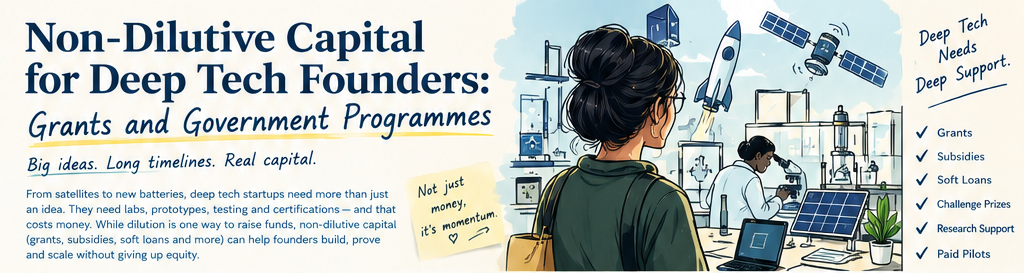
Non-dilutive funding for deep tech startups in India can help founders develop prototypes, test hardware and reach key technical milestones without giving up company equity.
Ask a SaaS founder what they need to launch, and they’ll say a laptop and a few months. Ask a deep tech founder building a satellite sensor or a new battery cell, and the answer sounds very different: a lab, a prototype, a round of testing, maybe a certification. All of that costs money before a single customer shows up.
That’s the real problem with funding hardware. The timeline is long, the technical risk is high, and the cheque sizes don’t always match what early investors expect. Hardware and deep tech startups are still attracting attention, with GalaxEye among those reported to have raised rounds in September 2026. But smart founders know a priced round isn’t the only door. Many quietly build their first layer of funding through non-dilutive funding, meaning money that doesn’t cost them a slice of the company.
What “Non-Dilutive” Really Means
It’s simple. Non-dilutive capital is funding you don’t pay back with equity. Grants are the best-known form, but it also includes some soft loans, subsidies, challenge prizes, paid pilots and research support.
The catch is that it’s not free money. Grants come with applications, milestones, reports and sometimes conditions on IP or where you manufacture. Think of it as a project with a deadline, not a gift.
Where Indian Deep Tech Founders Can Look
India has no single window for this. Support is spread across different ministries, agencies and programmes, and each has its own focus. Here’s the broad map, but check the official page of each scheme before applying, because limits and eligibility get revised often.
| Route | Who it suits | What it generally offers |
| Startup India Seed Fund Scheme | Early-stage startups with a proof of concept | Grants for validation & routed through selected incubators |
| DST programmes (NIDHI and related) | Science and tech-led founders | Incubation and early-stage support through partner institutions |
| BIRAC schemes | Biotech and life sciences founders | Grants and mentoring for early biotech innovation |
| Technology Development Board | Startups commercialising indigenous technology | Concessional support, often as soft loans |
| iDEX and defence programmes | Defence and dual-use tech | Funding and procurement pathways |
| IN-SPACe | Space-tech startups | Technical facilities, mentoring and sector support |
| MeitY programmes | Electronics, hardware and chip design founders | Product development and design-linked support |
| State startup policies | Founders open to location-linked benefits | Grants, subsidies, lab access and reimbursements that vary by state |
The government has also announced larger efforts aimed at deep tech and R&D financing. These roll out in phases, so read the latest official guidelines rather than relying on a blog, including this one, for the fine print.
Not All Support Comes as Cash
Some of the best help never shows up in your bank account.
Shared labs and testing facilities at institutes and incubators can save months and a lot of capital. A paid pilot with a government department, PSU or defence body can be better than any grant, because it gives you a real customer and a real reference. Challenge programmes bring visibility and sometimes small prizes. And partnering with a university or research lab can bring in research funding and talent at the same time.
Writing an Application That Gets Read
Reviewers go through a lot of proposals, so clarity does most of the work. Start with the problem and the technical risk. Say what you’re trying to prove, not only what you plan to build. Break your plan into clear milestones, like prototype, test results, pilot and certification, so the reviewer can see how the money turns into progress.
Be honest about the budget. A line-by-line plan feels trustworthy, while a vague one raises doubts. And show that you can actually execute. A working demo, an early test result or a letter of intent from a customer says more than three pages of ambition.
One more practical thing: apply early. Government cycles can be slow, and approvals and disbursements sometimes take months. Plan your runway around that instead of assuming the money will land on time.
Where Founders Slip Up
The most common mistake is chasing every scheme at once. It spreads the team thin and produces weak applications. Some founders build their whole business around a grant instead of a customer. Others win the money and then struggle with reporting. And a few forget that grant conditions on IP, reporting or manufacturing location can matter to investors later, so it’s worth having a lawyer read the terms before you sign.
How Grants and Equity Fit Together
Non-dilutive money is best seen as the layer that gets you to your next real milestone. A grant that funds a working prototype can change the conversation with investors, because they’re now backing evidence instead of a deck. That’s why many strong deep tech founders use both: grants for early technical risk, equity for scaling production, hiring and entering the market.
A Note for Incubators, Colleges and MSME Bodies
Institutions can make a big difference here. Incubators can help founders choose the right scheme, write the application and handle compliance. Colleges can open lab access and connect student founders with mentors. MSME bodies and industry associations can help hardware startups with testing, certification and first customers. Even one well-run support desk can save a founder months.
FAQs
What is non-dilutive funding?
It’s capital that doesn’t require giving up equity, such as grants, certain subsidies and some soft loans.
Is a grant better than venture capital for deep tech?
Neither wins outright. Grants reduce early technical risk without dilution, while venture capital helps with growth at scale. Many founders use both.
Can a very early-stage startup get a grant?
Yes. Several programmes target the idea, prototype and proof-of-concept stages, usually through incubators.
Do grants affect future fundraising?
They can. Conditions on IP, reporting or manufacturing may matter to investors, so read the terms carefully.
How long does it take to get the money?
It depends on the scheme, but government processes often take months. Build that into your runway.
Final Thoughts
Deep tech is a long game, and equity isn’t the only way to fund it. Founders who understand the grant landscape, apply with clear milestones and treat government support as part of their financing plan usually walk into investor meetings in a stronger position. At Eve Consultancy, we help founders, incubators and MSMEs understand their funding options, prepare applications and plan sensible capital strategies.
As a deep tech business prepares to commercialise its products and reach international customers, founders can also explore MSME export schemes to understand potential support for entering global markets.
Startup India
Startup support programmes and incubator-related information.
BIRAC
Biotechnology innovation programmes and support for eligible life-sciences ventures.
IN-SPACe
Support and opportunities for India’s space sector.