
INTRODUCTION
For years, many businesses treated their GST credit reconciliation as a casual, end-of-month administrative task. Today, that outdated mindset is a recipe for operational disaster. The tax department has unleashed a ruthless, fully automated, and highly aggressive digital grid that tracks every single invoice. A seemingly minor miscalculation or an oversight regarding your input tax credit no longer just results in a polite email; it triggers instantaneous, system-generated tax notices, crippling financial penalties, and extreme cash flow bottlenecks. As an evergreen GST topic focused on a common business compliance issue, the misallocation of input tax credits remains one of the fastest ways to invite a catastrophic government audit.
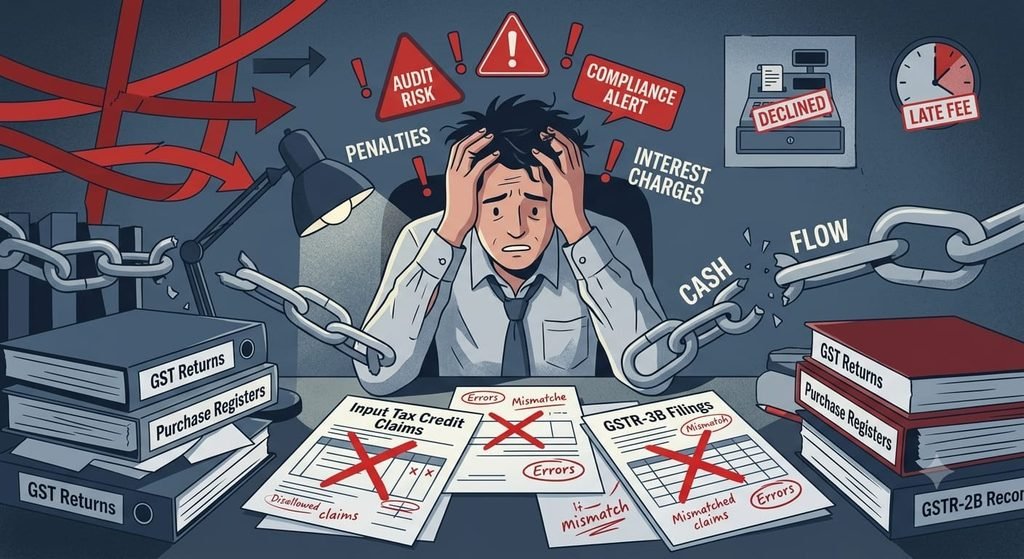
7 COMMON PROBLEMS CAUSED BY ITC ERRORS
1. THE AUTOMATED MISMATCH TRAP( GSTR-3B vs GSTR-2B)
Under Section 16(2)(aa) of the CGST Act, possessing a physical tax invoice is no longer enough to claim your GST credit. Credit is only available if the supplier has filed their GSTR-1 and the invoice is successfully communicated and auto-populated into your GSTR-2B statement. If you aggressively claim credit based purely on your purchase register while ignoring GSTR-2B mismatches, the system will automatically trigger a DRC-01C intimation. This mismatch instantly red-flags your business for severe scrutiny.
2. THE 180-DAY PAYMENT REVERSAL SHOCK
One of the most expensive and frequently ignored rules is the 180-day payment clock. Under Rule 37, if you fail to pay your supplier the full invoice value plus tax within 180 days of the invoice date, you are legally mandated to add that input tax credit back to your output tax liability. Worse, this reversal attracts an unforgiving 18% interest charge under Section 50 of the CGST Act. Missing this timeline completely destroys the financial benefit of the credit.
3. THE SECTION 16(4) DEADLINE CLIFF
The government does not allow you to claim forgotten credits indefinitely. Section 16(4) establishes a ruthless “claim-by” clock. Input tax credit relating to an invoice for a specific financial year must generally be claimed by November 30 following that financial year, or the date of filing the relevant annual return, whichever is earlier. If a negligent supplier delays uploading their invoices and the credit lands in your GSTR-2B after this absolute deadline, that money is generally permanently lost.
4. CRUSHING PENALTIES FOR WRONGFUL UTILIZATION
The authorities severely penalize any wrongful availment and utilization of a GST credit. Section 122 of the GST Act dictates that if you mistakenly claim and utilize credit for reasons other than fraud, you face a penalty of up to 10% of the tax amount or Rs. 10,000, whichever is higher. However, if the department’s AI determines there was fraud or a deliberate intent to evade taxes, they can legally impose a devastating penalty of either Rs. 10,000 or 100% of the incorrectly claimed amount, whichever is higher.
5. UNSTOPPABLE INTEREST CHARGES UNDER SECTION 50
If you wrongly avail and actually utilize an input tax credit, you do not just owe the principal amount back to the government. Section 50 of the CGST Act mandates a compensatory 18% per annum interest charge on the wrongfully utilized funds. Because this interest is calculated continuously from the original due date up to the date of the actual correction filing, the compounding financial damage can be massive.
6. CLAIMING BLOCKED OR INELIGIBLE CREDITS
A very common, highly dangerous error is claiming credit simply because an invoice appeared in your GSTR-2B. The portal will auto-populate supplier invoices, but the purchase may have been for personal use or relate to a blocked category. Claiming this ineligible GST credit immediately puts you in the crosshairs of compliance officers, leading to swift reversals and audits.
7. CASH FLOW PARALYSIS AND VENDOR HOSTILITY
When your input tax credit claims are blocked because a supplier failed to file their GSTR-1, your business is temporarily forced to cover the gap. Dealing with the non-reflection of ITC requires persistent communication and proactive reconciliation. Failure to aggressively pursue suppliers and verify these errors early paralyzes your cash flow and disrupts your accounting, forcing you to withhold payments and severely damaging
critical vendor relationships.
CONCLUSION
In the modern GST landscape, treating input tax credit reconciliation as a casual administrative afterthought is a gamble no business can afford to take. The transition from manual oversight to an aggressive, automated digital grid has transformed compliance into a critical business imperative. As discussed, the risks are no longer theoretical; they are immediate and systemic. From the automated mismatch traps of GSTR-2B and the unforgiving 180-day payment reversal rules to the absolute deadlines of Section 16(4) and crushing financial penalties, the cost of error is catastrophic. To safeguard cash flow and preserve vital vendor relationships, businesses must move beyond reactive accounting and adopt proactive, rigorous compliance measures. Rigorous reconciliation is no longer just about tax filing—it is about ensuring the fundamental operational survival and financial integrity of the enterprise.
REFERENCES
[1.] ‘’GST Input Tax Credit: 10 Most Common Errors and How to Fix Them’’, Grovia.[Online].Available:GST Input Tax Credit: 10 Most Common Errors and How to Fix Them | Grovia Blog | Grovia
[2.] ‘’ 7 Input Tax Credit (ITC) Mistakes That Trigger GST Notices’’, Finavrit.[Online].Available:7 Input Tax Credit (ITC) Mistakes That Trigger GST Notices | Finavrit | Finavrit
[3.] ‘’Top 5 Reasons Input Tax Credit (ITC) Gets Rejected (2026 Guide)’’, taxsolver.[Online].Available:Top 5 Reasons Input Tax Credit (ITC) Gets Rejected (2026 Guide)
[4.] AI image references from Gemini.