Consent Manager Registration: Who Can Apply Under DPDP?
Consent Manager registration under the DPDP framework establishes how eligible companies can provide individuals with an accessible platform to manage, review and withdraw their personal data consent.
The Digital Personal Data Protection Act, 2023 has defined the definition of consent manager as a person registered with the Data Protection Board of India in section 2(g). The manager gives individuals one place to handle consent through an accessible, transparent and interoperable platform. In practical terms, someone could use it to manage consent across participating businesses, rather than opening each organisation’s settings one by one.
This has some similarities to India’s Account Aggregator framework, though the two sit in different regulatory areas. A consent manager is more than a consent pop up or a business’s private dashboard. The meaning of the role comes from registering under the DPDP framework.
Understanding the November 2026 Timeline
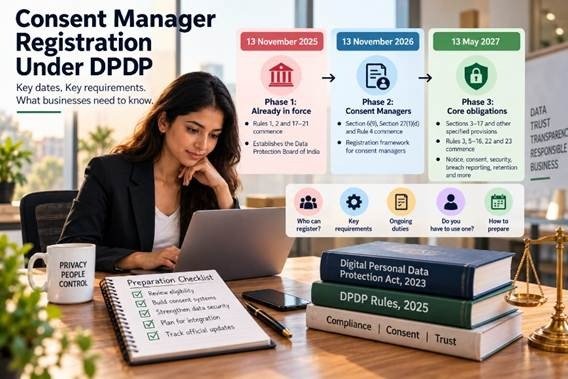
The government had announced the phased commencement schedule of the DPDP Act through G.S.R. 843(E) on 13th November 2025. The following day, on 14 November, these DPDP Rules were published in the Gazette. That one-day gap matters when working out when each requirement begins. The Act provisions on consent managers are due to take effect one year after the Act’s notification, on 13 November 2026. The Rules’ publication is linked with Rule 4 – Registration and consent manager responsibilities, which will take effect from 14 November 2026. It is important for businesses to verify the two dates, as they might not be identical.
The next big phase is scheduled for 13 May 2027. These are the core provisions of the Act, which are accompanied by Rules, that are scheduled to come into effect when the Act does so. These are the main provisions of the Act and Rules that are related that are due to take effect when the Act does. November 2026, then, is not a general DPDP compliance deadline. It marks the planned start of the consent manager framework and related provisions; May 2027 is the more important date for many substantive duties on data fiduciaries.
Who Can Apply for Registration?
The First Schedule to the DPDP Rules lists the eligibility conditions. Applicants must be companies legally incorporated in India, with enough technical, operational and financial capacity to carry out their responsibilities. Their overall financial position and management must be sound, and net worth must reach at least ₹2 crore. The Schedule also looks at the company’s expected business volume, capital structure and prospects for earning.
Directors, key managerial personnel and senior management should have a general reputation for fairness and integrity, backed by a record that supports it. Implicit in the Memorandum and Articles of Association, too, are certain duties that must be followed, such as preventing conflict of interests. There are no special exceptions for these provisions without the prior approval of the Board. The Board will publish the standards and assurance framework that applicants are required to obtain from an independent party to certify their interoperable platform. They also need suitable technical and organisational measures. Meeting the financial threshold by itself won’t qualify an applicant.
What Registered Consent Managers Must Do
Under Rule 4, registered consent managers have to comply with the obligations in Part B of the First Schedule. Their platforms need to provide people with the ability to grant, collect, review and revoke consent to participate data fiduciaries. They have to maintain adequate records of consent, connected notices and information sharing and provide relevant records in machine-readable form. The Schedule says these records must be kept for at least seven years. A longer period shall be used as may be required by law, the shorter period shall be used as may be permitted by the applicable provisions.
The rules also establish the principles pertaining to independence and accountability. A consent manager is required to have a fiduciary relationship with any individual, manage conflicts of interest and ensure it is not able to access personal data that it has released through its platform. It will not be able to outsource these responsibilities. Its technical and organisational controls, continuous eligibility and compliance should be subject to effective audit mechanisms.
In case of the transfer of control of the registered company by way of a sale, a merger or due to any other arrangement, the Board shall approve such transfer prior to the transfer of control. The Board shall conduct investigations for compliance and implement corrective action, if necessary. It may also suspend or cancel registration of individuals, but following the necessary procedure.
Does Every Business Need a Consent Manager?
No. The DPDP Rules don’t generally require each data fiduciary to appoint or use a registered consent manager. Businesses can still set up and run their own compliant consent processes, as long as they meet the legal requirements that apply. Consent managers may matter commercially if customers would rather manage permissions on an independent platform. Organisations hoping to offer that option may eventually need technical integration and consent records that work with the platform.
Using a consent management tool doesn’t turn a These are two different jobs. A data fiduciary continues to have the obligation to comply with its obligations under the Act, such as obtaining a proper basis for processing, providing the notices and implementing appropriate safeguards. The outsourcing of a technical activity does not automatically transfer the responsibility for the legal activities of the organisation.
What Businesses Should Do Now
When companies think about registering, they should look at Indian incorporation status, net worth, governance structures and conflict of interests. Companies need to examine whether their platform can work with others whether their privacy architecture preserves privacy and whether they can pass certification and audit tests. These steps do not happen in split-time. Waiting for an application window can put pressure on companies and create unnecessary stress.
Other businesses should keep a record of how consents gathered, documented updated and revoked across their systems. They should review whether their systems keep records are usable for reliable export and provide easy‑to‑understand consent choices.
It makes sense to get ready for integrations but organizations should separate voluntary planning from legal obligations that have not yet begun. Implementation should follow the phased schedule and must be guided by consent managers in a transparent way.
Conclusion
Consent managers exist to give people a way to control their personal information. The DPDP Rules set a role define eligibility requirements and set technical expectations for consent managers. Not every person has to be a consent manager. Does every organization need to have a consent manager but consent managers are key to managing consent.
Significant dates are 13 November 2026 for aspects of the Act 14 November 2026 for Rule 4 and 13 May 2027, for the next big batch of substantive obligations. Organizations should check the updates find out what they need to do and work to improve their consent offering while they have time before these deadlines.
Organizations should look at updates determine what they must do and work to enhance their consent offering before the deadlines. This will help ensure that consent managers can operate effectively and that consent processes remain compliant.
Businesses preparing for Consent Manager registration should also understand the DPDP Rules timeline for 2026–27, including the November 2026 and May 2027 commencement dates.
References
- Government of India, The Digital Personal Data Protection Act, 2023. https://www.indiacode.nic.in/indiacode/handle/123456789/22037
- Ministry of Electronics and Information Technology, Government of India, Digital Personal Data Protection Rules, 2025, G.S.R. 846(E), Nov. 14, 2025. https://www.meity.gov.in/documents/act-and-policies/digital-personal-data-protection-rules-2025-gDOxUjMtQWa?pageTitle=Digital-Personal-Data-Protection-Rules-2025
- Government of India, “Commencement notification under the Digital Personal Data Protection Act, 2023,” G.S.R. 843(E), Nov. 13, 2025. https://upload.indiacode.nic.in/showfile?actid=AC_CEN_45_0_00003_2023-22_1763464807080&filename=c56ceae6c383460ca69577428d36828b.pdf&type=hindinotification