DPDP Rules Timeline: 3 Key Phases of Implementation
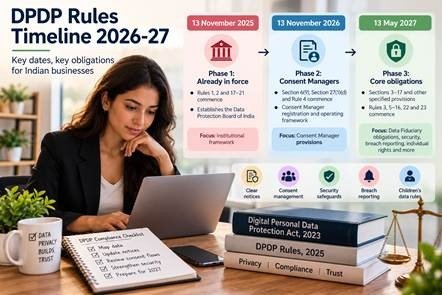
The DPDP Rules timeline sets out three phases for India’s Digital Personal Data Protection framework, with institutional provisions beginning in November 2025, Consent Manager provisions in November 2026 and core compliance obligations in May 2027.
India’s Digital Personal Data Protection (DPDP) framework is coming in stages, not through one big compliance deadline. On 13 November 2025, the Digital Personal Data Protection Rules, 2025, and the DPPDA, 2023, were notified for commencement. The government has spread things out to give organisations time to get ready for the new requirements.
The dates to highlight if you are in the process of finalising your DPDP plan are 13 November 2025 for the first provisions coming into effect; 13 November 2026 for the Consent Manager provisions; and 13 May 2027 for when most substantive provisions will begin to apply. It should be easy to keep these dates in mind to help organisations plan what they need to prepare for now and what is still to come.
Phase 1: Provisions already in force
The first provisions have been in force since 13 November 2025. They set up the institutional framework, including the Data Protection Board of India. Rules 1, 2, and 17–21 commenced immediately. This first phase is mostly about setting up and running the framework. It does not yet bring in the full set of obligations for organisations processing personal data.
This transition does not let businesses set aside privacy rules that already apply. The Information Technology Act, 2000 and the applicable provisions of the Sensitive Personal Data or Information Rules, 2011 must be considered until the amendments and replacement scheme are implemented. In a sense, it is businesses that need to examine what they must do, and not presume that all previous requirements have been removed by the new Act.
Phase 2: 13 November 2026 — Consent Managers
The second phase starts exactly one year after notification. Section 6(9) and Section 27(1)(d) of the DPDP Act, along with Rule 4 of the Rules, are set to commence on 13 November 2026.
A Consent Manager is a registered intermediary who provides a platform that is accessible and interoperable for individuals, known as Data Principals, to give, manage, review and withdraw consent. Registration and operating requirements are contained in Rule 4 which include the aspects of governance, independence, security and transparency.
This date matters for organisations that plan to become Consent Managers, and for businesses working out how consent-management services could connect with their systems. It doesn’t bring all the usual Data Fiduciary obligations into force. It’s important for businesses to review their consent systems today to avoid a need for hasty technical modifications later on.
Phase 3: 13 May 2027 — Core compliance obligations
The last scheduled phase starts 18 months after notification. Sections 3–17, along with the other provisions named in the commencement notification, come into force on 13 May 2027. Rules 3, 5–16, 22 and 23 begin at the same time.
These provisions outline the day to day responsibilities of Data Fiduciaries. They involve providing notices, obtaining consent, keeping reasonable security measures, notifying of breaches, addressing requests for individual rights, responding to complaints, and extra requirements for Significant Data Fiduciaries. The obligations won’t be identical for all businesses, so they should make sure that the requirements are applicable to their operations.
Children’s data needs close attention. Under the Act, a child is anyone under 18. Organisations should ensure they have the adequate parental consent and adhere to the limits on processing children’s personal data, except in cases of a statutory exemption.
Retention and deletion deserve a closer look too. The Rules set specific deletion duties for certain large platforms after specified periods of inactivity, subject to conditions and exceptions. These provisions shouldn’t be read as a universal three-year deletion deadline for every organisation.
Significant Data Fiduciaries have much more to do, such as regular Data Protection Impact Assessments and independent audits. Businesses should monitor if they could be notified as a Significant Data Fiduciary, and make the necessary governance arrangements.
Breach response needs documented procedures. The Rules require affected individuals to be notified without delay, followed by staged reports to the Board, including detailed information within 72 hours, where applicable. Organisations shouldn’t wait until May 2027 to set up an incident-response process.
A practical compliance roadmap
Organisations should determine if they will be Consent Managers and designate responsibility for privacy compliance before 13 November 2026, and audit existing consent systems. This preparation can detect technical dependencies well in advance of the start of the provisions.
Organisations will have to operate and regularly test compliance arrangements from May 2027, maintain appropriate records, provide responses to individual requests, and audit practices, if they change or their operations change.
Bottom Line
A clear understanding of the phases of the DPDP Rules timeline makes it easier to handle. Institutional provisions commenced in November 2025, the Consent Manager provisions in November 2026 and the bulk of the substantive obligations in May 2027. If businesses take the time to prepare over the intervening months, they will be more ready to fulfil their obligations without the last-minute disruption.
Just as businesses organise sustainability information through ESG data management software, they should establish structured systems to manage personal data, consent records and compliance evidence under the DPDP framework.
References
- Government of India, Digital Personal Data Protection Act, 2023. https://www.indiacode.nic.in/bitstream/123456789/22037/2/a2023-22.pdf
- Ministry of Electronics and Information Technology, Digital Personal Data Protection Rules, 2025. https://www.meity.gov.in/documents/act-and-policies/digital-personal-data-protection-rules-2025-gDOxUjMtQWa?pageTitle=Digital-Personal-Data-Protection-Rules-2025
- Government of India, “Commencement Notification, G.S.R. 843(E),” Nov. 13, 2025. https://upload.indiacode.nic.in/showfile?actid=AC_CEN_45_0_00003_2023-22_1763464807080&filename=c56ceae6c383460ca69577428d36828b.pdf&type=hindinotification
- Ministry of Electronics and Information Technology, Explanatory Note to Digital Personal Data Protection Rules, 2025. https://www.meity.gov.in/writereaddata/files/Explanatory-Note-DPDP-Rules-2025.pdf