5 Powerful Steps to Conduct an Effective Vendor ESG Audit
A vendor ESG audit helps companies evaluate suppliers’ environmental, social and governance performance, identify supply chain risks and strengthen sustainable procurement practices.
In addition to helping improve their own energy efficiency, reduce waste at their office and establish a policy to support their employees in a sustainable way, companies can also face major sustainability challenges regarding their suppliers. A company’s environmental and social impact can extend further than the company itself, including environmental impacts, either in raw materials or transport, manufacturing & subcontractors. Thus, the Sustainable Supply Chain is now an important part of Corporate Risk Management.
Boston Consulting Group (BCG) and CDP recently reported in June 2024 that companies reporting under CDP had on average 26x more emissions in scope 3 of their GHG reporting respectively to scope 1 and 2. 15% of companies reporting on CDP had set a Scope 3 emissions target. This contrast between awareness and action exposed by the results of these findings and their relevance for the supply chain risks makes for quite a difference.
The implications for Suppliers: the changing rules in the EU.
There have been substantial changes to the regulation of sustainability in Europe. Directive (EU) 2026/470 amended the two previously mentioned Directives: Corporate Sustainability Reporting Directive (CSRD) and the Corporate Sustainability Due Diligence Directive (CSDDD) in February 2026. The revised CSRD thresholds do not change, that’s as it was before, companies that have over 1000 employees, and over 450 million net turnovers in any national accounting period, will be subject to the reporting requirement, at least under the requirements of the Directive.
Typically, thresholds for the new CSDDD are slightly lower – especially in terms of companies with a workforce of over 5,000 employees and a net worldwide turnover of greater than €1.5 billion. The EU’s new framework for due diligence shall be transposed by the Member States by July 2028, and shall come into application from July 2029 as per the revised timeline.
These changes don’t mean that they no longer require supplier evaluations, it’s just that they are different. Large customers may request information on emissions, working conditions etc. as well as certification to use as leverage when making purchases, managing risk and reporting on such risk for investors and as well as because of voluntary commitments to climate change. By imposing commercial expectations on smaller suppliers, this is possible despite the fact that they may not be regulated by the laws relating to the industry.
The exceptions of issues to be included in a vendor ESG audit
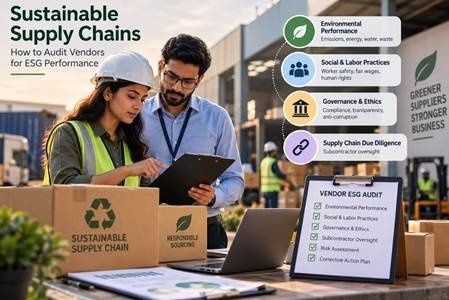
When using the Vendor ESG audit to review the responsible management of environmental, social and governance risk from the vendor. The scope should be customised to the activities of the supplier and their geographical location, as well as their importance for the business and their potential impact on the business.
The field of environmental performance refers to energy use, generation of GHGs, consumption of water, waste management, dangerous substances of interest, pollution reduction.Any estimates should be taken into account by the auditors, as well as the calculation methods of emissions.
Forced labour, child labour, workplace risk, working time, wages, discrimination and freedom of association are areas of social responsibility that represent risks. It is important to note, however, that one does not devalue the highly problematic aspects of working labour if a supplier is ferociously involved in signing up a code of conduct.
Governance and ethics cover anti-bribery policies, conflicts of interest, whistleblowing policy, data protection and responsible business. To audit a policy you must inspect the practices, not the policy.
It’s essential that the risks do not restrict themselves to the first supplier; they extend to subcontractors too. It is imperative that the businesses know what kind of activities are conducted in terms of outsourcing and whether the supplier closely watches its contractors. Care needs to be taken with the rate of visibility; not everything may be intended to be covered and it is important to highlight prime-level material risks, even if visibility is obscured.
To realize the maximum value from a vendor ESG audit, there are five steps to follow:
Start by crunching the numbers: Suppliers by spend, business criticality, geography, industry, and potential environmental and human rights ramifications. It is possible that a hazardous chemical supplier would need more attention than an office stationery supplier. For higher risk vendors, use detailed assessment or site visit; questionnaires for lower risk vendors.
Create a standard questionnaire for all the emissions, energy, water, waste, labour practices, safety and governance. Ask questions about the information that pertains to the supplier’s business and why it’s necessary. Match questions to known disclosure frameworks as appropriate, e.g. CDP and GHG Protocol. Make comparisons more meaningful and minimize repeating requests with consistent questions.
Verify and back up facts, not supposing to accept claims on. Only the initial steps of a completed questionnaire are covered. Look at supporting documents such as utility bills, emissions calculations and waste records, as well as medical and safety records and relevant certifications and independent audit results. Evaluate if there are any gaps and record any gap blocks. For high-risk suppliers, site visits could be deemed appropriate, but this should be proportionate to the identified risks.
The score findings will be part of the score and then followed by corrective actions. Coordinate with a scorecard that takes into account environmental performance, labour standards, governance and evidence quality. Establish criteria to identify critical findings, and time to take corrective action. Any level of serious misconduct will need to be escalated or suspended from school, whereas any manageable weaknesses will be dealt with using a documented improvement plan. Scores must not be used as a substitute for professional judgement when making purchasing decisions.
Collaborate with suppliers to make improvements. More effective audits will be done if the supplier is aware of what changes are necessary and only has practical opportunities to make them. Training and Technical Assistance, Energy Audits, and better Reporting System helps vendors to improve performance. BCG and CDP identified a near sevenfold increase for Climate Action companies when compared to non-Climate Action companies, in having both Scope 3 and 1.5°C transition goal-setting plans. This association does not imply that supplier engagement leads to better outcomes, but rather it enables supplier engagement.
Common errors that make supplier audits fail
It is impractical to send the same suppliers a number of different and overlapping questionnaires and may result in less quality of response. Only ask for information needed for a specific decision, and use trusted data as appropriate. Conversely, the information available for ESG must be gathered and then analysed to ensure results are known and to establish trust.
Another frequent error is assuming that a single audit is a stamp of approval for compliance. Supplier performance may alter after incidents, partial or complete changes of ownership, new subcontractors or changes in production. Review regularly for indications and look at major clues in between assessments.
The business justification of supplier monitoring
Supplier information can disclose areas where resources can be saved, operational resilience can be enhanced and a brand’s reputation can be saved. Both September 2024 CDP and companies that explicitly account for their Scope 3 emissions credited them with US$13.6 billion in cost savings, and 43 million tonnes of Greenhouse-Gas (GHG) savings from collaboration between buyers and suppliers. The numbers represent potential benefits—results vary with actions taken and businesses involved.
Conclusion
A credible vendor ESG audit is more than just gathering declarations. It is used to ascertain material risks, review evidence, allocate corrective action and to promote measurable improvements. Procurement will continue to be shaped by sustainability expectations, and companies with the ability to factor in supplier information to make informed purchasing decisions and track and manage supply-chain disruption will be in a better position to meet customer needs.
Companies can use ESG data management software to organise supplier information, track sustainability indicators, monitor reporting gaps and improve the consistency of vendor assessments.
References
- Boston Consulting Group and CDP, “Corporates’ Supply Chain Scope 3 Emissions Are 26 Times Higher Than Their Operational Emissions,” Jun. 25, 2024. https://www.cdp.net/en/press-releases/corporates-supply-chain-scope-3-emissions-are-26-times-higher-than-their-operational-emissions
- CDP, “Strengthening the Chain: Industry Insights to Accelerate Sustainable Supply Chain Transformation,” Sep. 25, 2024. https://www.cdp.net/en/insights/strengthening-the-chain
- European Parliament and Council of the European Union, “Directive (EU) 2026/470 of 24 February 2026,” Official Journal of the European Union, Feb. 26, 2026. https://eur-lex.europa.eu/legal-content/EN/TXT/?uri=CELEX:32026L0470
- CDP, “CDP Report Reveals Untapped Business Gains of $165 Billion From Tackling Supply Chain Climate Risks,” Sep. 25, 2024. https://www.cdp.net/en/press-releases/cdp-report-reveals-untapped-business-gains-of-usd165-billion