CSR vs ESG is an important distinction for Indian companies because corporate social responsibility focuses on statutory social initiatives, while ESG evaluates how a business manages its environmental, social and governance performance.
Everyone in India thinks CSR and ESG are same thing. I used to think that too. But when I started interning at a compliance firm in Delhi last year, my boss explained it in one line and it stuck with me.He said – CSR is what you do with your profit, ESG is how you made that profit.That one line clears the whole confusion about csr vs esg.For a long time, Indian companies thought doing charity is enough to be called sustainable. Build a school, donate to an NGO, put photos on website. Done. But now investors and foreign clients are asking deeper questions. And that’s where ESG comes in.
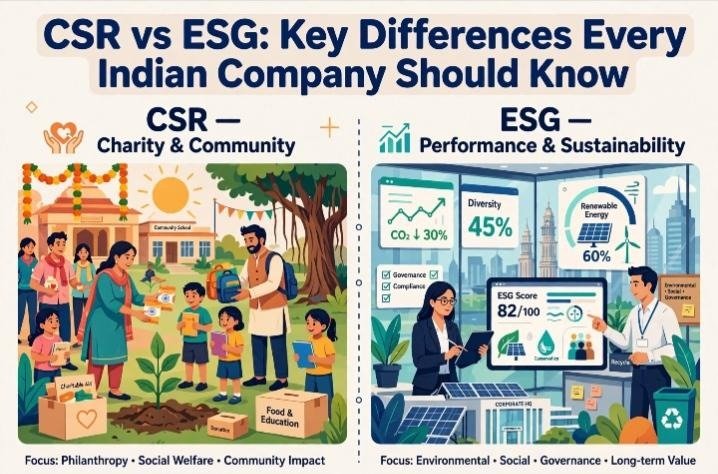
CSR vs ESG: 7 Critical Differences Indian Companies Should Understand
Let me break it in simple words.CSR in India is law. If your company has turnover above 1000 crore or net worth above 500 crore, you have to spend 2% of your profit on social work. It’s mentioned in Companies Act, 2013. You need a committee, you need to pick activities from Schedule VII – like education, health, poverty. If you don’t do it, you get notice.
So its compulsory spending. Its about being generous after you earned money.ESG is totally different game. No one forces you to spend 2%. ESG is how the market judges your business. E means how you treat environment – how much carbon you throw, how much water you use. S means how you treat people – your workers, your vendors, diversity.
G means how you run the company – is your board transparent, is there corruption? So basically CSR is statutory while ESG is performance-based. One is a legal tick-box, other is a score card given by investors and rating agencies like MSCI. You can spend crores in CSR and still get a terrible ESG score if your factory is polluting.[2]This is why many companies are getting shocked now. They are doing CSR properly but SEBI’s BRSR report is still showing them as risky.
Why this matters so much for Indian companies right now
Earlier it didn’t matter much. But now it does.Two reasons. First, SEBI has made BRSR mandatory for top 1000 listed companies. You have to disclose your ESG data. Second, Europe has started CBAM tax. If you export steel or cement to Europe and your ESG is poor, you will pay extra carbon tax.
So clients are directly asking for ESG data, not CSR certificates.I spoke to a textile exporter from Tirupur. He said his German buyer didn’t even ask about CSR. They asked – what is your water usage per t-shirt? What is your female worker ratio? Do you have an independent director? He had no answer. That’s ESG.And for true corporate sustainability, you need both. CSR builds your image in the village or city where you work. ESG builds your trust with investors, banks, and global customers. One without other is incomplete. A company doing donation but having unsafe factory is not sustainable. Similarly, a company with low emissions but zero community work is also not loved.
What smart companies are doing now?
The smart ones are aligning both. Instead of donating randomly, they use CSR money to improve ESG.For example, instead of donating to some random NGO, a cement company uses CSR fund to put solar panels in nearby villages. That counts as CSR and also improves its S and E score. Or a steel company uses CSR to train its own truck drivers and contract workers – that improves Social pillar.So they are not seeing CSR as charity anymore. They are using it as a tool to fix their ESG gaps.
Conclusion
So yeah, CSR and ESG look similar but they are not.CSR is after-profit charity and it is compulsory in India. ESG is how you run your core business and it is judged by performance. CSR tells your generosity story, ESG tells your responsibility story.If you are an Indian company that wants foreign funding or global clients in 2026, understanding this difference is not optional. You can no longer hide behind CSR photos. You have to show how you actually operate. Companies who get this shift from charity to accountability will survive. Others will keep getting low ESG ratings despite big donations.
Understanding ESG governance helps companies strengthen board oversight, improve accountability and connect sustainability performance with their wider business strategy.
References
1. “Corporate social responsibility,” _Wikipedia, The Free Encyclopedia._, Corporate_social_responsibility
2. “Environmental, social, and corporate governance,” _Wikipedia, The Free Encyclopedia._, Environmental,social,and governance
3. “Sustainability reporting,” _Wikipedia, The Free Encyclopedia._, Sustainability_reporting