Introduction
Social ESG metrics help businesses measure workforce diversity, employee wellbeing, human rights and workplace practices to improve transparency and accountability.
What makes a company truly sustainable? Is it simply reducing carbon emissions, saving energy, and managing waste or does sustainability also depend on how a company treats its employees, protects human rights, and creates equal opportunities? The answer lies in the social dimension of Environmental, Social, and Governance (ESG).
While environmental performance often receives significant attention, the social component examines the human impact of business operations. It considers whether employees are treated fairly, workplaces are safe, opportunities are accessible, and human rights are respected throughout the business and its supply chain. As investors, customers, employees, and regulators increasingly examine corporate responsibility, businesses need more than general statements about diversity and employee welfare.
They need reliable information that demonstrates what they are doing and whether their efforts are producing meaningful results. In India, the Securities and Exchange Board of India (SEBI) introduced the Business Responsibility and Sustainability Reporting (BRSR) framework to encourage more structured ESG disclosures by listed companies. Its reporting framework includes social considerations such as employee wellbeing, gender diversity, human rights, and inclusive development.
The BRSR Core framework also identifies specific indicators intended to improve the consistency and credibility of important ESG disclosures. This makes social ESG metrics increasingly important for businesses that want to understand their workforce, strengthen accountability, and build long-term stakeholder trust.
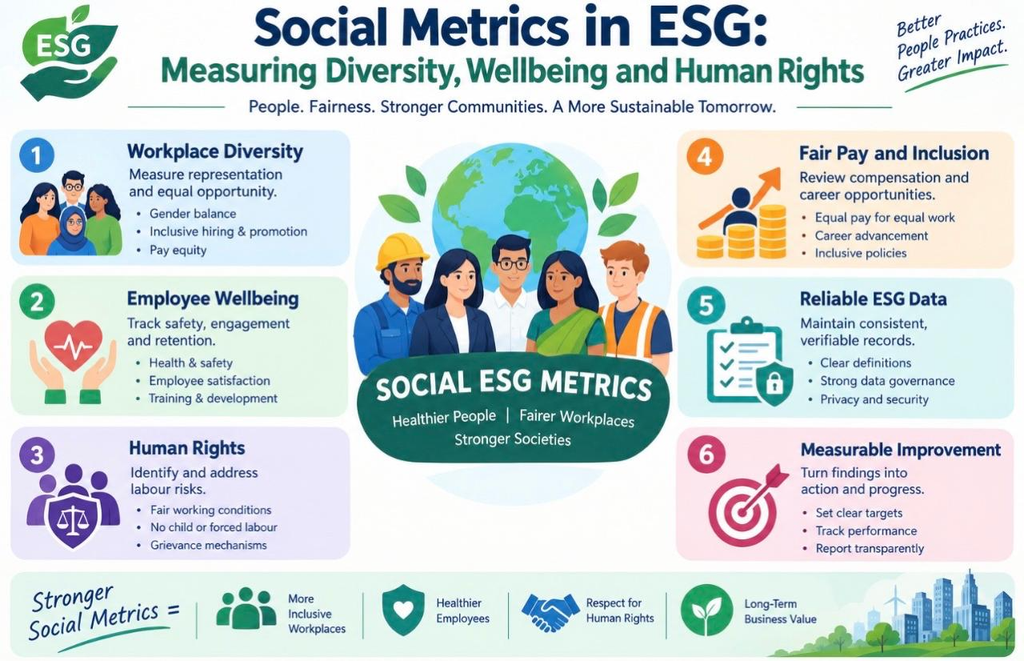
5 Important Social ESG Metrics Every Business Should Measure
1. Diversity Metrics: Measuring Representation and Equal Opportunity
A diverse workforce can bring different perspectives, experiences, and ideas into an organisation. However, businesses cannot understand whether their workplaces are genuinely inclusive simply by stating that they value diversity. They need to examine who is represented across different levels of the organisation and whether employees have fair access to recruitment, training, promotion, and leadership opportunities.
Useful diversity metrics include: Gender representation: The proportion of women and men across the workforce and management levels. Leadership diversity: Representation of different groups in senior positions. Pay equity: Differences in compensation across comparable roles, taking relevant factors into account. Hiring and promotion: Recruitment, retention, and promotion patterns across employee groups.Workplace discrimination: Reported incidents, complaints, and the actions taken to address them.
For example, a company may employ a substantial number of women but have very limited female representation in senior management. Workforce data can help identify this gap and encourage the company to investigate promotion practices, access to leadership development, or retention challenges. The Global Reporting Initiative (GRI) provides sustainability reporting standards that help organisations communicate their impacts on people and society.
Its work on diversity, inclusion, and equal opportunity also highlights the importance of transparent reporting on workplace practices. The key takeaway: Diversity reporting should measure not only who joins a company, but also who advances, who receives opportunities, and whether employees experience fair treatment.
2. Employee Wellbeing: Looking Beyond Salary and Benefits
Employee wellbeing is another important part of social ESG. A company may offer competitive salaries and attractive benefits, but these alone do not necessarily indicate that employees have a healthy and supportive working environment. Long working hours, workplace stress, unsafe conditions, and poor management practices can affect employee satisfaction, productivity, and retention. Businesses can assess wellbeing through several indicators: Health and safety: Workplace injuries, incidents, and preventive measures. Absenteeism: Patterns of employee absence that may warrant further investigation.
Employee turnover: The proportion of employees leaving during a reporting period.Training and development: Access to learning, professional development, and skill-building opportunities. Employee feedback: Results from surveys, engagement assessments, and grievance processes. Consider a manufacturing company that notices an increase in workplace injuries. Rather than simply reporting the number, management can examine the underlying causes, review safety procedures, and monitor whether corrective actions reduce incidents.
Similarly, high employee turnover may indicate concerns about workload, career progression, management, or workplace culture. These indicators should be interpreted in context rather than treated as proof of a particular problem. SEBI’s BRSR Core framework includes social indicators relating to employee wellbeing and safety, reflecting the importance of measuring these issues alongside other sustainability factors.
The key takeaway: Effective wellbeing metrics help businesses identify workplace risks early and assess whether their employee-support initiatives are making a difference.
3. Human Rights: Extending Responsibility Beyond the Office
A company’s social responsibilities do not necessarily end at its own workplace. Business activities can affect contract workers, suppliers, temporary employees, communities, and other people connected to its operations. Human rights considerations may include fair working conditions, freedom from discrimination, safe workplaces, prevention of forced labour and child labour, and access to appropriate grievance mechanisms.
Businesses can monitor relevant indicators such as: Human rights assessments: The proportion of operations or suppliers assessed for potential human rights risks. Labour practices: Compliance with applicable labour requirements and internal policies. Grievance resolution: The number and nature of complaints received and resolved. Supplier screening: The extent to which relevant suppliers are evaluated for labour and human rights risks. Corrective action: Steps taken to address identified problems and prevent recurrence.
For example, a clothing brand may maintain strong employment policies at its headquarters while relying on suppliers whose working conditions are not adequately monitored. Supplier assessments and worker grievance channels can help the company identify potential risks beyond its direct operations. The International Labour Organization (ILO) explains that human rights due diligence involves identifying, preventing, and mitigating actual or potential adverse impacts and accounting for how these impacts are addressed. Labour rights are an important part of this process.
The key takeaway: Human rights reporting should demonstrate how a company identifies risks, responds to concerns, and works to prevent harm across its business relationships.
4. Data Accuracy: Making Social Disclosures Credible
Even the most detailed ESG report can be misleading if its underlying data is incomplete or inconsistent. Imagine that a company reports different employee headcounts in its HR records and sustainability report. Or suppose its safety statistics exclude contract workers without clearly explaining the reporting boundary. Such inconsistencies can weaken confidence in the company’s disclosures.
To improve data quality, businesses should establish clear definitions for each metric, identify reliable data sources, assign responsibility for reporting, and document how figures are calculated. For instance, employee turnover should have a consistent definition and reporting period. Diversity statistics should explain which employee categories are included, while safety indicators should clearly state their scope and methodology.
Companies should also protect sensitive personal information. Social reporting requires meaningful transparency, but that does not mean publishing identifiable employee records or confidential complaint details. GRI’s standards are designed to support more consistent and credible reporting of an organisation’s impacts on people, the environment, and the economy.
The key takeaway: Reliable social ESG reporting depends on consistent definitions, documented evidence, appropriate privacy safeguards, and clear accountability.
5. Turning Social Metrics Into Meaningful Action
Collecting data is only the beginning. Social metrics become valuable when businesses use them to identify problems, set priorities, and measure improvements over time. A company might discover that women are underrepresented in leadership roles, that safety incidents are concentrated in one facility, or that employee grievances take too long to resolve.
Each finding provides an opportunity to investigate the underlying issue and develop a measurable response. Businesses can establish baseline figures, set realistic targets, assign responsibility to relevant teams, and review progress regularly.
They should also explain when a target has not been achieved and what corrective measures are planned. For example, instead of simply stating that it supports employee wellbeing, a company could report its workplace injury rate, explain the safety measures introduced, and compare results across reporting periods.
Social indicators should also reflect the company’s actual risks and circumstances. A technology company, for instance, may prioritise workplace inclusion and employee wellbeing, while a construction business may place particular emphasis on occupational safety, contractor welfare, and labour practices. The key takeaway: Social metrics should lead to practical decisions and measurable improvements, not simply fill space in an annual sustainability report.
Conclusion
Social ESG metrics help businesses understand how their decisions affect employees, workers, suppliers, and communities. By measuring diversity, employee wellbeing, and human rights, organisations can move beyond broad promises and demonstrate how they manage their social responsibilities. However, meaningful reporting requires more than collecting statistics.
Businesses must define indicators consistently, protect personal information, investigate negative outcomes, and use the findings to improve workplace practices. For Indian businesses, the growing importance of structured sustainability disclosures makes it particularly valuable to develop reliable systems for collecting, reviewing, and reporting social data.
Companies should also consider the reporting requirements and standards applicable to their circumstances rather than assuming that every framework applies equally to every organisation. Ultimately, strong social ESG performance is not about presenting perfect numbers; it is about being transparent, recognising where improvements are needed, and taking measurable action to protect people and create fairer workplaces.
Businesses can use ESG data management software to collect, organise, verify and report social performance information more consistently.
References
[1] Securities and Exchange Board of India (SEBI), “BRSR Core – Framework for Assurance and ESG Disclosures for Value Chain,” sebi.gov.in, July 12, 2023. [Online]. Available:
[2] Securities and Exchange Board of India (SEBI), “Business Responsibility and Sustainability Reporting by Listed Entities,” sebi.gov.in, May 10, 2021. [Online]. Available:
[3] Global Reporting Initiative (GRI), “GRI Standards,” globalreporting.org. [Online]. Available:
[4] Global Reporting Initiative (GRI), “Transparency on Workplace Inclusion and Equal Opportunity,” globalreporting.org, July 1, 2025. [Online]. Available:
[5] International Labour Organization (ILO), “ILO Helpdesk: Business and the Labour Dimension of Human Rights Due Diligence,” ilo.org, Apr. 22, 2024. [Online]. Available:
- SEBI — BRSR Core Framework — Section 2.
- GRI Standards — Sections 1 and 4.
- International Labour Organization — Section 3.
AI Detection
Plagiarism

Proofreading