Research and Promotion Intern | Eve Paper
Keywords: cost optimisation, sme operations
Cost optimisation for Indian SMEs can improve financial resilience without layoffs by strengthening cash flow, reducing operational waste and making better use of existing resources.
Over the last few months I’ve been reading a lot about how small businesses handle money, and honestly the mood is gloomy. Banks are asking harder questions. Investors have stopped clapping for growth alone and want to see profit. That matters for Indian SMEs, which make up roughly 30% of the country’s GDP [1]. During my internship at Visvaniti Foundation I worked on a paper about US tariffs and India’s trade, and what stuck with me was how little cushion small exporters have when costs jump overnight.
When money gets tight, cutting people is usually the first idea. Salaries are the biggest line in the books, so it’s tempting. But layoffs tend to cost more than they save. You lose skills, the people who stay get nervous, and the work still has to be done by someone. So what can an owner try first?
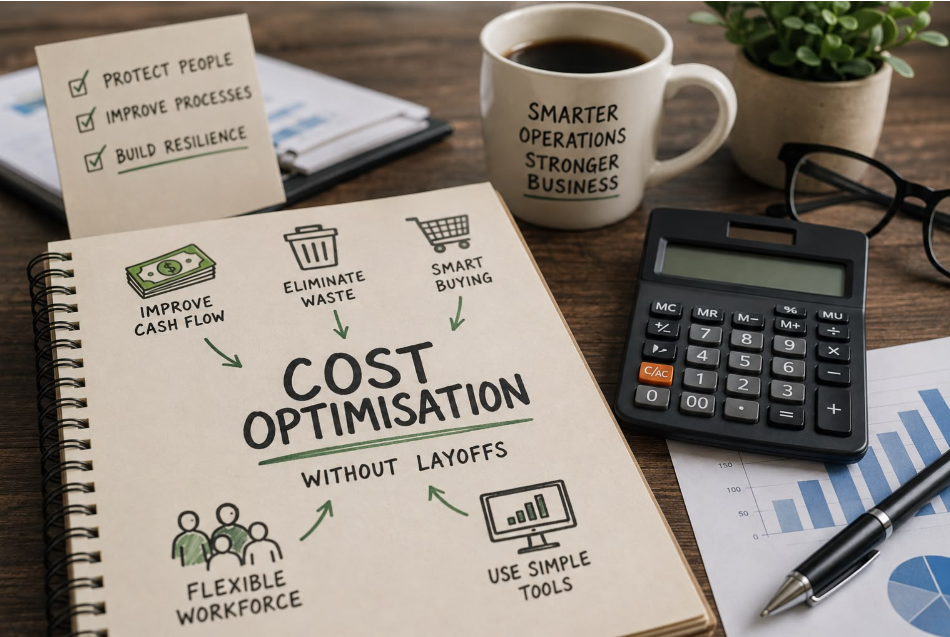
The above given picture is generated by chatgpt
1. 5 Powerful Cost Optimisation Strategies for Indian SMEs
A lot of SMEs aren’t actually losing money. They’re running out of it. Cash gets stuck in unpaid invoices and in stock that isn’t moving. Goldratt’s idea that every system is held back by one bottleneck fits here, since for small firms that bottleneck is often cash flow [2]. The fixes are boring but they work: send invoices the day you deliver, chase payments every week, and ask suppliers for longer terms. Even a few days off the collection cycle can mean less borrowing at high interest.
2. Find the waste
According to Ohno, seven types of wastes occur in the TPS, which include, but are not limited to, overproduction, waiting, and rework [3]. You do not have to hire a consultant to see them; just observe. Maybe fabric waits two days before it’s cut. Maybe a services team rewrites the same proposal from scratch every time. Womack and Jones say to begin with what the customer actually values and drop the rest [4]. That lowers cost per unit and nobody loses a job.
3. Energy and buying
The owners will hardly doubt their power bills and suppliers, but maybe they should start. Turning on huge machinery during the period when there is low demand, maintaining their equipment, and installing solar panels on the roof where possible can all help save money on electricity bills. Buying supplies together with several other local SMEs will do. Comparing supplier quotes every quarter costs close to nothing.
4. Flexible, not smaller
This one speaks most directly to the layoff question. Train your staff to play multiple roles in case one is unavailable, which will not hinder the job completion. Relate part of their salary to performance in order for fixed costs to be easy when the period is poor. In case the situation gets worse, shortening of working days, recruitment freeze, and taking vacation may aid a business. What makes these work is honesty. People accept a short-term hit more willingly when the owner shows them the numbers.
5. Keep the tools simple
I don’t need to spend money on a costly ERP system because throughout the internship I conducted everything through the Internet, and email and Google Meet were enough for cooperation, receiving advice from my mentor, and deadline management. Admittingly, it turned out to be harder to organize myself on my own than I initially expected. This concept can be implemented by smaller companies as well. Basic accounting software, WhatsApp for order tracking and a shared spreadsheet for stock remove a lot of double-handling. It’s mostly about visibility. You can’t trim what you can’t see.
Conclusion
Funding isn’t going to loosen up soon, and efficiency is what gets rewarded now. For SMEs that doesn’t have to mean a smaller team. It can mean faster cash, less waste, smarter buying and more flexible working. Protect the people and question everything around them. I think firms that do this will be in better shape when things turn.
SMEs exploring digital improvements can learn how an AI operating model helps organise workflows, improve accountability and reduce repetitive work.
References
[1] Ministry of Micro, Small and Medium Enterprises, Government of India, Annual Report 2023-24. New Delhi, India: Government of India, 2024.
[2] E. M. Goldratt and J. Cox, The Goal: A Process of Ongoing Improvement. Great Barrington, MA, USA: North River Press, 1984.
[3] T. Ohno, Toyota Production System: Beyond Large-Scale Production. Cambridge, MA, USA: Productivity Press, 1988.
[4] J. P. Womack and D. T. Jones, Lean Thinking. New York, NY, USA: Simon & Schuster, 1996.
Use these sources to support relevant points in your article:
- Ministry of Micro, Small and Medium Enterprises — Government of India — for the role and importance of Indian SMEs.
- Lean Enterprise Institute — for lean principles and waste reduction.
- Google Sheets — as an example of a simple tool for tracking stock and operations.