Source: ChatGPT [ Open AI ]
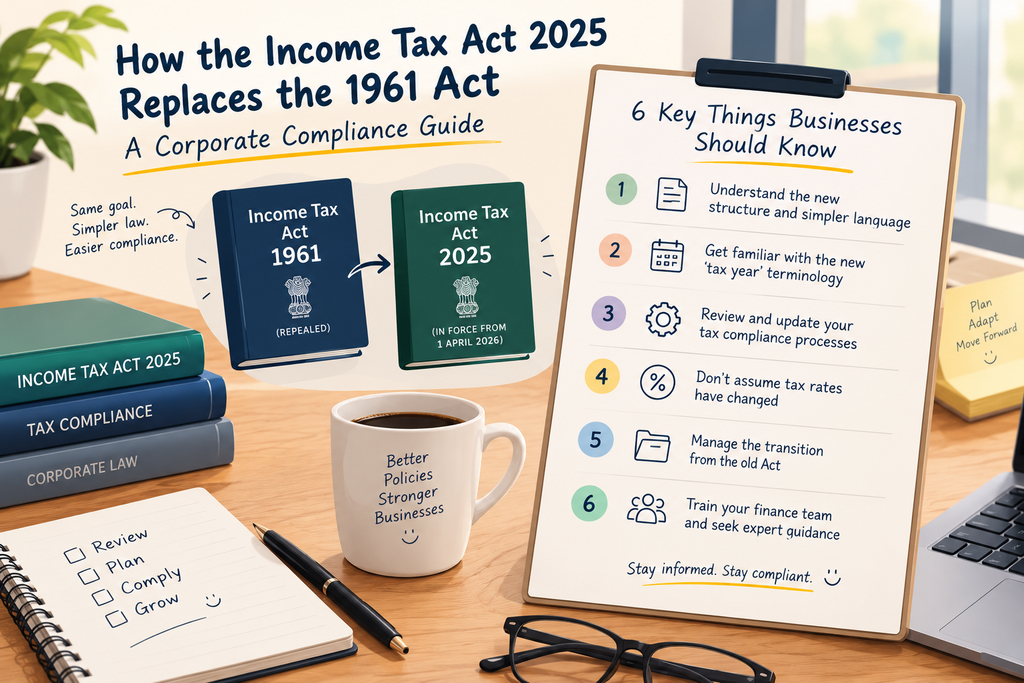
The Income-tax Act 2025 came into effect on 1 April 2026, replacing India’s Income-tax Act, 1961 and introducing a reorganized framework for income-tax compliance.
Tax compliance is already a regular part of running a business. From maintaining financial records to filing returns and meeting deadlines, companies have several responsibilities to manage. Now, India has introduced a new income-tax law that businesses need to understand.
The Income-tax Act, 2025 came into effect on 1 April 2026, replacing the Income-tax Act, 1961. The aim is to make tax laws easier to read and follow. But what does this change mean for companies in their day-to-day operations? Here are six important things businesses should keep in mind.
1. Income-tax Act 2025: Six Changes Businesses Need to Understand
The 1961 Act had grown over six decades, with numerous amendments and provisions that could make it difficult to navigate. The new Act brings the rules into a more organised structure and uses simpler language.
For businesses, this can make it easier to locate relevant provisions and understand their responsibilities. However, simpler wording does not mean every tax question will have a straightforward answer. Companies should still seek professional advice when dealing with complex transactions or unusual tax situations.
2. Understand the New Meaning of “Tax Year”
One noticeable change is the introduction of the term “tax year.” Under the earlier Act, businesses commonly dealt with the terms “previous year” and “assessment year,” which could sometimes be confusing.
The new Act uses “tax year” for the 12-month period aligned with the financial year. For example, income earned during April 2026 to March 2027 falls within Tax Year 2026–27.
Companies should update their internal tax documentation and make sure their finance teams understand the new terminology. The change does not require businesses to alter their existing accounting year.
3. Review Tax Compliance Processes
A new law is a good reason to review existing procedures. Businesses should check whether their tax calculations, return preparation processes, internal checklists and compliance records reflect the applicable provisions of the new Act.
The Income-tax Rules, 2026 and updated forms also matter because they explain how various requirements are to be followed in practice.
Rather than changing every process at once, companies can begin by identifying which procedures need updating and assigning responsibility to the relevant finance or tax team.
4. Do Not Assume Tax Rates Have Automatically Changed
A new law does not necessarily mean a new tax burden. The main purpose of the Income-tax Act, 2025 is to simplify and reorganise the existing framework, rather than introduce a completely new system of taxation.
Businesses should therefore avoid making financial decisions based only on the replacement of the Act. They should review the provisions and tax rates applicable to their particular circumstances before estimating their tax liability or revising budgets.
5. Pay Attention to the Transition from the Old Act
The transition is especially important for companies dealing with earlier tax years. The repeal of the 1961 Act does not make previous tax records, assessments or pending proceedings invalid.
Under the new law’s transition provisions, matters relating to tax years beginning before 1 April 2026 generally continue to be handled under the earlier Act. This means businesses may need to refer to both laws while managing different tax periods.
Keeping previous returns, assessment records, notices and supporting documents organised can help finance teams handle these matters more efficiently.
6. Train Your Finance Team and Seek Expert Guidance
Even when a law becomes easier to read, employees still need time to understand how it applies to their work. Finance and accounts teams should become familiar with the new terminology, relevant provisions and updated compliance requirements.
Companies can arrange internal training, consult tax professionals and review official guidance issued by the Income Tax Department. These steps can help reduce avoidable errors and make the transition smoother.
Businesses should review their business tax compliance procedures to ensure that their records, tax calculations, and filing processes reflect the rules applicable to each tax period.
A More Practical Approach to Compliance
The Income-tax Act, 2025 is an important change in India’s direct-tax framework, but businesses do not need to treat it as a complete reset of their tax obligations. The better approach is to understand what has changed, identify the requirements relevant to the organisation and update procedures accordingly.
Ultimately, good tax compliance is not just about filing returns on time. It also means keeping accurate records, understanding legal responsibilities and preparing for changes before they create problems. With the right information and a little planning, businesses can make the shift to the new Act with greater confidence.
References:
[1] Income-tax Act, 2025: 7 Changes Every Business Owner Should Know, October 2026 , SSRA & Co. [ Online ]
Available:
[2] The Income Tax Act, 2025 Reshaping Tax Framework, September 2025 , Press Information Bureau [ Online ]
Available:
https://static.pib.gov.in/WriteReadData/specificdocs/documents/2025/sep/doc202593626601.pdf
Reports:
AI Report

Plagiarism Report

Grammar Report