
Knowing how to calculate TDS helps small businesses deduct the correct tax from eligible payments, follow applicable thresholds and rates, and meet tax compliance requirements.
Writer: Tanishka | Informational / Search Intent
Primary SEO keyword: how to calculate TDS
Secondary keywords: TDS rates 194C 194J; TDS deduction calculation
Background
Tax deducted at source (TDS) is a way of collecting income tax when certain payments are made or credited. For a small business, calculating it correctly means identifying the payment, checking the applicable threshold and rate, and deducting tax at the right time. A missed deduction can create interest, reporting work and disputes with a vendor. A simple, repeatable check before every payment helps prevent avoidable errors.
Table of Contents
- Identify the payment and the applicable rule
Start with what the payment is for, rather than the vendor’s label. Contractor bills, professional fees, rent, commission and interest can fall under different TDS provisions. For payments or credits from 1 April 2026, use the Income-tax Act, 2025 framework and the relevant entry in section 393. Earlier transactions remain governed by the Income-tax Act, 1961. The familiar 194C, 194J and similar section numbers may still appear in older material, so match the rule to the transaction date and current portal guidance.
- Check the threshold and rate
Before calculating, confirm whether the payment has crossed the applicable threshold. Thresholds and rates differ by payment type, payee status and circumstances; do not apply one rate to every supplier. The Income Tax Department says the 2025 Act retained the existing TDS rates and monetary thresholds. For example, the rule for a contractor is not automatically the rule for a consultant. Verify the current statutory table, check the payee’s PAN details, and confirm whether a special rate applies. This quick check is more reliable than copying a rate from an old invoice.
- How to Calculate TDS on Business Payments
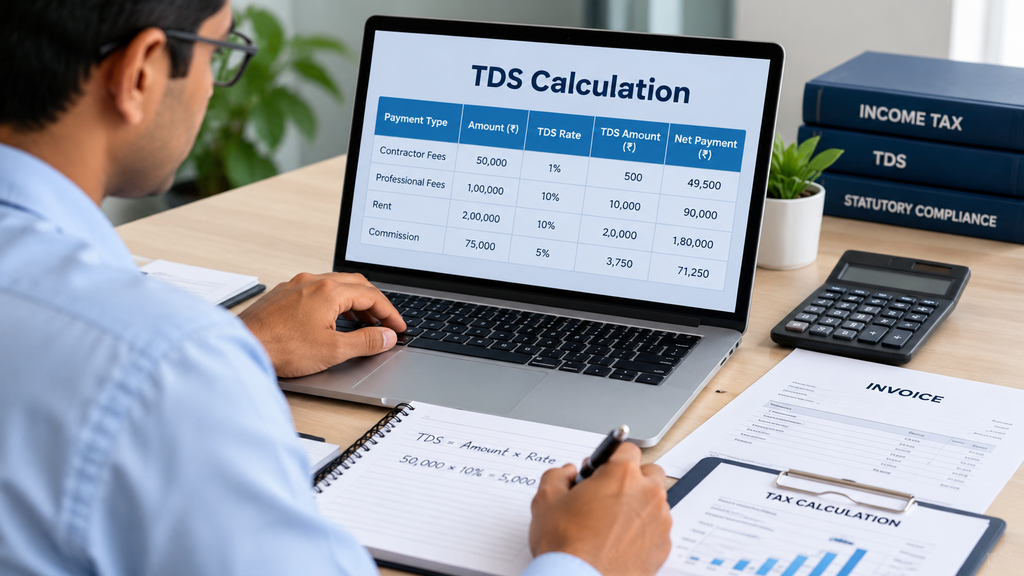
Once the correct rate and base are known, calculate: TDS = amount liable to deduction x applicable rate. Suppose a qualifying service payment has a taxable base of Rs 50,000 and the verified rate is 10 per cent. TDS would be Rs 5,000, leaving Rs 45,000 payable to the vendor, subject to the contract and applicable rules. This is an illustration only; the real rate and base depend on the transaction. Record the gross amount, tax deducted, net payment, date and rule used in the ledger.
- Deposit, report and reconcile
Deduct TDS at the applicable point, generally when the amount is credited or paid, whichever occurs first under the relevant provision. Deposit it by the prescribed deadline and file the correct quarterly statement. From Tax Year 2026-27, the Income Tax Department identifies Form 140 as the quarterly statement for TDS on non-salary payments to residents; it was earlier known as Form 26Q. The portal lists quarter-end filing dates as 31 July, 31 October, 31 January and 31 May for the final quarter. Reconcile each filing with the ledger, challan and vendor records, then provide the required TDS certificate.
Maintaining accurate financial records helps businesses reconcile tax deductions, track payments, and prepare their tax returns.
Conclusion
Good TDS calculation is a short workflow: classify the payment, check the date, threshold and rate, calculate the deduction, then deposit and report it on time. Keep the supporting invoice and calculation together so another person can follow the decision. Because rules and forms can change, confirm the current Income Tax Department guidance before filing, especially for unusual payments or missing PAN details. A chartered accountant can help review complex or high-value cases.
References
- Income Tax Department, “TDS Compliance,” https://www.incometax.gov.in/iec/foportal/help/all-topics/e-filing-services/tds-compliance
- Income Tax Department, “Form 140 User Manual,” https://www.incometax.gov.in/iec/foportal/newformpage/forms/form140-um