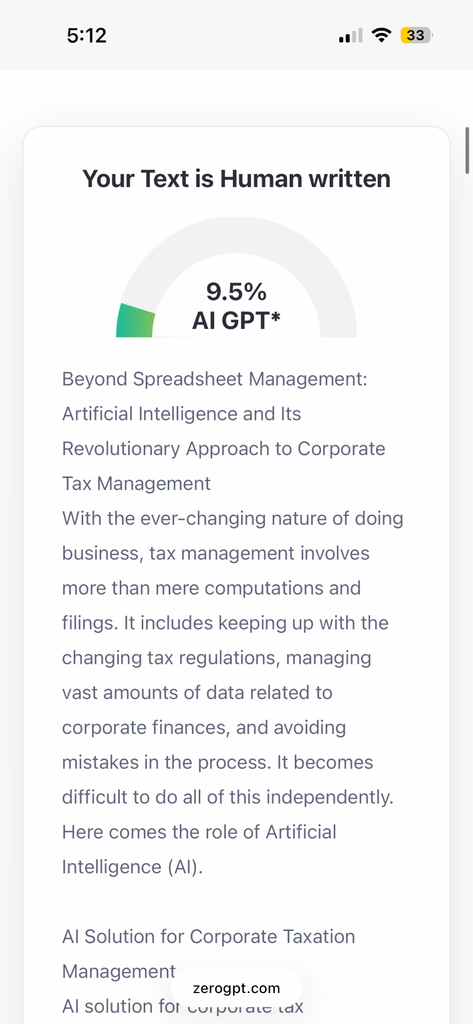
AI Tax Management With the ever-changing nature of doing business, tax management involves more than mere computations and filings. It includes keeping up with the changing tax regulations, managing vast amounts of data related to corporate finances, and avoiding mistakes in the process. It becomes difficult to do all of this independently. Hence, we use AI for these things.
AI Tax Management AI Solution for Corporate Taxation Management
An AI solution for corporate tax management refers to the use of innovative technologies such as machine learning, data analysis, and automation, which will help corporations deal with all aspects relating to their taxation more efficiently. Instead of using manual methods such as calculations and the use of spreadsheets, companies will be able to take advantage of computerized systems that analyze the company’s financial data and reach conclusions.
For example, if a company operates in different countries, then there are many things that should be considered, including different taxes and reporting deadlines. The AI solution will organize all this information and identify problems that should be handled.
AI Tax Management Tax Saving Opportunities Identification
Each business should make sure about wise spending, including taxes. Application of AI in financial document analysis can be used for identification of certain tax-saving opportunities like deductions, exemptions, credits, and others.
Thus, where some eligible research and development activities take place in the course of business operation, there are certain tax-saving opportunities. Such AI-powered tax software for businesses can be of great use in this process.
Nevertheless, a recommendation of particular action does not automatically mean legal acceptance of the tax opportunity. AI Tax Management
AI Tax Management Improvement of Compliance and Reduction of Risk
It is rather common for taxes to change, especially for organizations working in various jurisdictions. Non-compliance with particular deadlines and wrong reporting may result in penalties and other costs.
The use of AI may help monitor deadlines, analyze transactions, detect abnormal trends, and uncover potential risks of non-compliance. In case of multinational companies, such features may become especially useful. AI Tax Management
Moreover, AI will be able to notify about any issues or fraud, but it will not guarantee the identification of all risks. That is why it is essential to perform audits.
AI Tax Management Difficulties Arising As a Result of the Use of Technology
Despite numerous advantages, however, an AI will not be able to solve issues magically. The quality of the result provided by the algorithm is based on the data used. In case of inaccurate financial data, errors are unavoidable.
Also, the following difficulties should be taken into account, such as loss of privacy and security of data, high price of software, and bias in the advice. It is essential to know tax laws, and the advice of the AI will not include all aspects of the company.
Therefore, proper software and professional advice are required.
AI Tax Management Corporate Tax Planning of the Future
Artificial intelligence transforms the process of corporate tax planning from a set of routine tasks into a more forward-looking and data-driven practice aimed at boosting efficiency, making the right decisions, and staying compliant.
It must be noted that the application of AI technology in the tax management of the company is not only about savings but also about the rational management of finances of the firm in accordance with the laws and regulations. Although technology performs calculations, decision-making remains an exclusive prerogative of people.
Success in business is always achieved when technology meets prudence.
References- IEEE Format
[1] Organisation for Economic Co-operation and Development (OECD), Tax Administration 3.0: The Digital Transformation of Tax Administration. Paris, France: OECD Publishing, 2020. [Online]. Available: https://doi.org/10.1787/ca274cc5-en
[2] OECD, Tax Administration Digitalisation and Digital Transformation Initiatives. Paris, France: OECD Publishing, 2025. [Online]. Available: https://doi.org/10.1787/c076d776-en
[3] Thomson Reuters Institute, “Corporate tax teams eager for AI, but frustrated by pace of change, new report shows,” Mar. 16, 2026. [Online]. Available: https://www.thomsonreuters.com/en/institute/reports/corporate-tax-department-technology-report-2026
[4] Deloitte India, “Tax Technology Solutions.” [Online]. Available: https://www.deloitte.com/in/en/services/tax/about/tax-technology.html
[5] National Institute of Standards and Technology (NIST), Artificial Intelligence Risk Management Framework (AI RMF 1.0), NIST AI 100-1, Jan. 2023. [Online]. Available: https://doi.org/10.6028/NIST.AI.100-1
[6] OECD, “AI in tax administration,” in Governing with Artificial Intelligence. Paris, France: OECD Publishing, 2025. [Online]. Available: https://www.oecd.org/en/publications/governing-with-artificial-intelligence_795de142-en/full-report/ai-in-tax-administration_30724e43.html
[7] Internal Link: Add Post ‹ Eve Consultancy — WordPress