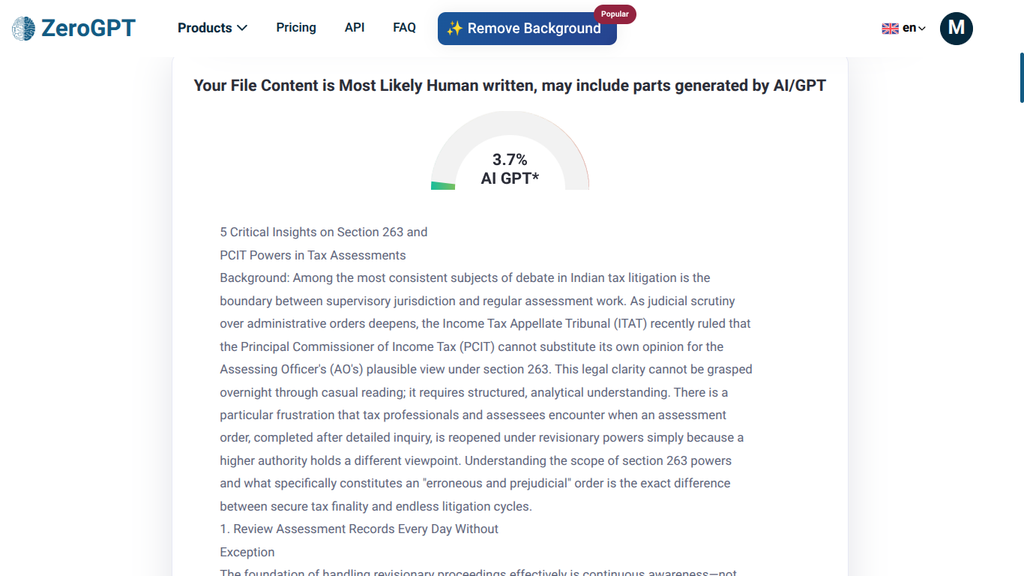
Section 263 Tax Assessment Background: Among the most consistent subjects of debate in Indian tax litigation is the boundary between supervisory jurisdiction and regular assessment work. As judicial scrutiny over administrative orders deepens, the Income Tax Appellate Tribunal (ITAT) recently ruled that the Principal Commissioner of Income Tax (PCIT) cannot substitute its own opinion for the Assessing Officer’s (AO’s) plausible view under section 263. This legal clarity cannot be grasped overnight through casual reading; it requires structured, analytical understanding. There is a particular frustration that tax professionals and assessees encounter when an assessment order, completed after detailed inquiry, is reopened under revisionary powers simply because a higher authority holds a different viewpoint. Understanding the scope of section 263 powers and what specifically constitutes an “erroneous and prejudicial” order is the exact difference between secure tax finality and endless litigation cycles.
1. Section 263 Tax Assessment: Review Assessment Records Every Day Without Exception
The foundation of handling revisionary proceedings effectively is continuous awareness—not occasional reviews, not weekend scrambles, or looking at case files only when a notice arrives. Tax professionals build procedural fluency through repeated, cumulative engagement with assessment orders in the same way they handle regular filings. For tax practitioners, the daily review target should involve structured examination of scrutiny notices, noting whether orders passed by the AO reflect adequate application of mind.
2. Section 263 Tax Assessment: Focus on Inquiry Logic, Not Just Information Extraction
One of the most important shifts a tax practitioner must make is moving from simple information checking—what documents were submitted?—to inquiry structure analysis—did the AO conduct proper verification during the assessment? Revisionary provisions under section 263 are designed to test whether an assessment order is both erroneous and prejudicial to the interests of the revenue, rather than merely re-evaluating an issue where the AO took a legally sustainable view. Section 263 Tax Assessment
3.Section 263 Tax Assessment: Time Your Case Analysis and Track Precedents
Legal compliance and defense strategy require measurement and timing. Without tracking statutory limitation periods and recent tribunal rulings, a consultant has no reliable way to know whether a response to a revision notice is robust. Timed case law reviews—analyzing judicial precedents against specific factual matrices—provide the data that makes legal preparation genuinely developmental rather than reactive. Section 263 Tax Assessment
4.Section 263 Tax Assessment: Build Jurisprudential Clarity Through Contextual Study
Case law application is both a defense enabler and a direct requirement in tax litigation. Practitioners frequently respond to section 263 notices by citing generic case lists—a strategy that produces short-term comfort but limited long-term protection. The more effective strategy is contextual legal analysis, examining how appellate authorities interpret the limits of PCIT powers within specific factual scenarios before drafting submissions.
5.Section 263 Tax Assessment: Practice Specific Assessment Scenarios Across Jurisdictions
While general tax knowledge builds the baseline foundation, targeted analysis of specific assessment disputes—such as corporate disallowances, capital gains evaluations, and transfer pricing margins—is essential for protecting assessment orders. Tax professionals handling complex audits should ensure their review processes cover diverse scrutiny profiles rather than focusing only on familiar sectors.
Conclusion
Understanding section 263 powers is not a talent that some tax experts possess and others do not. It is a skill built through systematic case study, measured through regular tracking of judicial trends, and deepened through analytical engagement with tax jurisprudence. The practitioner who commits to structured legal analysis, evaluates AO discretion honestly, and respects recent tribunal rulings is building the single most reliable litigation defense skill available.
References
[1] Income Tax Appellate Tribunal, “Recent Rulings on Section 263 and PCIT Jurisdiction,” ITAT Reports, New Delhi, 2026. [Online]. Available: https://itat.gov.in/
[2] Central Board of Direct Taxes, “Income Tax Act, 1961: Section 263 Revision of Orders Prejudicial to Revenue,” Government of India, New Delhi, 2026. [Online]. Available: https://incometaxindia.gov.in/
[3] Supreme Court of India, “Judicial Precedents on Commissioner’s Revisionary Powers,” SCC Online, New Delhi, 2025. [Online]. Available: https://main.sci.gov.in/
[4] S. L. Pressley and P. Afflerbach, “Verbal Protocols of Reading: The Nature of Constructively Responsive Reading,” Lawrence Erlbaum Associates, New Jersey, 1995. [Online]. Available: https://www.routledge.com/
[5] Institute of Chartered Accountants of India, “Guidance Note on Tax Scrutiny and Revision Proceedings,” ICAI, New Delhi, 2025. [Online]. Available: https://www.icai.org/
[6] Internal link: Add Post ‹ Eve Consultancy — WordPress