ABSTRACT
Macro Trends Indian Enterprises At the end of 2026, the world’s monetary architecture reveals re-tightening, migration of capital and fast technological assimilation. The article focuses on five key trends in global finance that have significant implications for companies in an interconnected market economy: monetary hawkishness, the surge in private credit, agentic AI in corporate finance, supply chain diversification under China+1, and the need for companies to give higher weight to ROI in tech investments.
INTRODUCTION
The world economy is a two-story story as September 2026 unfolds – a story of strong technology innovation but of continued structural uncertainty. Indian businesses are not as protected as they think from the wider macro-economic changes, although India is outperforming most of the emerging markets with a GDP growth rate of 6.6%–7.0%. The global liquidity and interest rate tightening by the central banks, high crude prices, and modification of capital inflows directly affect domestic liquidity, cost of borrowing, and foreign direct investment (FDI). Corporate finance leaders across India need to be aware of five key global trends in the month of February to become more resilient and leverage international opportunities. Macro Trends Indian Enterprises
Macro Trends Indian Enterprises need to monitor closely in September 2026 as global economic conditions continue to influence business decisions and financial performance. Changes in interest rates, inflation, currency movements, trade policies, and global demand can create both opportunities and challenges for Indian companies. By tracking these major financial trends, businesses can better understand market risks, plan investments, manage costs, and prepare for changes in international markets. Staying informed about global finance trends can help Indian enterprises make smarter decisions and maintain steady growth in a changing economic environment.
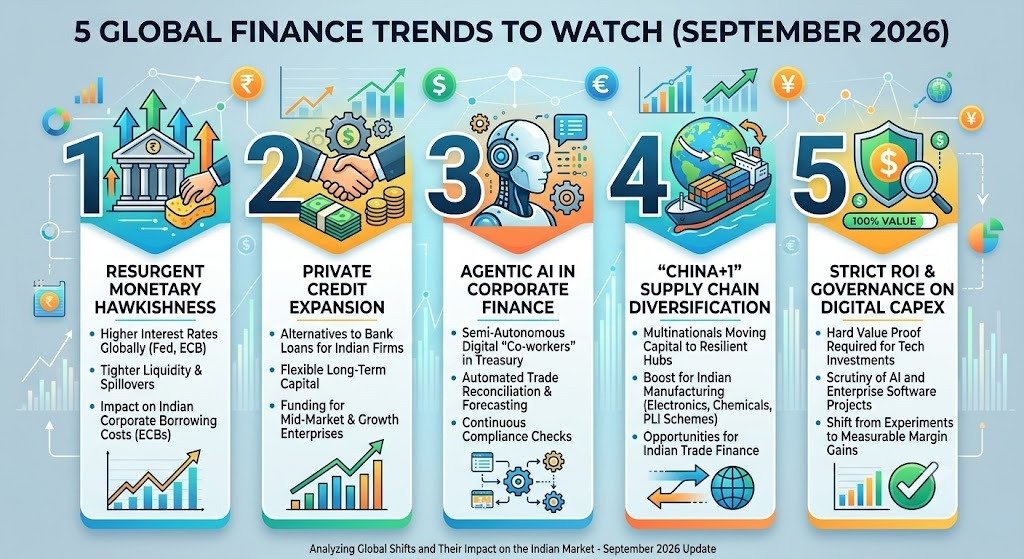
5 GLOBAL FINANCE TO WATCH
1. Resurgent Monetary Hawkishness and Tighter Global Liquidity: Macro Trends Indian Enterprises
September 2026, major central banks, like the U.S. Federal Reserve and the European Central Bank, have indicated a hawkish move, by raising benchmark rates, to quell entrenched inflation as a result of energy and logistics shocks.
The impact on India: Borrowing abroad through External Commercial Borrowings (ECBs) is getting more expensive for Indian corporations. Given that the Reserve Bank of India (RBI) is keeping a check on global spillover risks, there is upward pressure on yields for domestic debt markets; risk management and floating-rate debt hedging are the key priorities. Macro Trends Indian Enterprises
2. The rapid growth of private credit: Macro Trends Indian Enterprises
Traditional bank lending in the world is limited by tougher capital regulations (including Basel regulations) and corporate capital has been quickly shifting into private credit funds. Middle-market corporate financing is increasingly going to the private credit market – and it’s getting bigger by the day.
For capital expenditure, Indian mid-market enterprises and high-growth businesses can approach alternative global private debt facilities, secondary markets and structured risk transfer instruments, as an alternative to public banks in India. Macro Trends Indian Enterprises
3. Adopt ‘Agentic AI’ in Corporate Treasury
In corporate treasury and finance, operations have transitioned from mere passive automation to ‘agentic AI’—digital collaborators that perform trade reconciliations, ongoing compliance monitoring and real-time cash flow forecasts on their own. Macro Trends Indian Enterprises
Large Indian technology services, banking institutions and shared service centers (GCCS) need to move their services from manual back-office operations to oversee and audit semi-autonomous AI processes.
4. “China+1” Supply Chain Capital Flows accelerations
Multinational companies are urgently reallocating capital to those resilient supply chain hubs in the face of escalating geopolitical fragmentation and trade policy changes in Q3 2026.
India as a major beneficiary in certain key activities like electronics manufacturing, specialty chemicals, pharmaceuticals, and auto components to name a few. The Government of India Production Linked Incentive (PLI) schemes will help companies to draw in capital inflows and international trade finance.
5. Digital Capex is subject to strict Governance and “Proof-of-Value”.
In 2026, enterprise finance teams are asking for more concrete return on investment (ROI) metrics and governance before investing in large-scale digital transformations, after years of aggressive investments in technology experimentation. Data quality and security are now required basic conditions for corporate approval. Macro Trends Indian Enterprises
The repercussions in India: Indian IT services exporters and CFOs within Indian businesses are coming under pressure to demonstrate the return on investments in enterprises’ software and AI solutions in terms of cash flow and margin improvements instead of the more abstract concept of efficiency gains.
CONCLUSION
Indian business leaders will need to shift from the defensive “cost-cutting mentality” to a more proactive “strategic positioning” approach in the global macroeconomic environment of September 2026. Indian companies can effectively mitigate the impact of high interest rates in other countries by optimizing their capital structures with alternative financing sources, using agentic AI in treasury functions, and identifying the impact of trade disruptions caused by global supply chain reconfigurations. Indian businesses can protect themselves against high foreign interest rates and continue to grow in the local market by optimizing capital structures with alternative funding options, leveraging agentic AI in treasury functions, and identifying trade disruptions arising from global supply chain reconfigurations. Macro Trends Indian Enterprises
REFERENCES
- World Economic Forum (2026) – Emerging Trends for 2026: Banking Enters the Agentic Era and Private Credit Expansion. Available at: World Economic Forum
- Protiviti Global Finance Trends Survey (2026) – 2026 Global Finance Trends: CFO Priorities, AI Strategy, and Measurable Value. Available at: Protiviti Research
- Trintech (2026) – 5 Key Trends Impacting Finance Leaders in 2026: Agentic AI, Data Quality, and Agility. Available at: Trintech Insights
- LiveMint Market Bureau (2026) – Global Interest Rate Cycle Impact on Indian Stock Markets and Corporate Liquidity. Available at: LiveMint News
- CA Dialogue Outlook (2026) – Global Market Outlook 2026: What Indian Investors and Enterprises Must Know. Available at: CA Dialogue Analysis
- Internal Link: Add Post ‹ Eve Consultancy — WordPress