ABSTRACT
BRICS 2026 Cross-Border Payments BRICS is increasingly integrating economically and frictionless cross-border payment is a key geopolitical and financial priority. The traditional global trade is based on multi-tiered correspondent banking that entails high transaction fees, foreign exchange risk, and settlement time delays of many days. This article explores the potential to improve the efficiency of intra-bloc commercial transactions and change international commerce through cross-border national retail interoperability, local currency settlement and decentralized messaging systems.
INTRODUCTION
September 2026 marks an important moment for the world of trade, particularly one involving the 18th BRICS Summit. The BRICS alliance is an important part of the global population and output, and has long-standing structural issues in international trade. One of the main challenges is the existing international payment system, which typically involves intermediaries and high processing costs for payments sent across borders, often with delays in settlement. Member states, in turn, are taking steps to facilitate bilateral trade and mitigate exchange rate friction through interlinked payment programs and local currency settlement arrangements.Meanwhile, Member States are actively promoting interlinked payment programs and local currency settlement processes to facilitate bilateral trade and remove exchange rate friction.
KEY MECHANISMS DRIVING CROSS – BORDER PAYMENT REFORM : BRICS 2026 Cross-Border Payments
1. Interoperability of Fast Payment Systems: BRICS 2026 Cross-Border Payments
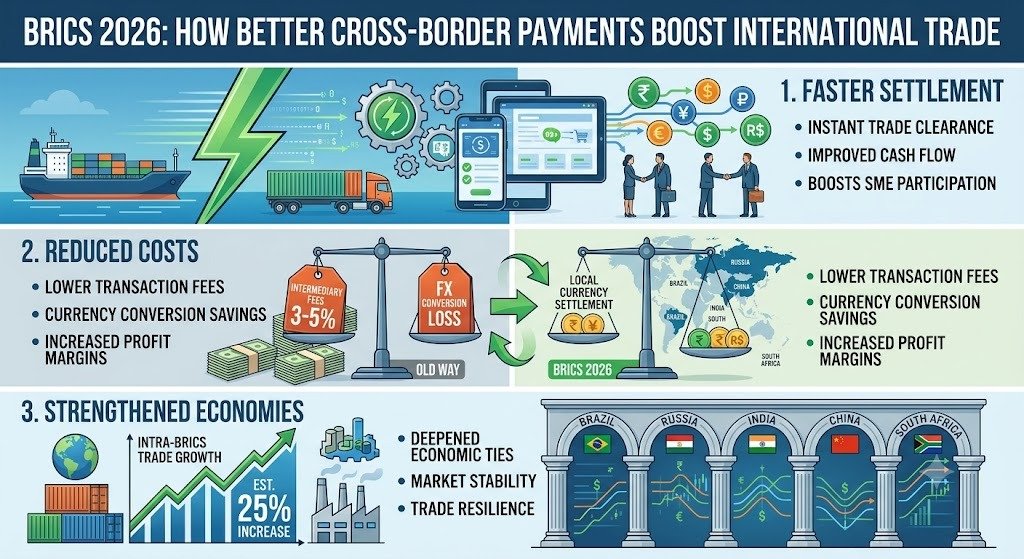
To enable direct merchant and peer-to-peer transactions across borders, national systems for real-time payments like UPI in India, Pix in Brazil, and UnionPay/China’s CIPS needs to be connected. When these enterprises link up with each other without any intermediary correspondent banks, they are able to settle small and medium-sized commercial deals almost instantly. BRICS 2026 Cross-Border Payments
2. Local Currency Trade Settlement
In order to reduce losses due to currency conversion on foreign exchange markets, it is preferable to form direct currency pairs between currencies of the BRICS countries. Trading partners can enter into contracts and place orders in their local currencies without being affected by the fluctuations in foreign exchange rates, thus reducing hedging expenses. BRICS 2026 Cross-Border Payments
3. Decentralised Financial Messaging Networks: BRICS 2026 Cross-Border Payments
The initiatives of the BRICS Payment Task Force are centered on the decentralized cross-border messaging systems (DCMS), which complement legacy messaging frameworks such as SWIFT. These networks enable the direct flow of encrypted trade documentation and transaction instructions between the banks involved, bypassing any single central “clearing” house.
4. Central Bank Digital Currency (CBDC) Integration
With the Wholesale Central Bank Digital Currencies (CBDCs), settlement is programmed and atomic. With the simultaneous settlement of cash and asset legs, multi-CBDC platforms lower counterparty risk, enabling more large-scale trade finance and capital market transactions.
IMPACT ON INTERNATIONAL TRADE : BRICS 2026 Cross-Border Payments
Reduced Transaction Costs: Fewer banking intermediaries and fewer banking fees in direct settlement routes, enabling economic trade by small and medium enterprises (SMEs).
Avoiding capital lock up periods: In accelerated Working Capital Cycles, each capital cycle is settled immediately to provide exporters with quicker liquidity and ensure more predictability in cash flow.
Improved Trade Resilience: Multi-modal payment facilities help to sustain global trade flows, in the face of external unilateral shocks or system disruption.
CONCLUSION
Investment in cross-border payment infrastructure will not only be a technology upgrade, it will be an economic accelerator for the BRICS economies. The direct payment linkages, local currency adoption and decentralized financial technology will help reduce the friction for transactions in international trade, enhance systemic resilience and establish a more equitable global financial system for the BRICS member countries.
REFERENCES
- National Crowdfund & Fintech Association (NCFA Canada) – 2026 BRICS Summit Advances Cross Border Payment Links. Available at: NCFA Canada
- BRICS Information Portal – BRICS Announces Plans to Launch BRICS Pay in 2026 as Independent Alternative. Available at: BRICS Info Platform
- Ministry of External Affairs, Government of India – 18th BRICS Summit Media Declarations and Financial Taskforce Updates. Available at: MEA India
- Wikipedia Financial Systems Documentation – BRICS Pay and Decentralized Cross-Border Messaging System Architecture. Available at: Wikipedia Entry on BRICS Pay
- Internal Link: Add Post ‹ Eve Consultancy — WordPress