
Blog Topics: Import duties USA, HTS USA
The Indian economy is dependent on Agriculture. It is primarily the backbone due to its significant contribution to job creation and livelihood. Post-independence, the country of India was found to be dependent on imports to take care of its agricultural needs. Nevertheless, with significant agricultural advancements, the nation has achieved considerable progress in food self-sufficiency. The agricultural production (which includes crops, animal farming, forestry, and fishing) is the major focus of the nutritional requirements of the nation. The allied sector involving animal husbandry, dairy, and fishing is steadily coming up as a high-growth sector. The agriculture sector in India is known to contribute about 16 per cent (PE) of GDP in the country in the current prices that are in FY24, and it also supports nearly 46.1 per cent of the population (Indian Economic Survey 2024-25).
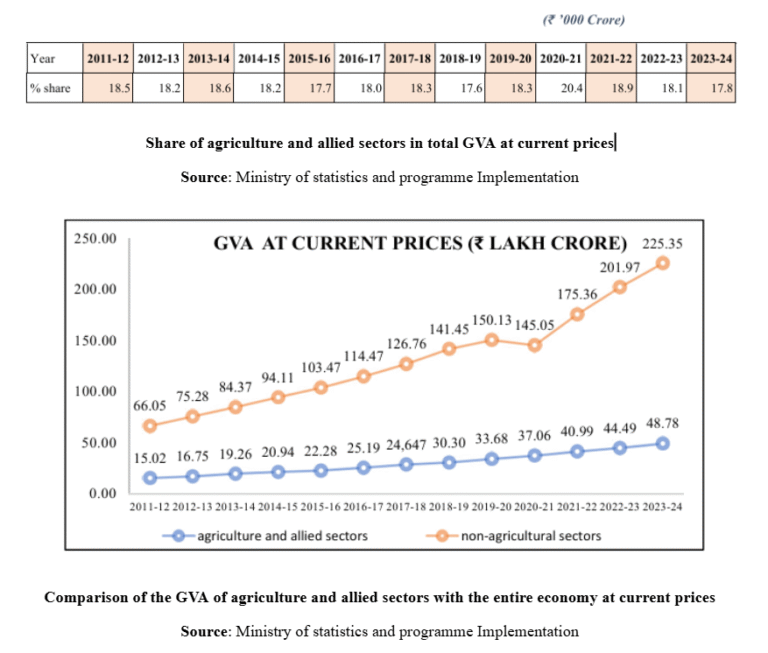
The term current prices (which is also referred to as nominal prices) describes the value of goods and services expressed in prices prevailing in that particular financial year without making changes concerning inflation.
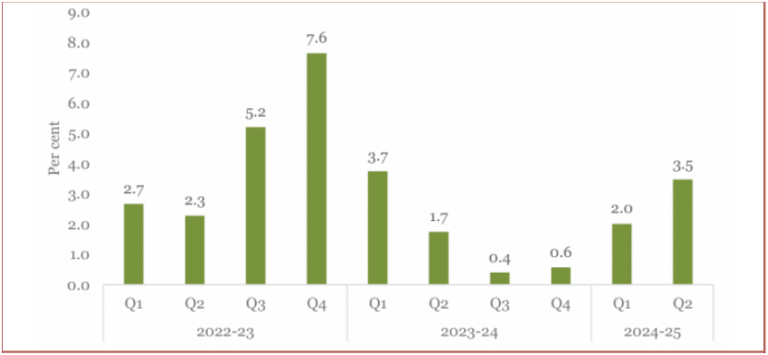
The agriculture sector in India has witnessed a strong growth, averaging 5 per cent in the last five years (FY17 to FY23), which is reflective of the sector being toughened by bumps. The growth rate in the agriculture sector stood at 3.5 per cent in the second quarter of FY25 (Economic Survey 2024-25).
“India’s Agricultural Triumph — Or Just a Half-Harvested Potential?”
Decades later, the country has witnessed its self-reliance in food security. While the milestone has been celebrated, the critical question remains: Are we truly utilising our full potential? Is self-sufficiency the same as efficiency?
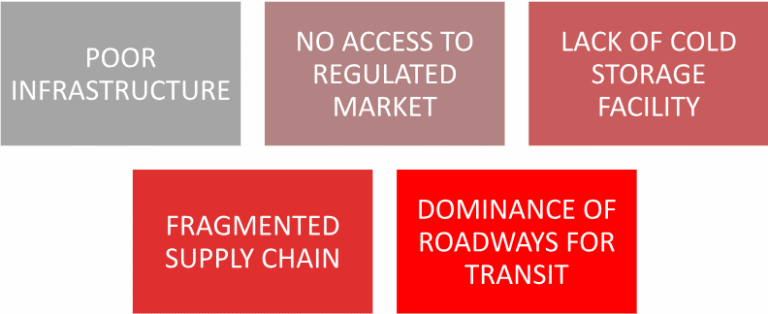
The progress has indeed been made, but there are many logistical and financial loopholes that continue to limit the sector’s true impact. The lack of infrastructure is one of the major constraints. Inadequate rural roads, limited storage, and warehousing facilities hinder the trade of agricultural products. India sees temperatures soaring to as high as 45 to 50 degrees Celsius during the summer months. Many temperature-sensitive products transported within the country often arrive damaged or degraded due to insufficient or broken cold chain systems. Transit losses during distribution processes remain a significant concern.
Agriculture falls under the State List of the Constitution of India. In most states, it is regulated by Agriculture Produce Market Committees established by state governments under the respective APMC Acts. APMC is also called MANDI, which is a regulated market for buying and selling of crops. The government has also introduced e-NAM (National Agricultural Markets), a digitally regulated market. Many small farmers are not connected with these regulated markets due to a lack of access opportunities and awareness.
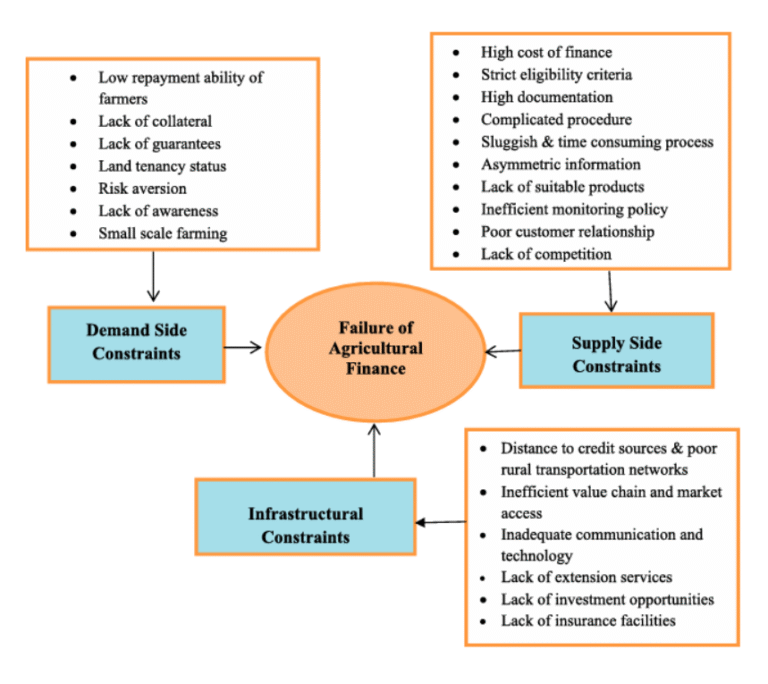
Like any other business agricultural sector needs investment. But due to several constraints on agricultural financing, farmers usually have limited choices, which restricts their borrowing capacity and makes it challenging for them to secure sufficient funds to invest in their agricultural operations. These limited access to credit and insurance restrict domestic trade.
FROM CHALLENGES TO CHANGES
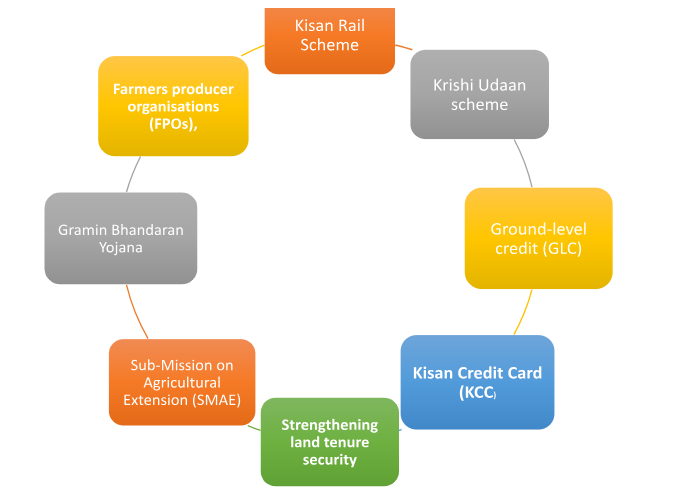
In order to tackle some of the issues of transportation of agricultural produce, Kisan Rail and Krishi Udaan scheme were announced in the Budget 2020-21. Kisan Rail was set up by Indian Railways in a public-private partnership (PPP) mode for providing a cold supply chain to transport perishable agricultural goods. The first Kisan Rail ran from Devlali (Maharashtra) to Danapur (Bihar). Since then, routes have expanded to several other states. Krishi Udaan was launched by the Civil Aviation Ministry to transport agricultural products to national as well as international destinations. The cooperative societies also played an important role in mitigating the risks involved with inadequate marketing infrastructure. Farmers producer organisations (FPOs), which are a hybrid between cooperative societies and private limited companies, provide an important institutional mechanism to organise small and marginal farmers, which can help them overcome the constraints. For instance, Amul’s cooperative model in India empowers dairy farmers to negotiate better milk prices, significantly enhancing their income.
It is also important to address the risk faced by farmers in financing capital. The Government of India introduced the Kisan Credit Card (KCC) to enable farmers to meet their short-term working capital requirements promptly and hassle-free. This has helped enhance the working capital flow to agriculture and allied sectors.
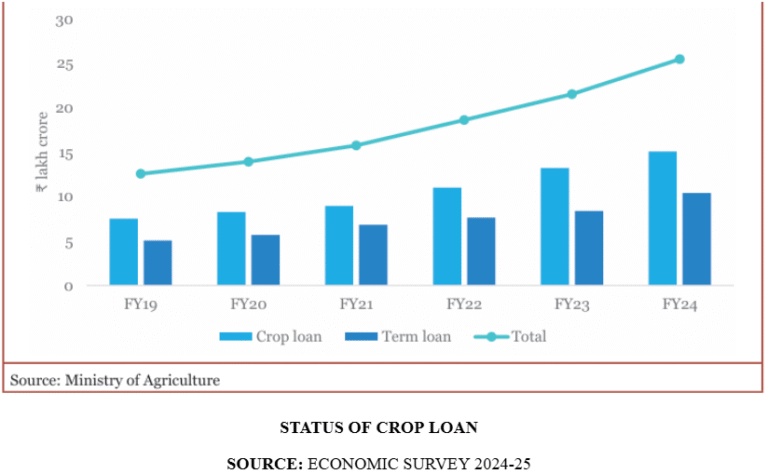
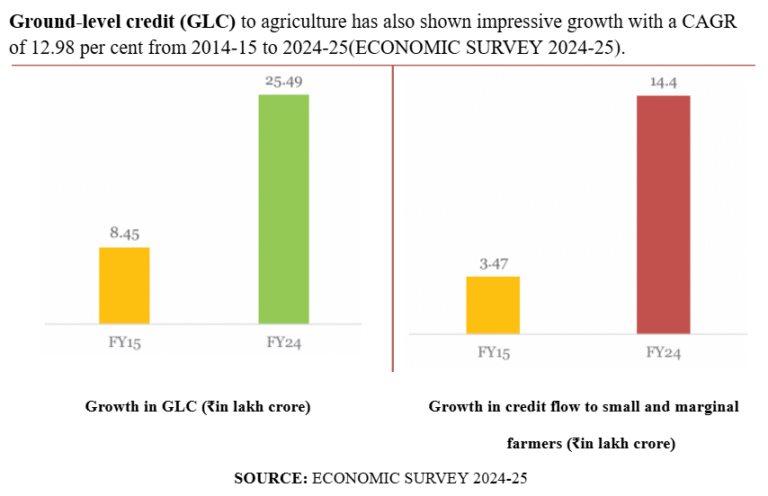
This can also entail a crop insurance risk-sharing model where farmers will be motivated to take credit to invest in agriculture. Capacity-building initiatives and financial literacy programmes would help the farmers to acquire knowledge and expertise in accessing the market and using credit facilities. The is being introduced by the government in order to boost agricultural extension services, increase their level of entrepreneurship, and raise their level of productivity in the agricultural field in India as a whole. The other important element is the support afforded by the Agricultural Technology Management Agency (ATMA), targeted at disseminating the latest technologies in agriculture with the aim of increasing production. These initiatives involve training for farmers, demonstrations, exposure visits, kisan melas, farmer groups mobilisation, and the opening of farm schools. Moreover, the government has come up with the scheme of short-duration skill training of rural youth in view of providing rural youth as well as farmers with short-term skill training in agriculture and allied areas. Besides the training programs, the government has the Kisan call centre to help answer the farmers’ queries in agriculture and the allied sector.
FAQs
- What are the key logistical problems that affect agricultural producers in India?
The major logistical problems are a poor rural road network, improper storage and warehouses, and the absence of a cold chain system. Such problems usually lead to spoiled or damaged produce due to transportation problems, particularly perishable goods.
- Why do small farmers not have easy access to regulated markets such as APMC and the e-NAM?
Others have small farmers who are not accessible to these platforms either because they are not aware that such facilities are available or lack infrastructure and access to the Internet. Their access to markets is also limited by their geographical location and poor outreach through these controlled markets.
- Which are the financial controls affecting the domestic trade of Indian farmers?
Farmers usually have difficulties with access to formal credit and insurance. Their debt limit is limited, and this means that they can hardly invest in better production and logistics. Financial literacy and financial awareness levels are also not high in the rural areas.
- What measures by the government are assisting in curbing these challenges?
Various plans have been launched, including Kisan Rail and Krishi Udaan, and Kisan Credit Card (KCC). They are meant to enhance the cold-chain logistics, access to markets, and easy access to credit. Also, the capacity-building projects and FPOs enable farmers to develop their marketing and negotiation skills.
- What is the government doing in terms of the development of new skills and the adoption of technology in the agricultural sector?
The government is promoting the use of technology, entrepreneurshi,p and transfer of knowledge through such agencies as ATMA and programs such as short-duration skill training to rural youth. These are demonstrations, kisan melas, farmer group mobilisatio,n and farm schools.
Penned by Reeya Kumari,
Edited by Somewrit Sekhar Maiti, Research Analyst
For any feedback, mail us at info@eveconsultancy.in
Finance made simple, fast, and fun! 🏦💡 Sign up for your daily dose of financial insights delivered in plain English. In just 5 minutes, you’ll be smarter already!
Simplify Your Business Compliance with Eve Consultancy
Eve Consultancy is your trusted partner for end-to-end compliance services, including Company Incorporation, GST Registration, Income Tax Filing, MSME Registration, and more. With a quick and hassle-free process, expert guidance, and affordable pricing, we help businesses stay compliant while they focus on growth. Backed by experienced professionals, we ensure smooth handling of all your legal and financial requirements. WhatsApp us today at +91 9711469884 to get started.