
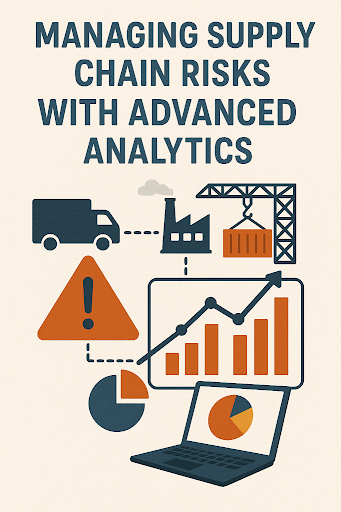
Topic: Supply Chain Risk Management
Introduction
In today’s times of complex and global economic situations, companies count on a vast ecosystem of distributors, manufacturers, suppliers, and logistics to deliver goods and services worldwide. Many supply chain disruptions can occur during these complex processes, like slower operations, shortages of materials or resources, and reduced profitability. This gives the Supply Chain Risk Management (SCRM) tools a pivotal place in organisations that are looking to increase their working capacity and operational continuity. The role of advanced analytics is important for identifying susceptibilities in supply chains and for further improving decision-making processes. It empowers organisations by providing them with data-driven insights, helping them to assess potential risks and develop mitigation strategies. Managing the supply chain risks with the help of advanced analytics helps organisations build sustainable supply chains and provides resilience to navigate uncertainties in businesses and ensure continuity.
3 Dimensions of Advanced Analytics
Various companies use advanced analytics techniques to take their supply chain management system to the next level. The technology dispersed uses innovative statistical and mathematical tools that involve machine learning and data analysis methods to gain valuable insights from raw data.
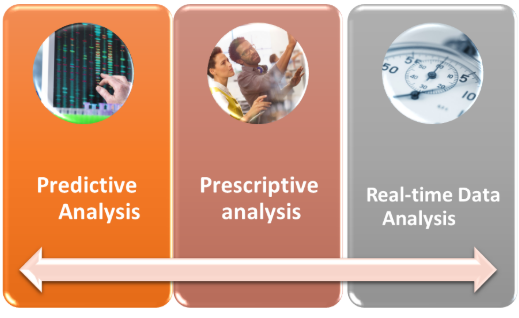
The following aspects come under the Advanced Analytics technique:
Predictive Analysis: This technology provides companies with future development predictions and demand forecasts with accuracy. It uses historical data and advanced algorithms to map out stock levels in advance, and supply bottlenecks are avoided. Data processing techniques like data cleansing, integration and scaling. Through precise predictive analysis, those involved in forecasting trends and patterns can use resources more efficiently and make customer supply more reliable.
Prescriptive analysis: This analyses the various actions for the companies and creates specific recommendations to avoid bottlenecks or waste. The aim is to enable greater profitability by predicting the probable effects of the decisions taken by the company.
Real-time Data Analysis: The real-time data makes the company aware of the delivery delays or fluctuations in demand. This helps the company in identifying the potential disruptions and fosters quick reactions, which in turn increases its agility.
Evading Top 5 Supply Chain Risks Using Advanced Analytics
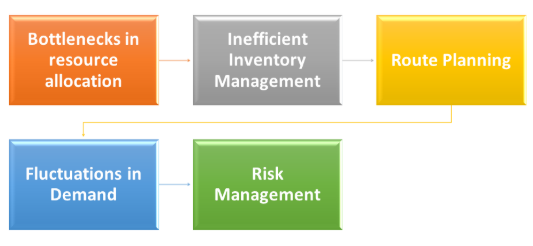
Advanced analytics can help companies switch from reactive problem solving to proactive prevention mode, which means that all sorts of delays and bottlenecks, as well as any other sorts of disruptions, can be easily recognised as well as solved prior to them having any real impact on the supply chain. Here is a list of the top 5 supply chain risks that can be avoided using advanced analytics:
- Bottlenecks in resource allocation: Companies usually deal with the problems of limited resources, which might range from limited production capacities, storage spaces, or transport. Advanced analytics can transform these bottlenecks into mathematical optimization problems by accurately representing the resources to enhance their utilization.
- Inefficient Inventory Management: Advanced analytics makes use of data analysis, predictive analytics, and algorithms, which ensure that products are available and inventory is efficiently managed. The company can avoid excess stock and develop effective approaches for optimal use of resources.
- Route Planning: Varying transportation costs, different delivery times, and various stopovers are some of the challenges in route planning. Optimisation algorithms like the Travelling Salesman Problem (TSP) or Vehicle Route Problem (VRP) consider factors like reducing the overall distance or adhering to the delivery schedules, and some advanced analytical techniques modify and adapt the routes in real time.
- Fluctuations in Demand: Accurate demand forecasting helps in avoiding under- as well as overstocking. Advanced analytics make use of predictive models and machine learning algorithms for inventory planning.
- Risk Management: There are various risks along the supply chain, such as natural disasters, geopolitical tensions, or market fluctuations, that need to be assessed. Using scenario modelling techniques, possible effects can be simulated and evaluated to strengthen resilience.
Conclusion
Advanced analytics presents a significant chance to reshape the challenges phase in supply chain management. Managers are able to reinterpret intricate issues, devise creative solutions, and base their decisions on data. By doing this, companies can create a smooth transition from data to meaningful information, which can improve the business performance.
References
- “Advanced Analytics in Supply Chain Management: Proactively identifying and avoiding supply chain risks,” SupplyX, 2025. [Online]. Available:https://supplyx.info/en/advanced-analytics-scm/.
- V. Ahuja, “The Role of Advanced Analytics in Supply Chain Risk Management: Identifying Vulnerabilities and Enhancing Decision-Making Processes,” SSRN, Aug. 2025. [Online]. Available: https://papers.ssrn.com/sol3/papers.cfm?abstract_id=5373088.
FAQ Section: Supply Chain Risk Management
1. What is supply chain risk management?
Supply chain risk management is the process of identifying, assessing, and mitigating risks that can disrupt the flow of goods, services, and information across a company’s supply chain.
2. Why is supply chain risk management important in 2025?
In 2025, global markets face frequent disruptions from economic shifts, geopolitical issues, and natural disasters. Effective supply chain risk management ensures business continuity and resilience.
3. How does advanced analytics support supply chain risk management?
Advanced analytics helps organizations detect vulnerabilities, forecast demand, optimize inventory, and create proactive strategies for supply chain risk management.
4. What are the main types of risks in supply chain risk management?
The main risks include demand fluctuations, inventory inefficiencies, transportation delays, resource shortages, and external factors such as political or environmental disruptions.
5. How does predictive analytics improve supply chain risk management?
Predictive analytics uses historical data and machine learning to forecast demand, prevent overstocking or understocking, and strengthen supply chain risk management.
6. What role does prescriptive analytics play in supply chain risk management?
Prescriptive analytics suggests the best decisions and strategies to avoid bottlenecks, reduce waste, and maximize profitability in supply chain risk management.
7. Can real-time data analysis improve supply chain risk management?
Yes, real-time data analysis enables companies to respond quickly to delays, demand changes, and market shifts, enhancing agility in supply chain risk management.
8. How does advanced analytics prevent bottlenecks in supply chain risk management?
By optimizing resource allocation, advanced analytics identifies capacity limits, storage issues, and transport inefficiencies to strengthen supply chain risk management.
9. How can inventory management be optimized with supply chain risk management?
Through predictive models, companies can avoid excess stock, reduce waste, and ensure product availability, leading to more efficient supply chain risk management.
10. How does route optimization help in supply chain risk management?
Using algorithms like TSP and VRP, route optimization reduces delivery costs, ensures timely shipments, and supports efficient supply chain risk management.
11. How does demand forecasting improve supply chain risk management?
Accurate demand forecasting prevents stockouts and overstocking, making supply chain risk management more reliable and cost-effective.
12. How does scenario modeling enhance supply chain risk management?
Scenario modeling simulates different risk events—like natural disasters or market shocks—helping companies prepare and strengthen supply chain risk management.
13. What technologies are used in modern supply chain risk management?
Technologies include advanced analytics, machine learning, AI-driven forecasting, IoT-enabled monitoring, and cloud-based platforms for supply chain risk management.
14. What are the long-term benefits of supply chain risk management?
The benefits include improved resilience, cost savings, customer satisfaction, and sustainability—making supply chain risk management a long-term strategic investment.
15. How can companies start implementing supply chain risk management with analytics?
Companies can begin by collecting clean data, applying predictive models, integrating real-time monitoring tools, and building an analytics-driven culture for effective supply chain risk management.
Penned by Kinjal Bagrecha
Edited by Reeya Kumari, Research Analyst
For any feedback mail us at info@eveconsultancy.in
Finance made simple, fast, and fun! 🏦💡 Sign up for your daily dose of financial insights delivered in plain English. In just 5 minutes, you’ll be smarter already!
Simplify Your Business Compliance with Eve Consultancy
Eve Consultancy is your trusted partner for end-to-end compliance services, including Company Incorporation, GST Registration, Income Tax Filing, MSME Registration, and more. With a quick and hassle-free process, expert guidance, and affordable pricing, we help businesses stay compliant while they focus on growth. Backed by experienced professionals, we ensure smooth handling of all your legal and financial requirements. WhatsApp us today at +91 9711469884 to get started.