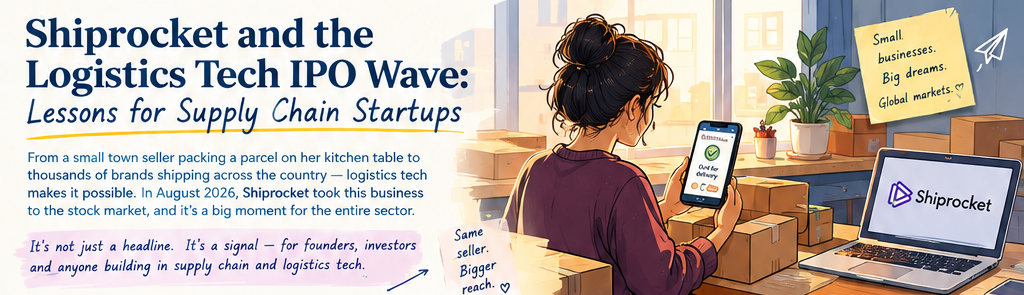
( Source of Image : CHATGPT )
7 Powerful Shiprocket IPO Lessons for Logistics and Supply Chain Startups
Shiprocket IPO lessons offer Indian logistics and supply chain startups practical insights into customer retention, asset-light growth, profitability and investor readiness.
A seller in a small town packs a parcel on her kitchen table, books a courier from her phone, and tracks the delivery without ever speaking to a logistics company. That one routine action is the business Shiprocket built, and in August 2026 it took that business to the stock market.
For founders in supply chain and logistics tech, this listing is more than a headline. It shows what public investors want to see, and what private startups should be building towards. Here’s what happened and what logistics tech founders can learn from it.
What Happened
Shiprocket’s IPO was worth about ₹1,617 crore, opened for subscription on August 12, 2026, and was planned to close on August 14, with listing on BSE and NSE targeted for August 19. The issue combined a fresh issue of ₹885.50 crore with an offer for sale of ₹731.98 crore, and OFS proceeds go to selling shareholders, not to the company. The price band was ₹92 to ₹97 per share (see the sources below for the detailed breakdown). (Shiprocket IPO to Open on August 12, 2026: Price Band, Issue Size, Subscription Dates and Key Details +2)
Demand picked up as the issue progressed. One IPO tracker shows overall subscription climbing from about 1 time on day one to over 100 times by the close on August 14. That late rush is common in Indian IPOs, so it’s best read as a sign of strong interest, not a guarantee of how the stock will trade afterwards. Check the live market data for current performance. (5paisa)
What Shiprocket Actually Is
It’s easy to call it a courier company, but it isn’t one. Shiprocket describes itself as an e-commerce enablement platform for MSMEs, D2C brands and large retailers, and a Redseer report named it India’s largest new-age end-to-end horizontal platform of its kind by revenue in Fiscal 2026.
Its core is an asset-light model. It integrates multiple courier partners to offer multi-carrier allocation, order and tracking management, and post-purchase tools, with newer segments such as cross-border shipping, fulfilment, checkout, advertising, financing and hyperlocal delivery. In other words, it doesn’t own the trucks. It owns the seller relationship and the software layer in between.
Lesson 1: Own the Customer, Not Just the Shipment
Moving a parcel is a commodity. Couriers compete fiercely on price and speed. What’s harder to copy is the daily relationship with thousands of sellers who run their shipping, returns and tracking through your platform.
For supply chain startups, the question to ask is simple: if a customer can switch providers in one click, what keeps them? Workflow, data and integrations usually matter more than the delivery itself.
Lesson 2: Asset-Light Scales Faster, But Margins Need Proof
An asset-light model lets a startup grow without buying fleets and warehouses. That’s why many logistics tech companies start here. The trade-off is that you depend on partners, and your margin can get squeezed if you’re only reselling capacity.
Public investors will look closely at this. The strongest stories show that the platform earns more than a thin spread: through software, financing, fulfilment, advertising or other services layered on top. If your revenue is just a markup on someone else’s service, expect tough questions.
Lesson 3: Expand Along the Merchant’s Journey
Shiprocket didn’t stop at shipping. Its expansion into cross-border, fulfilment, checkout and financing follows what a seller needs next. That’s a useful pattern. The best add-on products come from watching where your existing customers struggle, not from chasing every adjacent market.
A word of caution: each new line adds complexity. Founders should expand only where they have a real edge and enough data to know it’s working.
Lesson 4: Be Ready for Public-Market Scrutiny Early
Going public changes how a company is judged. Investors look at the quality of revenue, customer concentration, unit economics, governance and the path to profit, in far more detail than most private rounds require.
Startups that want to be IPO-ready someday should build habits now:
- Keep clean, audit-ready financials from the early stages
- Track unit economics by product line, not just overall
- Maintain a tidy cap table and proper statutory records
- Build a real board and compliance process before you need one
- Be clear about the use of funds and how growth will turn into profit
Lesson 5: Understand the Difference Between Fresh Issue and OFS
The Shiprocket IPO included both new money for the company and shares sold by existing investors. This is a good example for students and founders of how an IPO can serve two purposes: raising growth capital and giving early backers a partial exit. When you read any IPO, check how much of the issue is fresh capital, because that’s the part that funds the business.
Is It Really a “Wave”?
Shiprocket’s listing sits in a broader story of Indian logistics and e-commerce enablement companies reaching the public markets, after earlier listings in the sector. But one IPO doesn’t make a trend, and market windows open and close. Founders shouldn’t plan a strategy around an IPO wave. Build a business that would be strong with or without one, and treat a listing as one possible outcome.
What MSME and Supply Chain Founders Can Do Now
If you’re building in this space, a few practical steps stand out:
Pick a specific problem in the supply chain and solve it better than anyone, before widening the scope
Study the public filings of listed peers; they’re free lessons in how the market values logistics businesses
Focus on repeat usage and customer retention, not just new sign-ups
Build compliance and reporting systems early
Use non-dilutive support and early investors wisely, so that the cap table stays clean for later rounds
For Incubators and Support Bodies
Listings like this are a useful case study for portfolio startups. Incubators can run sessions on reading an RHP, understanding public-market metrics and preparing for institutional diligence. Even startups that never list benefit from learning how large investors think.
FAQs
What is the Shiprocket IPO?
It’s the public offering of Shiprocket Limited, an e-commerce enablement and logistics tech platform, which was scheduled to list on the NSE and BSE in August 2026.
Does Shiprocket own its delivery network?
It follows an asset-light model, working with multiple courier partners instead of owning a large fleet.
What is the difference between a fresh issue and an offer for sale?
A fresh issue raises new money for the company. An offer for sale lets existing shareholders sell their shares, and that money goes to them.
Does an IPO mean a startup is successful?
It means the company reached a certain scale and governance standard, but long-term success depends on how the business performs after listing.
What should early-stage logistics startups learn from this?
Own the customer relationship, prove the margins, expand carefully and build strong financial discipline from the start.
Final Thoughts
Shiprocket’s listing shows that Indian investors are willing to back technology platforms that sit inside the supply chain, as long as the business is clear, the numbers hold up and the growth story makes sense. For founders, the real lesson isn’t to chase an IPO. It’s to build the kind of company that could survive one. At Eve Consultancy, we help founders, incubators and MSMEs with funding strategy, compliance readiness and practical business guidance.
Founders preparing for future fundraising or a public listing should prioritise cap table hygiene before Series A to maintain accurate ownership records and improve investor readiness.
SEBI — Securities and Exchange Board of India
Regulatory information and public-offering disclosures.
NSE India — National Stock Exchange
Check official listing information and market disclosures.
Shiprocket — Official Website
Company information and details about its e-commerce logistics platform.