
Introduction
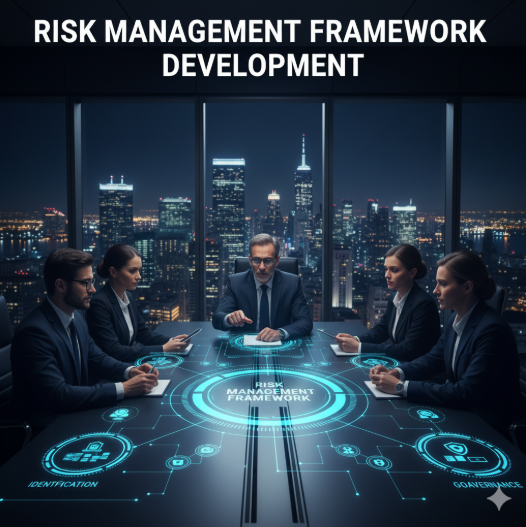
All organizations, either small or big, have to deal with uncertainty. Market turbulence, regulatory changes, cyber attacks, and unforeseen crises can impact the performance and image of a company. To effectively deal with such threats, companies require a good risk identification, assessment, and management framework and that is precisely what a Risk Management Framework (RMF) offers. Creating an RMF is not about avoiding problems; it is about creating strength and keeping the company poised to deal with changes confidently.
What Is a Risk Management Framework?
- Risk Management Framework is a systematic and ongoing process that assists an organization in finding out potential risks, evaluation of their impact, and countermeasures to reduce them. It’s a manual that guides management to make effective decisions. The RMF changes risk management from an issue of chance to one of regular operation of the organization.
- Instead of responding to crises once they have occurred, organizations with a strong RMF are in a position to anticipate and avoid them. The framework ties together policy direction, standard practice, and responsibility controls so that everyone knows exactly what their part is in protecting the organization.
Key Steps in Developing a Risk Management Framework
1. Getting to Know the Organizational Context
Prior to constructing the framework, a firm should have some concept of its internal environment i.e., its mission, goals, and culture and the external environment i.e., industry trends, competition, and legislation. This provides the context in which one can determine what kinds of risks the firm is likely to encounter and how much risk it can tolerate.
2. Determining Possible Risks
The second is to recognize what can go awry. Risks may be financial (such as market volatility), operational (equipment breakdown), technological (information breaches), or reputational (public outrage). Risk identification is about compiling information from staff, learning from things in the past, and auditing. By doing so, even latent or less conspicuous risks are exposed.
3. Evaluating and Examining Risks
Once risks are determined, they must then be assessed in terms of probability (how probable they are to occur) and impact (how damaging the consequences would be). As this allows risks that immediately require attention to be prioritized and risks that need to be tracked over time. Organizations utilize the utilization of a risk matrix to see and prioritize visually risks from least to greatest.
4. Developing Risk Reduction Plans
After analysis, the company decides how to respond. There are several strategies with which risks can be avoided, reduced, shifted (like through insurance), or absorbed if avoidance costs more than the loss. The goal is to manage risks wisely, not eliminate them.
5. Implementation of Controls
It is where it happens. The company establishes specific policies, controls, and procedures to contain the identified risks
Regular training programs, good communication, and responsibility are the key points here. Every department must understand its contribution toward the proper execution of these controls.
6. Ongoing Monitoring and Review
Risk management is not a one-time process. Things evolve, and risks occur over time. Regular monitoring and review are therefore necessary. Reports, performance measurement, and feedback enable that the framework is effective and up to date.
7. Reporting and Communication
There should be open and transparent risk communication. There should be regular reporting to the stakeholders and the management to facilitate trust and evidence-based informed decision-making. Reporting also makes employees aware of potential threats and responsible for minimizing them.
Benefits of Good Risk Management Framework
A well-structured RMF has numerous benefits. It enables better decision making, since it creates a clearer picture of potential risks for the leaders. It enhances regulatory compliance with the law and industry standards. Additionally, it reduces financial losses and enhances the image of the organization. Above all, it instills a culture of preparedness where both seasoned managers and fresh recruits get exposed to their role in risk management.
Conclusion
Developing an RMF is an investment for a company’s future. It ensures stability in times of uncertainty and enables companies to recover stronger from unforeseen interruptions. No organization can exist without risk management in today’s ever-changing world. A good RMF which has been well-spotted-out guards the organization as well as enables it to grow with courage. Where there are wise decisions on risks, there can be boldly ventured opportunities and that is the real value of a good RMF.
References
[1] “Risk management framework development,” broadleaf.com.au. [Online]. Available: https://broadleaf.com.au/work/services/risk-management-framework-development/
Penned by Himanshu
Edited by Sushmita Halder, Research Analyst
For any feedback mail us at info@eveconsultancy.in
Finance made simple, fast, and fun! 🏦💡 Sign up for your daily dose of financial insights delivered in plain English. In just 5 minutes, you’ll be smarter already!
Simplify Your Business Compliance with Eve Consultancy
Eve Consultancy is your trusted partner for end-to-end compliance services, including Company Incorporation, GST Registration, Income Tax Filing, MSME Registration, and more. With a quick and hassle-free process, expert guidance, and affordable pricing, we help businesses stay compliant while they focus on growth. Backed by experienced professionals, we ensure smooth handling of all your legal and financial requirements. WhatsApp us today at +91 9711469884 to get started.