Introduction
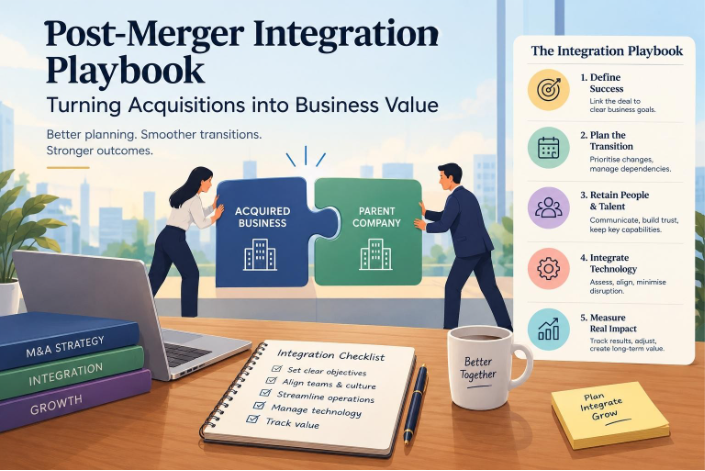
Post-merger integration helps businesses turn acquisitions into lasting value by aligning operations, retaining key employees, integrating technology and tracking results.
An acquisition can provide a company with new technology, valuable talent or access to new markets, but that does not guarantee that it will actually benefit the buyer. After a deal is complete, the company needs to integrate its newly acquired assets into its operations while limiting disruptions to its existing operations.
In a more selective mergers and acquisitions (M&A) environment, businesses need to get better value from their deals and cannot afford disruptions and unrealised expectations.
That is why post merger integration needs to be prioritised in an organisation’s M&A strategy. It ties the purpose of an acquisition to the practical decisions that allow it to realise value.
7 Powerful Strategies for Successful Post-Merger Integration
The first step towards a successful acquisition is deciding what it should achieve. Without a desired end state, integration can appear as an untargeted set of administrative changes. At this stage, management needs to decide on the purpose of the acquisition and set priorities. For instance, when a manufacturing company buys a smaller firm to acquire a particular production technology, its primary integration priority should be adopting this technology.
Managers should establish what benefits they expect from the target company’s capabilities, resources or talent, set targets for post merger integration and designate who will be accountable for achieving them. They may need to set different priorities depending on the type of the target company: for instance, a buyer may set different goals for integrating an entire business that it acquired versus a smaller supplier.
A well-defined business case can also highlight value drivers and help organisations distinguish between essential and optional changes.
Implement new processes in stages
During the merging process, companies have to make significant alterations in financial reporting, organization of work, suppliers’ relations, and other areas. Such large-scale and complicated reorganization can confuse the workers and obstruct crucial processes, which is why it is better to implement changes step by step.
Firstly, the integration managers should look over the list of vital actions that can be taken immediately, like sustaining key customer relationships, preserving the intellectual property, establishing leadership, etc. Secondly, other modifications that are less important but still significant for the functioning of the merged company should be made in the second stage depending on their risk level, complexity, and expenses.
For example, when two companies with different financial reports merge, the accounting processes can be simplified right away, but the software systems’ integration that two firms have been using maybe postponed to a more appropriate time when the integration managers will be able to assess all the details and drawbacks of their merging.
Thus, the task force of the integration managers should be established to plan the unified schedule of post merger modifications, resolve all vertical and horizontal conflicts, and ensure the effective communication of all stakeholders in order to explain the new procedures and their advantages.
Keep the valuable people and processes
When a company acquires another business, its employees often have many unanswered questions about how their roles, responsibilities and even workplaces will change. This can cause confusion and even talent drain if critical employees feel that their skills and experience are not needed anymore.
This is particularly true for acquiring companies that seek to obtain foreign expertise, whether in the form of core competencies, tacit knowledge or even the target company’s unique organisational capabilities. To mitigate these risks, managers should identify the most valuable employees and advise them on the changes that will enhance their performance. They also need to ensure that the acquired company’s effective working practices are adopted, and that differences in the managerial approaches are resolved.
Companies should not attempt to make one business fully identical to another. Instead, they should focus on unifying their goals and using the combined strengths of the target company and the acquiring firm.
Review the target company’s technology
Acquisitions of technology require a special approach to post merger integration, particularly in terms of software capabilities, cybersecurity, data management and continuity of product development. During the integration, it can be tempting to move data and operations to the acquiring company’s existing IT infrastructure, but this can create complications.
Before making any structural or technological changes, managers should perform a technology audit to understand how the target company’s software systems fits into their own ecosystem. They may need to consider applications’ unique features, security needs, dependencies, data storage requirements and maintenance costs.
Based on this information, integration managers can decide whether to consolidate or retire applications, migrate individual elements of the technology or leave them separate if it makes the acquisition more valuable.
Assess progress based on actual results
Completing post merger integration tasks is not a guarantee of a successful acquisition. It is important that the company assesses its progress and makes sure that integration delivers value. Project managers should establish indicators that show whether the acquisition is on track or not. They should also take responsibility if the indicators demonstrate that the merger is not progressing as planned. The key indicators of the successful acquisition may include financial performance, workforce retention, customer satisfaction, disruption of critical business functions, and revenue growth.
These indicators should have target values set and should be owned by specific individuals. This way, project managers can update the timeline if necessary, based on the indicators’ progress. It will also be possible to re-prioritize tasks and update the business plan if there is a need to do so.
Conclusion
An acquisition can create value, but the way in which companies utilise their acquired assets will ultimately determine whether this value is realised. Disorganisation during post merger integration can cause increased costs, disruption to critical operations and even failure to utilise the target company’s key capabilities. A well-structured approach to new business integration helps companies set the right priorities, retain their most valuable talents and processes and assess the outcomes of their M&A activity.
In a more selective M&A environment, companies that take this approach will be able to gain more value from their acquisitions by making the most of the opportunities that they create.
Companies managing complex acquisitions can also explore how an AI operating model helps align workflows, clarify accountability and measure business performance.
Use these relevant resources as followed links in the article: