
MSME export schemes in 2026 can help Indian small businesses access export credit, reduce logistics costs, meet overseas compliance requirements, and reach international buyers.
Most small manufacturers I know think exporting is a big-company game. Too much paperwork, too much working capital, too many rules in other countries. That belief is getting harder to defend, because export support remains a policy focus for MSMEs and the government has put real money behind it.
If you are a small business wondering which MSME export schemes are worth your time, and which export incentives you can actually claim, here are seven to look at in 2026.
1. 7 Powerful MSME Export Schemes to Support Global Growth in 2026
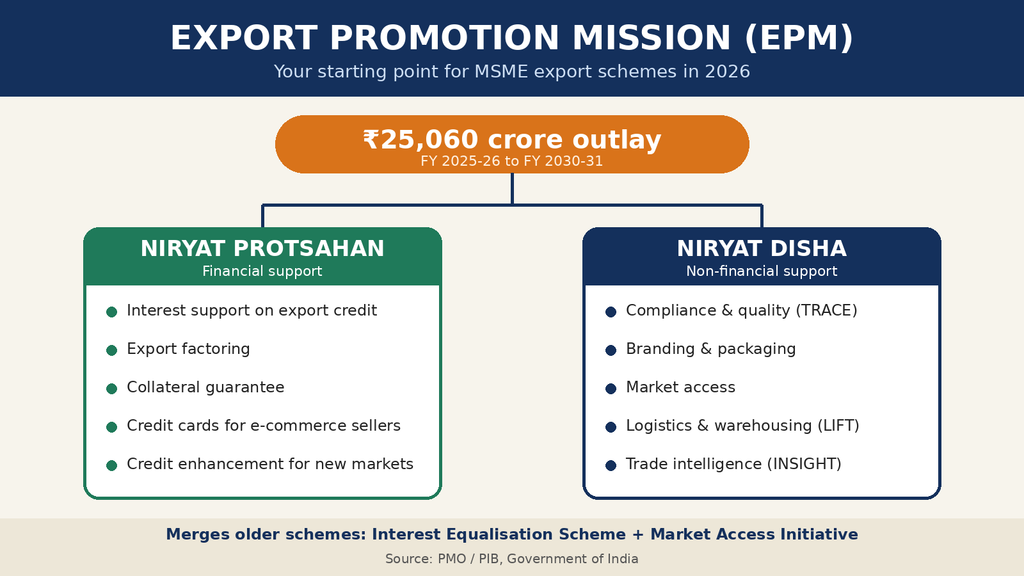
The Union Cabinet approved the Export Promotion Mission (EPM) to help MSMEs, first-time exporters and labour-intensive sectors. It has a total outlay of Rs 25,060 crore from FY 2025-26 to FY 2030-31 [1]. It also folds older schemes like the Interest Equalisation Scheme and the Market Access Initiative into one framework [1].
That matters because you no longer chase five different schemes with five different forms. The mission runs through two sub-schemes: Niryat Protsahan for finance, and Niryat Disha for everything else, such as compliance, branding and logistics [2]. The Department of Commerce launched the full set of interventions on 20 February 2026, and application windows are open on designated portals [3].
2. Interest Support on Export Credit
Export credit is expensive when your margins are thin. Under Niryat Protsahan, the first intervention gives interest support on pre- and post-shipment export credit [4].
There is a condition. It applies only to exports on a notified positive list of six-digit tariff lines, which covers about 75 per cent of India’s tariff lines [4]. So before you call your bank, check whether your product’s HS code is on that list.
3. Collateral Guarantees and Factoring
Banks often say no to small exporters because there is no property to pledge. Niryat Protsahan tries to fix that with export factoring, collateral guarantees for export credit, and credit cards for e-commerce exporters [1]. It also offers credit enhancement for companies diversifying into new markets [1].
If you sell through Amazon or other platforms, that last part of the toolkit is worth a conversation with your lender.
4. Help With Compliance Abroad (TRACE)
Here is something nobody tells first-time exporters: the rules of the importing country can sink a shipment faster than any price war. A scheme called TRACE, under Niryat Disha, is meant to help MSMEs meet the regulatory requirements of buyer countries [5].
If your product needs testing, certification or labelling to enter the EU or the US, this is the support to ask about.
5. Logistics, Warehousing and Market Data
Freight eats margins quietly. Three more Niryat Disha interventions go after that problem: LIFT supports freight and transport, FLOW supports logistics, overseas warehousing and fulfilment, and INSIGHT supports trade intelligence [5]. All of them were rolled out together in February 2026 and apply with immediate effect [5].
I would start with INSIGHT. Knowing which market actually wants your product is cheaper than finding out after you ship.
6. RoDTEP Refunds
RoDTEP refunds the embedded taxes that are otherwise not rebated on exports, which makes it one of the more practical export incentives for small units. Two things changed recently. DGFT extended the deadline for the Annual RoDTEP Return for FY 2023-24 to 31 March 2026, with a composition fee of Rs 15,000 [5]. RoDTEP rates were also rationalised in February 2026 [5].
So check the current rate for your HS code before you price your next order, and keep your filings on time.
7. Export Facilitation Centres and Older Duty Schemes
If all this sounds like a lot, start with an Export Facilitation Centre. EFCs help MSME exporters with information on schemes, training on compliance, and handholding on export documentation [6]. The Ministry of MSME also runs management development programmes on export marketing, packaging, credit and insurance [6].
Schemes like Advance Authorisation, EPCG, ECGC insurance cover and One District One Product also exist alongside the mission. I have not verified their latest rules for this article, so confirm current terms with DGFT or ECGC before you apply.
The Catch Nobody Puts in the Banner
Honest take: schemes do not export for you. The interest support depends on your product being on the positive list. Every scheme needs registration, documentation and deadlines you must track. Rules and rates also change often, as the RoDTEP updates show.
If your paperwork is messy, you will leave money on the table even when you qualify.
So, Should Your MSME Use These Schemes?
If you already sell in India and have a product that buyers abroad want, yes, look at them seriously. They will not fix a weak product, but they can lower your credit cost, ease collateral pressure and cut compliance and freight friction.
Get your Udyam and IEC registrations in order, check your HS code, talk to your bank and your nearest EFC, and apply while the windows are open. Exporting was never only for big companies. It just needed the right support.
MSMEs preparing to expand internationally should maintain accurate invoices and strengthen GST compliance for SMEs alongside export registrations, product classifications, and documentation.
References
[1] “Cabinet approves Export Promotion Mission,” Prime Minister’s Office, Government of India, Nov. 2025. [Online]. Available: https://www.pmindia.gov.in/?p=16733719
[2] “Export Promotion Mission: A Unified Framework for Export Competitiveness,” PIB, Dec. 2025. [Online]. Available: https://static.pib.gov.in/WriteReadData/specificdocs/documents/2025/dec/doc2025126720201.pdf
[3] “Export Promotion Mission (EPM) – Advisory for Members,” CHEMEXCIL, Mar. 25, 2026. [Online]. Available: https://chemexcil.in/circulars/viewcirculars/6599/896998f16779250ee6580c3ec18d1661.html
[4] “MSME Exporters Get Interest Relief And Collateral Support Under Rs 25,060 Crore Export Promotion Mission,” Swarajya, Jan. 3, 2026. [Online]. Available: https://swarajyamag.com/amp/story/economy/msme-exporters-get-interest-relief-and-collateral-support-under-rs-25060-crore-export-promotion-mission
[5] “TPM Consultants: March 2026 – Foreign Trade Policy,” Mondaq, Mar. 20, 2026. [Online]. Available: https://webiis08.mondaq.com/india/international-trade-investment/1761064/tpm-consultants-march-2026-foreign-trade-policy
[6] “Export Promotion,” Lok Sabha Unstarred Question, Ministry of Commerce and Industry, Feb. 10, 2026. [Online]. Available: https://eparlib.sansad.in/bitstream/123456789/3021940/1/AU1771_lVp4c4.pdf
REPORT
AI DETECTION

GRAMMARLY
PLAGIARISM
