
A Guide to Understanding Trade Credit and Its Risks for Small Businesses
Published: Oct 10, 2026
Key Highlights
- Trade credit allows businesses to purchase goods or services from suppliers and make payment at a later agreed date, helping manage short-term cash flow.
- Businesses using trade credit should maintain accurate invoices, payment terms, delivery records, and supporting transaction documents.
- Trade credit does not automatically remove GST obligations. Applicable tax requirements depend on the nature of the transaction and relevant GST provisions.
- Traders should check whether an e-way bill is required before transporting goods, based on consignment value, movement type, applicable rules, and exemptions.
- Accurate GSTINs, invoice details, addresses, PIN codes, and vehicle information help reduce documentation errors during transportation.
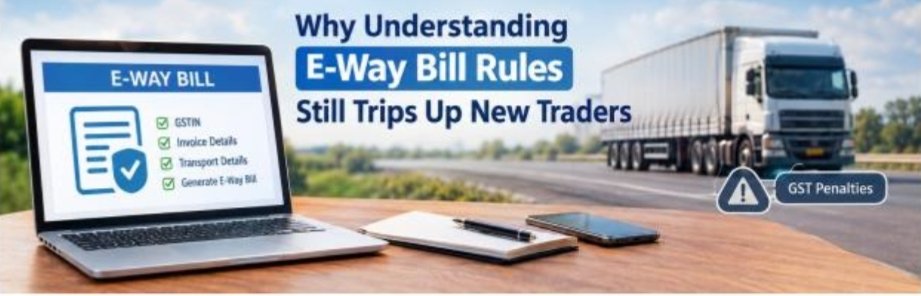
Trend: Why Trade Credit and E-Way Bill Compliance Matter
Trade credit plays an important role in helping small businesses and new traders manage their working capital while purchasing goods from suppliers. Under a trade credit arrangement, a supplier allows a buyer to receive goods immediately and make payment at an agreed later date. This arrangement can help businesses maintain inventory, manage day-to-day expenses, and continue operations without making immediate payments for every purchase.
Introduction:
Starting a trading business involves more than finding suppliers and customers. New businesses also need to understand the tax and documentation requirements attached to the movement of goods. Among these requirements, e-way bill compliance can create difficulties for businesses that are unfamiliar with GST procedures.
An e-way bill is an electronic document used for tracking the movement of goods under the GST framework. For specified movements involving consignments exceeding ₹50,000, it generally needs to be generated before transportation begins, subject to applicable rules and exemptions.
For new businesses, small mistakes in information, documentation or timing can create compliance complications. This makes understanding e-way bill rules and new traders an important part of setting up proper business processes.
What Is an E-Way Bill?
An e-way bill is generated electronically through the GST e-way bill system when goods are transported in circumstances covered by the GST rules.
It contains information relating to the consignment and its movement. Depending on the transaction, details can include the supplier, recipient, invoice or document information, approximate distance and transportation details.
The person generating the e-way bill should also ensure that relevant documents, such as the tax invoice, bill of sale or delivery challan and transportation details, are available as required.
Why Do New Traders Find E-Way Bill Rules Difficult?
Not Knowing When an E-Way Bill Is Required
A new trader may assume that every movement of goods follows the same procedure. However, the requirement depends on factors such as the nature of the movement, consignment value and applicable exemptions.
The GST e-way bill system specifies that goods covered by the rules generally require an e-way bill when transported for supply, certain inward supplies or other specified purposes. Some categories of goods and transactions are exempt.
Understanding these conditions before dispatch can prevent avoidable compliance problems.
Entering Incorrect Information
One of the most common practical difficulties is entering incorrect details. Errors involving GSTINs, addresses, invoices, PIN codes or transportation information can create discrepancies between the documents and the actual movement of goods.
The e-way bill system does not allow submitted details to simply be edited. Where incorrect information has been entered, the existing e-way bill generally needs to be cancelled and a fresh one generated with the correct information.
This is why checking the information before submission is particularly important.
Confusion About Validity
An e-way bill is not valid indefinitely. Its validity depends on the distance that the goods are required to travel and the applicable category of transportation.
Under the current rules, regular consignments generally receive one day of validity for every 200 kilometres or part thereof. Different provisions apply to Over Dimensional Cargo.
A trader who does not account for the expected journey time could therefore face difficulties if transportation continues beyond the permitted validity.
Problems With Vehicle Details
Transportation information must also correspond with the actual movement of goods. Vehicle details form part of Part-B of the e-way bill for road transportation. If the vehicle changes during transit or circumstances such as a breakdown or exceptional delay occur, the relevant procedure for updating or extending the e-way bill needs to be followed.
Treating Compliance as a One-Time Task
Another mistake is viewing e-way bill generation as something that ends once the document has been created.
Businesses should maintain a process for checking invoices, transportation details, validity periods and changes occurring during transit. This becomes especially important when a business handles multiple consignments simultaneously.
How New Traders Can Reduce E-Way Bill Errors
A simple compliance routine can make the process easier. Before dispatching goods, businesses should:
Confirm whether an e-way bill is required
Verify the supplier and recipient GSTIN
Match invoice and consignment information
Check addresses and PIN codes
Enter accurate transportation details
Review the estimated distance
Monitor the validity period
Update relevant details when transportation circumstances change
Keep supporting documents accessible during movement
Businesses handling frequent shipments can also assign responsibility for e-way bill checks to a specific employee or integrate the process into their accounting workflow.
Conclusion
E-way bill compliance can be confusing for new traders because it combines tax requirements with practical transportation information. Errors are often avoidable when businesses understand when an e-way bill is required, verify information before submission and monitor the document throughout the movement of goods.
For new businesses, learning the e-way bill rules and new traders should therefore be treated as part of everyday operational planning rather than an administrative task handled only after a shipment is ready to leave
Key Regulatory Takeaways-
Trade credit allows businesses to purchase goods or services and pay suppliers at a later agreed date, helping manage short-term cash flow.
Businesses should maintain accurate invoices, purchase orders, payment terms, and delivery records to document trade credit transactions.
Trade credit does not exempt businesses from applicable GST obligations. Tax requirements depend on the transaction and relevant legal provisions.
Traders should verify whether an e-way bill is required before transporting goods, considering consignment value, movement type, applicable rules, and exemptions.
Accurate GSTINs, invoice details, addresses, PIN codes, and vehicle information help reduce e-way bill errors.
FAQs
What is trade credit?
Trade credit is a business arrangement in which a supplier allows a buyer to purchase goods or services and pay for them at a later agreed date.
How does trade credit help new traders?
Trade credit helps new traders manage cash flow, purchase inventory without immediate payment, and maintain business operations while waiting for customer payments.
Statutory Citations & References
Goods and Services Tax Network (GSTN). “E-Way Bill System — Frequently Asked Questions.”
Link
Goods and Services Tax Network (GSTN). “E-Way Bill System — New FAQs.”
Link
Central Board of Indirect Taxes and Customs (CBIC). “E-Way Bill Rules.”
Link
Goods and Services Tax Network (GSTN). “E-Way Bill System — Official Portal.”
Link
Maximize Your Business Potential
Looking for a partner to advise on GST, ITR, Business Registration, or Financial Strategy? Our experts ensure your compliance is seamless and your solutions are optimized.
Book a Strategy ConsultationEve Finance: Your Daily Financial Eve-olution!
Finance made simple, fast, and fun! 🏦💡 Sign up for your daily dose of financial insights delivered in plain English. In just 5 minutes, you’ll be smarter and better!